

3 Generalized Onsager Principle and It Applications
123
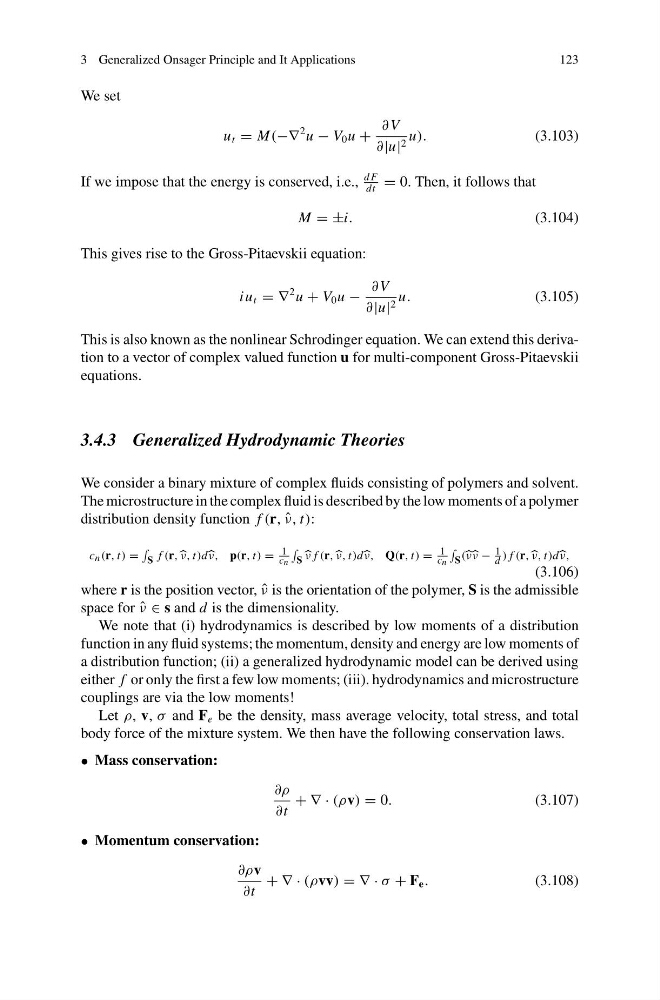
We set
u t = M(−∇
2 u − V 0 u +
∂ V
∂|u| 2 u).
(3.103)
If we impose that the energy is conserved, i.e.,
d F
dt
= 0. Then, it follows that
M = ±i.
(3.104)
This gives rise to the Gross-Pitaevskii equation:
iu t = ∇
2 u + V 0 u −
∂ V
∂|u| 2 u.
(3.105)
This is also known as the nonlinear Schrodinger equation. We can extend this derivation to a vector of complex valued function u for multi-component Gross-Pitaevskii
equations.
3.4.3 Generalized Hydrodynamic Theories
We consider a binary mixture of complex fluids consisting of polymers and solvent.
The microstructure in the complex fluid is described by the low moments of a polymer
distribution density function f (r, ˆ
ν, t):
c n (r, t) =
S f (r, ν, t)d ν, p(r, t) = 1
c n
S ν f (r, ν, t)d ν, Q(r, t) = 1
c n
S ( ν ν − 1
d ) f (r, ν, t)d ν,
(3.106)
where r is the position vector, ˆ
ν is the orientation of the polymer, S is the admissible
space for ˆ
ν ∈ s and d is the dimensionality.
We note that (i) hydrodynamics is described by low moments of a distribution
function in any fluid systems; the momentum, density and energy are low moments of
a distribution function; (ii) a generalized hydrodynamic model can be derived using
either f or only the first a few low moments; (iii). hydrodynamics and microstructure
couplings are via the low moments!
Let ρ, v, σ and F e be the density, mass average velocity, total stress, and total
body force of the mixture system. We then have the following conservation laws.
• Mass conservation:
∂ρ
∂t
+ ∇ · (ρv) = 0.
(3.107)
• Momentum conservation:
∂ρv
∂t
+ ∇ · (ρvv) = ∇ · σ + F e .
(3.108)
123
We set
u t = M(−∇
2 u − V 0 u +
∂ V
∂|u| 2 u).
(3.103)
If we impose that the energy is conserved, i.e.,
d F
dt
= 0. Then, it follows that
M = ±i.
(3.104)
This gives rise to the Gross-Pitaevskii equation:
iu t = ∇
2 u + V 0 u −
∂ V
∂|u| 2 u.
(3.105)
This is also known as the nonlinear Schrodinger equation. We can extend this derivation to a vector of complex valued function u for multi-component Gross-Pitaevskii
equations.
3.4.3 Generalized Hydrodynamic Theories
We consider a binary mixture of complex fluids consisting of polymers and solvent.
The microstructure in the complex fluid is described by the low moments of a polymer
distribution density function f (r, ˆ
ν, t):
c n (r, t) =
S f (r, ν, t)d ν, p(r, t) = 1
c n
S ν f (r, ν, t)d ν, Q(r, t) = 1
c n
S ( ν ν − 1
d ) f (r, ν, t)d ν,
(3.106)
where r is the position vector, ˆ
ν is the orientation of the polymer, S is the admissible
space for ˆ
ν ∈ s and d is the dimensionality.
We note that (i) hydrodynamics is described by low moments of a distribution
function in any fluid systems; the momentum, density and energy are low moments of
a distribution function; (ii) a generalized hydrodynamic model can be derived using
either f or only the first a few low moments; (iii). hydrodynamics and microstructure
couplings are via the low moments!
Let ρ, v, σ and F e be the density, mass average velocity, total stress, and total
body force of the mixture system. We then have the following conservation laws.
• Mass conservation:
∂ρ
∂t
+ ∇ · (ρv) = 0.
(3.107)
• Momentum conservation:
∂ρv
∂t
+ ∇ · (ρvv) = ∇ · σ + F e .
(3.108)