

3 Generalized Onsager Principle and It Applications
113
In summary, the extremal conditions on the Onsager-Machlup action potential
density or the Rayleighian yields the force balance for the nonequqilibrium system
in isothermal case among the dissipative force, the inertia and the conservative forces.
We next consider how to add external forces to the Onsager principle formulation
when the force is nonconservative.
3.2.5 Effect of External Forces
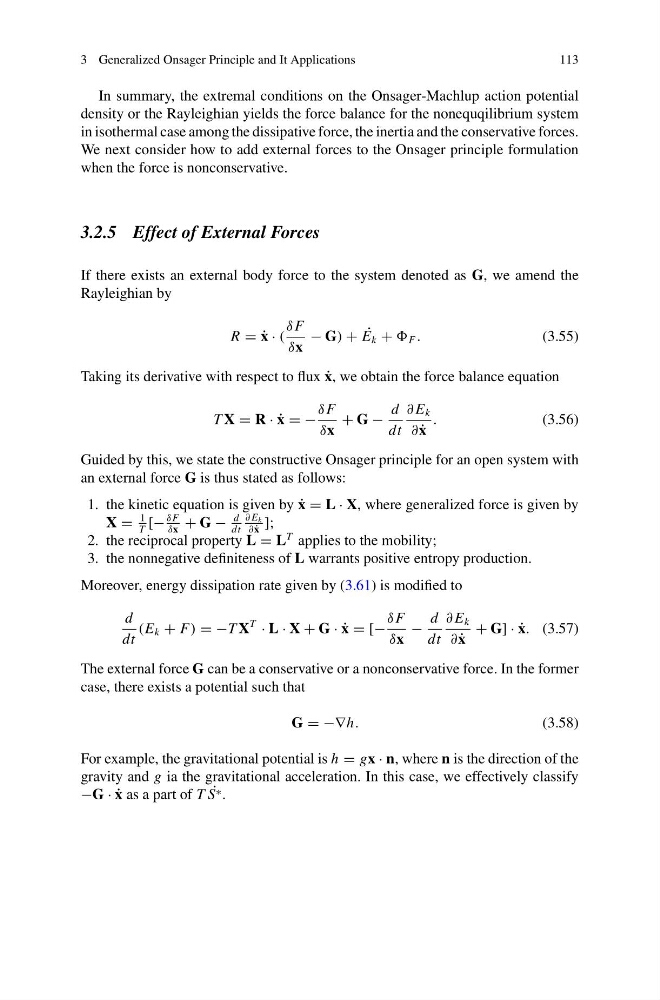
If there exists an external body force to the system denoted as G, we amend the
Rayleighian by
R = ˙
x · (
δ F
δx
− G) + ˙
E k + F .
(3.55)
Taking its derivative with respect to flux ˙
x, we obtain the force balance equation
T X = R · ˙
x = −
δ F
δx
+ G −
d
dt
∂ E k
∂ ˙
x
.
(3.56)
Guided by this, we state the constructive Onsager principle for an open system with
an external force G is thus stated as follows:
1. the kinetic equation is given by ˙
x = L · X, where generalized force is given by
X =
1
T
[−
δ F
δx
+ G −
d
dt
∂ E k
∂ ˙
x
];
2. the reciprocal property L = L
T applies to the mobility;
3. the nonnegative definiteness of L warrants positive entropy production.
Moreover, energy dissipation rate given by (3.61) is modified to
d
dt
(E k + F) = −T X
T
· L · X + G · ˙
x = [−
δ F
δx
−
d
dt
∂ E k
∂ ˙
x
+ G] · ˙
x. (3.57)
The external force G can be a conservative or a nonconservative force. In the former
case, there exists a potential such that
G = −∇h.
(3.58)
For example, the gravitational potential is h = gx · n, where n is the direction of the
gravity and g ia the gravitational acceleration. In this case, we effectively classify
−G · ˙
x as a part of T ˙
S ∗ .
113
In summary, the extremal conditions on the Onsager-Machlup action potential
density or the Rayleighian yields the force balance for the nonequqilibrium system
in isothermal case among the dissipative force, the inertia and the conservative forces.
We next consider how to add external forces to the Onsager principle formulation
when the force is nonconservative.
3.2.5 Effect of External Forces
If there exists an external body force to the system denoted as G, we amend the
Rayleighian by
R = ˙
x · (
δ F
δx
− G) + ˙
E k + F .
(3.55)
Taking its derivative with respect to flux ˙
x, we obtain the force balance equation
T X = R · ˙
x = −
δ F
δx
+ G −
d
dt
∂ E k
∂ ˙
x
.
(3.56)
Guided by this, we state the constructive Onsager principle for an open system with
an external force G is thus stated as follows:
1. the kinetic equation is given by ˙
x = L · X, where generalized force is given by
X =
1
T
[−
δ F
δx
+ G −
d
dt
∂ E k
∂ ˙
x
];
2. the reciprocal property L = L
T applies to the mobility;
3. the nonnegative definiteness of L warrants positive entropy production.
Moreover, energy dissipation rate given by (3.61) is modified to
d
dt
(E k + F) = −T X
T
· L · X + G · ˙
x = [−
δ F
δx
−
d
dt
∂ E k
∂ ˙
x
+ G] · ˙
x. (3.57)
The external force G can be a conservative or a nonconservative force. In the former
case, there exists a potential such that
G = −∇h.
(3.58)
For example, the gravitational potential is h = gx · n, where n is the direction of the
gravity and g ia the gravitational acceleration. In this case, we effectively classify
−G · ˙
x as a part of T ˙
S ∗ .