

98
W.-M. Zheng
f eq (θ, φ) =
ne βμE cos θ
e βμE cos θ d
≈
n
4π
(1 + βμE cos θ), P d = =μ cos θE/E ≈
1
3
nβμ 2 E.
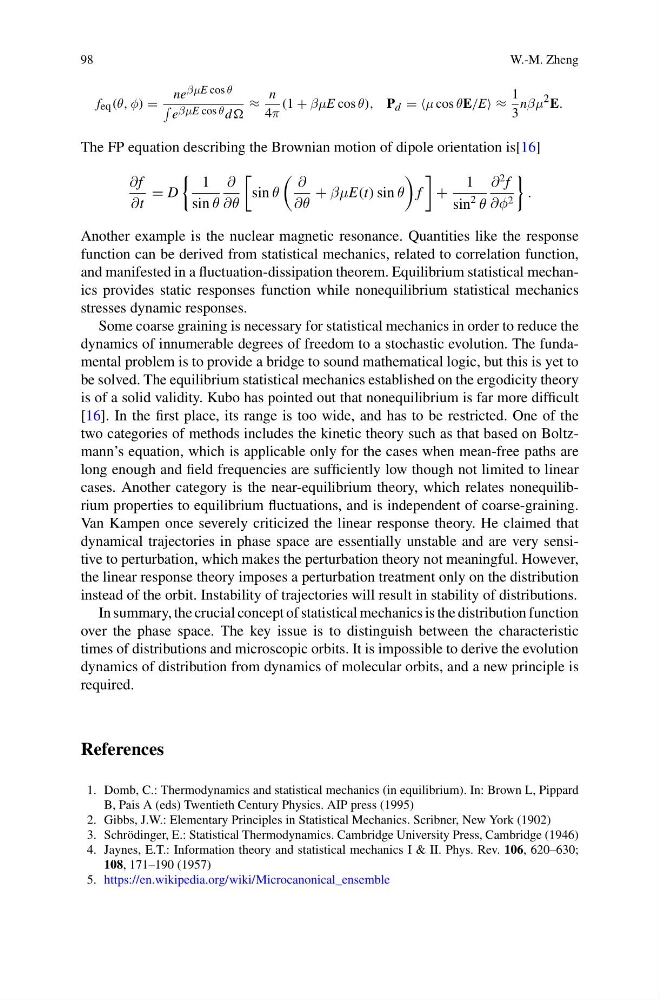
The FP equation describing the Brownian motion of dipole orientation is[16]
∂f
∂t
= D
1
sin θ
∂
∂θ
sin θ
∂
∂θ
+ βμE(t) sin θ
f
+
1
sin
2
θ
∂
2 f
∂φ 2
.
Another example is the nuclear magnetic resonance. Quantities like the response
function can be derived from statistical mechanics, related to correlation function,
and manifested in a fluctuation-dissipation theorem. Equilibrium statistical mechanics provides static responses function while nonequilibrium statistical mechanics
stresses dynamic responses.
Some coarse graining is necessary for statistical mechanics in order to reduce the
dynamics of innumerable degrees of freedom to a stochastic evolution. The fundamental problem is to provide a bridge to sound mathematical logic, but this is yet to
be solved. The equilibrium statistical mechanics established on the ergodicity theory
is of a solid validity. Kubo has pointed out that nonequilibrium is far more difficult
[16]. In the first place, its range is too wide, and has to be restricted. One of the
two categories of methods includes the kinetic theory such as that based on Boltzmann’s equation, which is applicable only for the cases when mean-free paths are
long enough and field frequencies are sufficiently low though not limited to linear
cases. Another category is the near-equilibrium theory, which relates nonequilibrium properties to equilibrium fluctuations, and is independent of coarse-graining.
Van Kampen once severely criticized the linear response theory. He claimed that
dynamical trajectories in phase space are essentially unstable and are very sensitive to perturbation, which makes the perturbation theory not meaningful. However,
the linear response theory imposes a perturbation treatment only on the distribution
instead of the orbit. Instability of trajectories will result in stability of distributions.
In summary, the crucial concept of statistical mechanics is the distribution function
over the phase space. The key issue is to distinguish between the characteristic
times of distributions and microscopic orbits. It is impossible to derive the evolution
dynamics of distribution from dynamics of molecular orbits, and a new principle is
required.
References
1. Domb, C.: Thermodynamics and statistical mechanics (in equilibrium). In: Brown L, Pippard
B, Pais A (eds) Twentieth Century Physics. AIP press (1995)
2. Gibbs, J.W.: Elementary Principles in Statistical Mechanics. Scribner, New York (1902)
3. Schrödinger, E.: Statistical Thermodynamics. Cambridge University Press, Cambridge (1946)
4. Jaynes, E.T.: Information theory and statistical mechanics I & II. Phys. Rev. 106, 620–630;
108, 171–190 (1957)
5. https://en.wikipedia.org/wiki/Microcanonical_ensemble
W.-M. Zheng
f eq (θ, φ) =
ne βμE cos θ
e βμE cos θ d
≈
n
4π
(1 + βμE cos θ), P d = =μ cos θE/E ≈
1
3
nβμ 2 E.
The FP equation describing the Brownian motion of dipole orientation is[16]
∂f
∂t
= D
1
sin θ
∂
∂θ
sin θ
∂
∂θ
+ βμE(t) sin θ
f
+
1
sin
2
θ
∂
2 f
∂φ 2
.
Another example is the nuclear magnetic resonance. Quantities like the response
function can be derived from statistical mechanics, related to correlation function,
and manifested in a fluctuation-dissipation theorem. Equilibrium statistical mechanics provides static responses function while nonequilibrium statistical mechanics
stresses dynamic responses.
Some coarse graining is necessary for statistical mechanics in order to reduce the
dynamics of innumerable degrees of freedom to a stochastic evolution. The fundamental problem is to provide a bridge to sound mathematical logic, but this is yet to
be solved. The equilibrium statistical mechanics established on the ergodicity theory
is of a solid validity. Kubo has pointed out that nonequilibrium is far more difficult
[16]. In the first place, its range is too wide, and has to be restricted. One of the
two categories of methods includes the kinetic theory such as that based on Boltzmann’s equation, which is applicable only for the cases when mean-free paths are
long enough and field frequencies are sufficiently low though not limited to linear
cases. Another category is the near-equilibrium theory, which relates nonequilibrium properties to equilibrium fluctuations, and is independent of coarse-graining.
Van Kampen once severely criticized the linear response theory. He claimed that
dynamical trajectories in phase space are essentially unstable and are very sensitive to perturbation, which makes the perturbation theory not meaningful. However,
the linear response theory imposes a perturbation treatment only on the distribution
instead of the orbit. Instability of trajectories will result in stability of distributions.
In summary, the crucial concept of statistical mechanics is the distribution function
over the phase space. The key issue is to distinguish between the characteristic
times of distributions and microscopic orbits. It is impossible to derive the evolution
dynamics of distribution from dynamics of molecular orbits, and a new principle is
required.
References
1. Domb, C.: Thermodynamics and statistical mechanics (in equilibrium). In: Brown L, Pippard
B, Pais A (eds) Twentieth Century Physics. AIP press (1995)
2. Gibbs, J.W.: Elementary Principles in Statistical Mechanics. Scribner, New York (1902)
3. Schrödinger, E.: Statistical Thermodynamics. Cambridge University Press, Cambridge (1946)
4. Jaynes, E.T.: Information theory and statistical mechanics I & II. Phys. Rev. 106, 620–630;
108, 171–190 (1957)
5. https://en.wikipedia.org/wiki/Microcanonical_ensemble