

3.1 The Nature of Lip Vibration
65
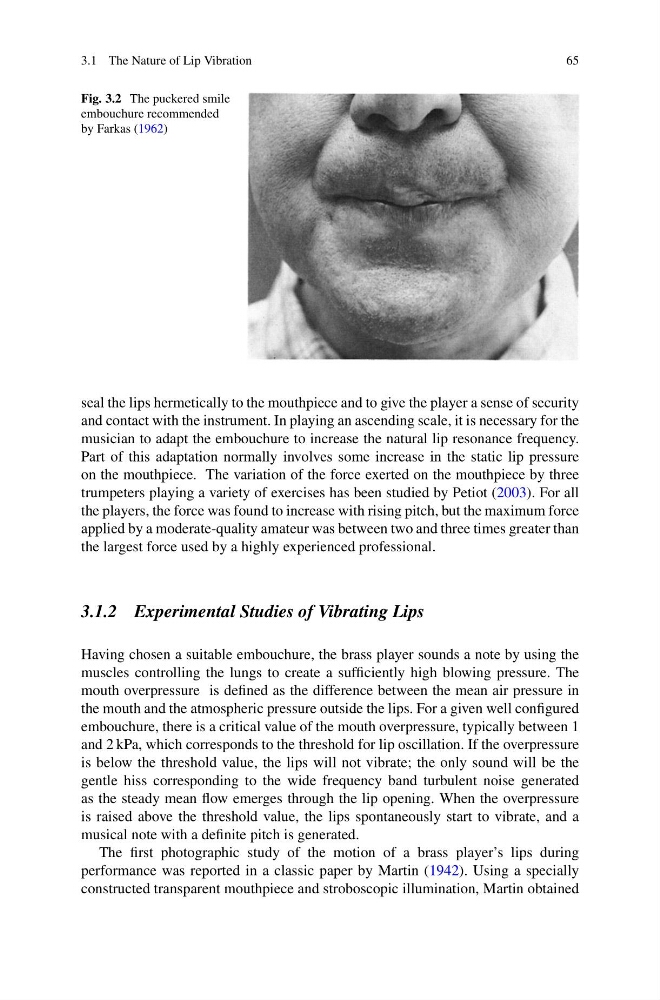
Fig. 3.2 The puckered smile
embouchure recommended
by Farkas (1962)
seal the lips hermetically to the mouthpiece and to give the player a sense of security
and contact with the instrument. In playing an ascending scale, it is necessary for the
musician to adapt the embouchure to increase the natural lip resonance frequency.
Part of this adaptation normally involves some increase in the static lip pressure
on the mouthpiece. The variation of the force exerted on the mouthpiece by three
trumpeters playing a variety of exercises has been studied by Petiot (2003). For all
the players, the force was found to increase with rising pitch, but the maximum force
applied by a moderate-quality amateur was between two and three times greater than
the largest force used by a highly experienced professional.
3.1.2 Experimental Studies of Vibrating Lips
Having chosen a suitable embouchure, the brass player sounds a note by using the
muscles controlling the lungs to create a sufficiently high blowing pressure. The
mouth overpressure is defined as the difference between the mean air pressure in
the mouth and the atmospheric pressure outside the lips. For a given well configured
embouchure, there is a critical value of the mouth overpressure, typically between 1
and 2 kPa, which corresponds to the threshold for lip oscillation. If the overpressure
is below the threshold value, the lips will not vibrate; the only sound will be the
gentle hiss corresponding to the wide frequency band turbulent noise generated
as the steady mean flow emerges through the lip opening. When the overpressure
is raised above the threshold value, the lips spontaneously start to vibrate, and a
musical note with a definite pitch is generated.
The first photographic study of the motion of a brass player’s lips during
performance was reported in a classic paper by Martin (1942). Using a specially
constructed transparent mouthpiece and stroboscopic illumination, Martin obtained
65
Fig. 3.2 The puckered smile
embouchure recommended
by Farkas (1962)
seal the lips hermetically to the mouthpiece and to give the player a sense of security
and contact with the instrument. In playing an ascending scale, it is necessary for the
musician to adapt the embouchure to increase the natural lip resonance frequency.
Part of this adaptation normally involves some increase in the static lip pressure
on the mouthpiece. The variation of the force exerted on the mouthpiece by three
trumpeters playing a variety of exercises has been studied by Petiot (2003). For all
the players, the force was found to increase with rising pitch, but the maximum force
applied by a moderate-quality amateur was between two and three times greater than
the largest force used by a highly experienced professional.
3.1.2 Experimental Studies of Vibrating Lips
Having chosen a suitable embouchure, the brass player sounds a note by using the
muscles controlling the lungs to create a sufficiently high blowing pressure. The
mouth overpressure is defined as the difference between the mean air pressure in
the mouth and the atmospheric pressure outside the lips. For a given well configured
embouchure, there is a critical value of the mouth overpressure, typically between 1
and 2 kPa, which corresponds to the threshold for lip oscillation. If the overpressure
is below the threshold value, the lips will not vibrate; the only sound will be the
gentle hiss corresponding to the wide frequency band turbulent noise generated
as the steady mean flow emerges through the lip opening. When the overpressure
is raised above the threshold value, the lips spontaneously start to vibrate, and a
musical note with a definite pitch is generated.
The first photographic study of the motion of a brass player’s lips during
performance was reported in a classic paper by Martin (1942). Using a specially
constructed transparent mouthpiece and stroboscopic illumination, Martin obtained