

64
3 Buzzing Lips: Sound Generation in Brass Instruments
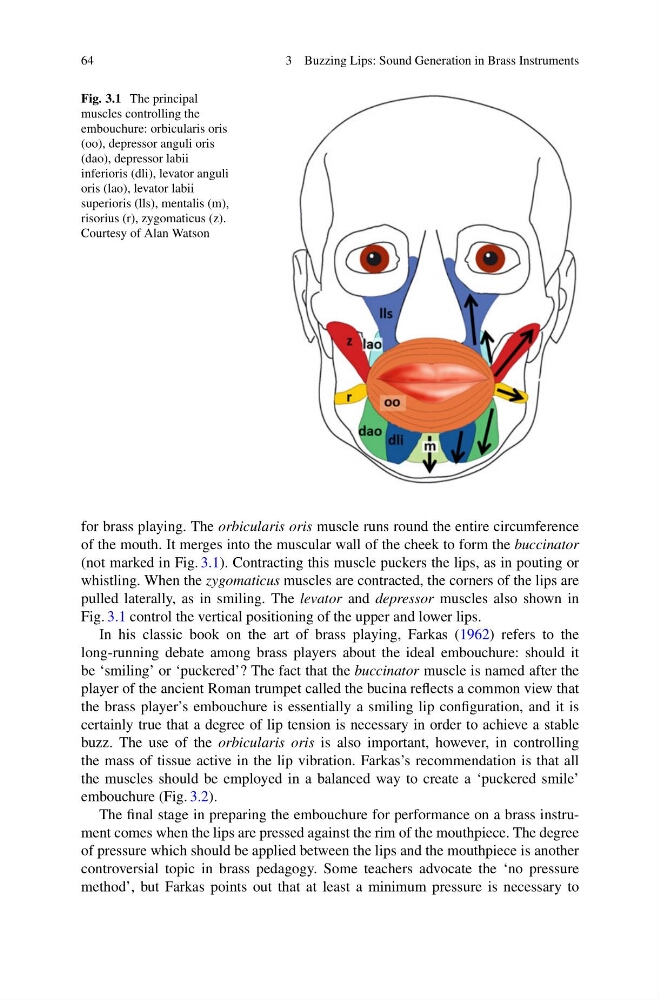
Fig. 3.1 The principal
muscles controlling the
embouchure: orbicularis oris
(oo), depressor anguli oris
(dao), depressor labii
inferioris (dli), levator anguli
oris (lao), levator labii
superioris (lls), mentalis (m),
risorius (r), zygomaticus (z).
Courtesy of Alan Watson
for brass playing. The orbicularis oris muscle runs round the entire circumference
of the mouth. It merges into the muscular wall of the cheek to form the buccinator
(not marked in Fig. 3.1). Contracting this muscle puckers the lips, as in pouting or
whistling. When the zygomaticus muscles are contracted, the corners of the lips are
pulled laterally, as in smiling. The levator and depressor muscles also shown in
Fig. 3.1 control the vertical positioning of the upper and lower lips.
In his classic book on the art of brass playing, Farkas (1962) refers to the
long-running debate among brass players about the ideal embouchure: should it
be ‘smiling’ or ‘puckered’? The fact that the buccinator muscle is named after the
player of the ancient Roman trumpet called the bucina reflects a common view that
the brass player’s embouchure is essentially a smiling lip configuration, and it is
certainly true that a degree of lip tension is necessary in order to achieve a stable
buzz. The use of the orbicularis oris is also important, however, in controlling
the mass of tissue active in the lip vibration. Farkas’s recommendation is that all
the muscles should be employed in a balanced way to create a ‘puckered smile’
embouchure (Fig. 3.2).
The final stage in preparing the embouchure for performance on a brass instrument comes when the lips are pressed against the rim of the mouthpiece. The degree
of pressure which should be applied between the lips and the mouthpiece is another
controversial topic in brass pedagogy. Some teachers advocate the ‘no pressure
method’, but Farkas points out that at least a minimum pressure is necessary to
3 Buzzing Lips: Sound Generation in Brass Instruments
Fig. 3.1 The principal
muscles controlling the
embouchure: orbicularis oris
(oo), depressor anguli oris
(dao), depressor labii
inferioris (dli), levator anguli
oris (lao), levator labii
superioris (lls), mentalis (m),
risorius (r), zygomaticus (z).
Courtesy of Alan Watson
for brass playing. The orbicularis oris muscle runs round the entire circumference
of the mouth. It merges into the muscular wall of the cheek to form the buccinator
(not marked in Fig. 3.1). Contracting this muscle puckers the lips, as in pouting or
whistling. When the zygomaticus muscles are contracted, the corners of the lips are
pulled laterally, as in smiling. The levator and depressor muscles also shown in
Fig. 3.1 control the vertical positioning of the upper and lower lips.
In his classic book on the art of brass playing, Farkas (1962) refers to the
long-running debate among brass players about the ideal embouchure: should it
be ‘smiling’ or ‘puckered’? The fact that the buccinator muscle is named after the
player of the ancient Roman trumpet called the bucina reflects a common view that
the brass player’s embouchure is essentially a smiling lip configuration, and it is
certainly true that a degree of lip tension is necessary in order to achieve a stable
buzz. The use of the orbicularis oris is also important, however, in controlling
the mass of tissue active in the lip vibration. Farkas’s recommendation is that all
the muscles should be employed in a balanced way to create a ‘puckered smile’
embouchure (Fig. 3.2).
The final stage in preparing the embouchure for performance on a brass instrument comes when the lips are pressed against the rim of the mouthpiece. The degree
of pressure which should be applied between the lips and the mouthpiece is another
controversial topic in brass pedagogy. Some teachers advocate the ‘no pressure
method’, but Farkas points out that at least a minimum pressure is necessary to