

414
9 Looking Back and Looking Forward
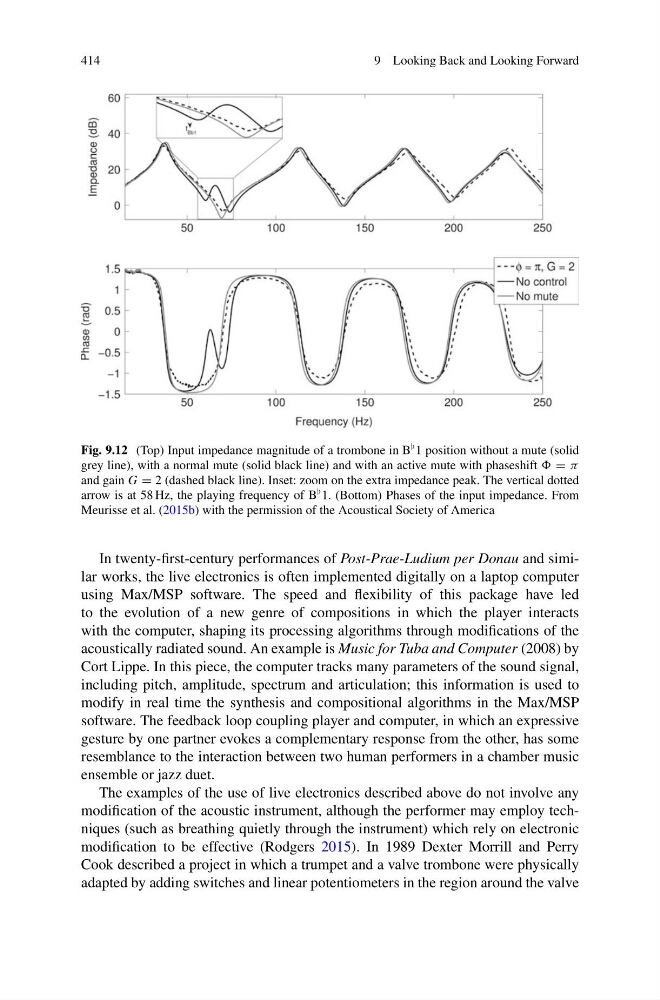
Fig. 9.12 (Top) Input impedance magnitude of a trombone in B 1 position without a mute (solid
grey line), with a normal mute (solid black line) and with an active mute with phaseshift = π
and gain G = 2 (dashed black line). Inset: zoom on the extra impedance peak. The vertical dotted
arrow is at 58 Hz, the playing frequency of B 1. (Bottom) Phases of the input impedance. From
Meurisse et al. (2015b) with the permission of the Acoustical Society of America
In twenty-first-century performances of Post-Prae-Ludium per Donau and similar works, the live electronics is often implemented digitally on a laptop computer
using Max/MSP software. The speed and flexibility of this package have led
to the evolution of a new genre of compositions in which the player interacts
with the computer, shaping its processing algorithms through modifications of the
acoustically radiated sound. An example is Music for Tuba and Computer (2008) by
Cort Lippe. In this piece, the computer tracks many parameters of the sound signal,
including pitch, amplitude, spectrum and articulation; this information is used to
modify in real time the synthesis and compositional algorithms in the Max/MSP
software. The feedback loop coupling player and computer, in which an expressive
gesture by one partner evokes a complementary response from the other, has some
resemblance to the interaction between two human performers in a chamber music
ensemble or jazz duet.
The examples of the use of live electronics described above do not involve any
modification of the acoustic instrument, although the performer may employ techniques (such as breathing quietly through the instrument) which rely on electronic
modification to be effective (Rodgers 2015). In 1989 Dexter Morrill and Perry
Cook described a project in which a trumpet and a valve trombone were physically
adapted by adding switches and linear potentiometers in the region around the valve
9 Looking Back and Looking Forward
Fig. 9.12 (Top) Input impedance magnitude of a trombone in B 1 position without a mute (solid
grey line), with a normal mute (solid black line) and with an active mute with phaseshift = π
and gain G = 2 (dashed black line). Inset: zoom on the extra impedance peak. The vertical dotted
arrow is at 58 Hz, the playing frequency of B 1. (Bottom) Phases of the input impedance. From
Meurisse et al. (2015b) with the permission of the Acoustical Society of America
In twenty-first-century performances of Post-Prae-Ludium per Donau and similar works, the live electronics is often implemented digitally on a laptop computer
using Max/MSP software. The speed and flexibility of this package have led
to the evolution of a new genre of compositions in which the player interacts
with the computer, shaping its processing algorithms through modifications of the
acoustically radiated sound. An example is Music for Tuba and Computer (2008) by
Cort Lippe. In this piece, the computer tracks many parameters of the sound signal,
including pitch, amplitude, spectrum and articulation; this information is used to
modify in real time the synthesis and compositional algorithms in the Max/MSP
software. The feedback loop coupling player and computer, in which an expressive
gesture by one partner evokes a complementary response from the other, has some
resemblance to the interaction between two human performers in a chamber music
ensemble or jazz duet.
The examples of the use of live electronics described above do not involve any
modification of the acoustic instrument, although the performer may employ techniques (such as breathing quietly through the instrument) which rely on electronic
modification to be effective (Rodgers 2015). In 1989 Dexter Morrill and Perry
Cook described a project in which a trumpet and a valve trombone were physically
adapted by adding switches and linear potentiometers in the region around the valve