

9.2 Brass Instruments in the Digital World
413
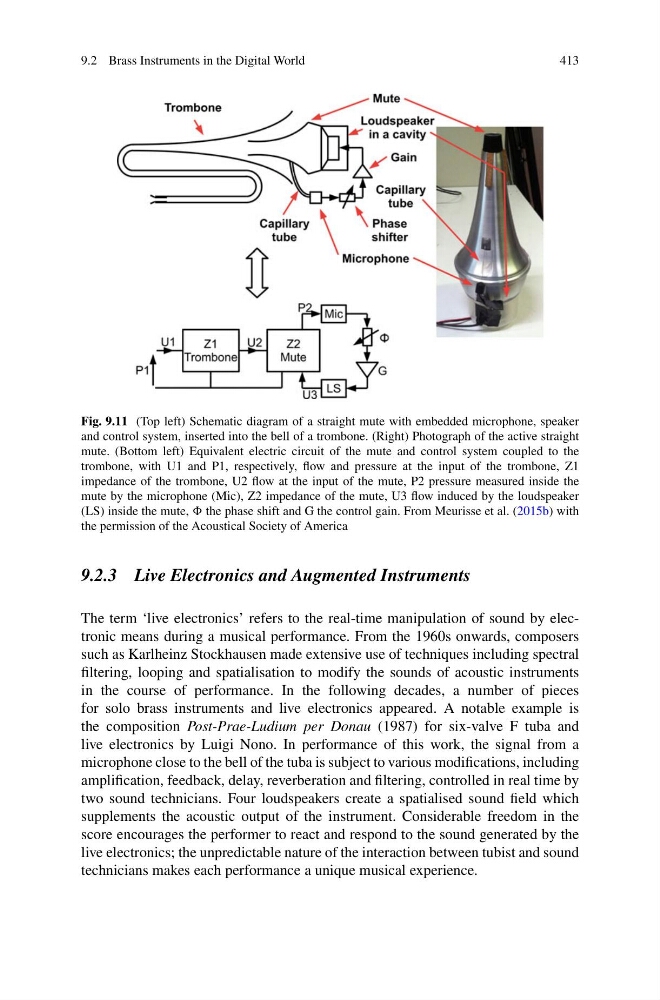
Fig. 9.11 (Top left) Schematic diagram of a straight mute with embedded microphone, speaker
and control system, inserted into the bell of a trombone. (Right) Photograph of the active straight
mute. (Bottom left) Equivalent electric circuit of the mute and control system coupled to the
trombone, with U1 and P1, respectively, flow and pressure at the input of the trombone, Z1
impedance of the trombone, U2 flow at the input of the mute, P2 pressure measured inside the
mute by the microphone (Mic), Z2 impedance of the mute, U3 flow induced by the loudspeaker
(LS) inside the mute, the phase shift and G the control gain. From Meurisse et al. (2015b) with
the permission of the Acoustical Society of America
9.2.3 Live Electronics and Augmented Instruments
The term ‘live electronics’ refers to the real-time manipulation of sound by electronic means during a musical performance. From the 1960s onwards, composers
such as Karlheinz Stockhausen made extensive use of techniques including spectral
filtering, looping and spatialisation to modify the sounds of acoustic instruments
in the course of performance. In the following decades, a number of pieces
for solo brass instruments and live electronics appeared. A notable example is
the composition Post-Prae-Ludium per Donau (1987) for six-valve F tuba and
live electronics by Luigi Nono. In performance of this work, the signal from a
microphone close to the bell of the tuba is subject to various modifications, including
amplification, feedback, delay, reverberation and filtering, controlled in real time by
two sound technicians. Four loudspeakers create a spatialised sound field which
supplements the acoustic output of the instrument. Considerable freedom in the
score encourages the performer to react and respond to the sound generated by the
live electronics; the unpredictable nature of the interaction between tubist and sound
technicians makes each performance a unique musical experience.
413
Fig. 9.11 (Top left) Schematic diagram of a straight mute with embedded microphone, speaker
and control system, inserted into the bell of a trombone. (Right) Photograph of the active straight
mute. (Bottom left) Equivalent electric circuit of the mute and control system coupled to the
trombone, with U1 and P1, respectively, flow and pressure at the input of the trombone, Z1
impedance of the trombone, U2 flow at the input of the mute, P2 pressure measured inside the
mute by the microphone (Mic), Z2 impedance of the mute, U3 flow induced by the loudspeaker
(LS) inside the mute, the phase shift and G the control gain. From Meurisse et al. (2015b) with
the permission of the Acoustical Society of America
9.2.3 Live Electronics and Augmented Instruments
The term ‘live electronics’ refers to the real-time manipulation of sound by electronic means during a musical performance. From the 1960s onwards, composers
such as Karlheinz Stockhausen made extensive use of techniques including spectral
filtering, looping and spatialisation to modify the sounds of acoustic instruments
in the course of performance. In the following decades, a number of pieces
for solo brass instruments and live electronics appeared. A notable example is
the composition Post-Prae-Ludium per Donau (1987) for six-valve F tuba and
live electronics by Luigi Nono. In performance of this work, the signal from a
microphone close to the bell of the tuba is subject to various modifications, including
amplification, feedback, delay, reverberation and filtering, controlled in real time by
two sound technicians. Four loudspeakers create a spatialised sound field which
supplements the acoustic output of the instrument. Considerable freedom in the
score encourages the performer to react and respond to the sound generated by the
live electronics; the unpredictable nature of the interaction between tubist and sound
technicians makes each performance a unique musical experience.