

26
1 The Musician’s Experience of Brass Instruments
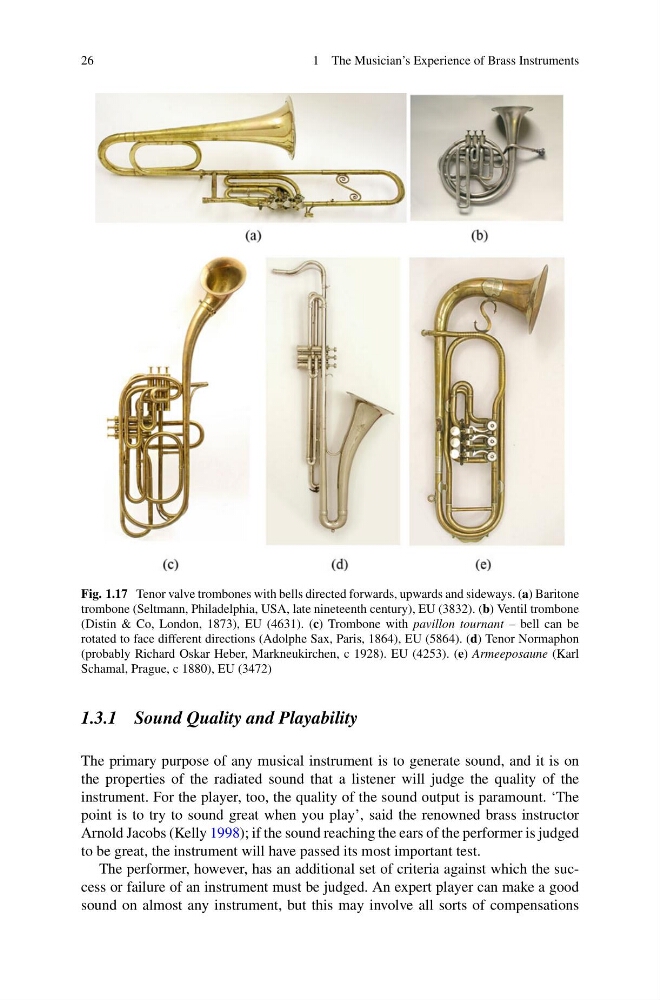
Fig. 1.17 Tenor valve trombones with bells directed forwards, upwards and sideways. (a) Baritone
trombone (Seltmann, Philadelphia, USA, late nineteenth century), EU (3832). (b) Ventil trombone
(Distin & Co, London, 1873), EU (4631). (c) Trombone with pavillon tournant – bell can be
rotated to face different directions (Adolphe Sax, Paris, 1864), EU (5864). (d) Tenor Normaphon
(probably Richard Oskar Heber, Markneukirchen, c 1928). EU (4253). (e) Armeeposaune (Karl
Schamal, Prague, c 1880), EU (3472)
1.3.1 Sound Quality and Playability
The primary purpose of any musical instrument is to generate sound, and it is on
the properties of the radiated sound that a listener will judge the quality of the
instrument. For the player, too, the quality of the sound output is paramount. ‘The
point is to try to sound great when you play’, said the renowned brass instructor
Arnold Jacobs (Kelly 1998); if the sound reaching the ears of the performer is judged
to be great, the instrument will have passed its most important test.
The performer, however, has an additional set of criteria against which the success or failure of an instrument must be judged. An expert player can make a good
sound on almost any instrument, but this may involve all sorts of compensations
1 The Musician’s Experience of Brass Instruments
Fig. 1.17 Tenor valve trombones with bells directed forwards, upwards and sideways. (a) Baritone
trombone (Seltmann, Philadelphia, USA, late nineteenth century), EU (3832). (b) Ventil trombone
(Distin & Co, London, 1873), EU (4631). (c) Trombone with pavillon tournant – bell can be
rotated to face different directions (Adolphe Sax, Paris, 1864), EU (5864). (d) Tenor Normaphon
(probably Richard Oskar Heber, Markneukirchen, c 1928). EU (4253). (e) Armeeposaune (Karl
Schamal, Prague, c 1880), EU (3472)
1.3.1 Sound Quality and Playability
The primary purpose of any musical instrument is to generate sound, and it is on
the properties of the radiated sound that a listener will judge the quality of the
instrument. For the player, too, the quality of the sound output is paramount. ‘The
point is to try to sound great when you play’, said the renowned brass instructor
Arnold Jacobs (Kelly 1998); if the sound reaching the ears of the performer is judged
to be great, the instrument will have passed its most important test.
The performer, however, has an additional set of criteria against which the success or failure of an instrument must be judged. An expert player can make a good
sound on almost any instrument, but this may involve all sorts of compensations