

1.3 Subjective and Objective Evaluation of Brass Instrument Quality
25
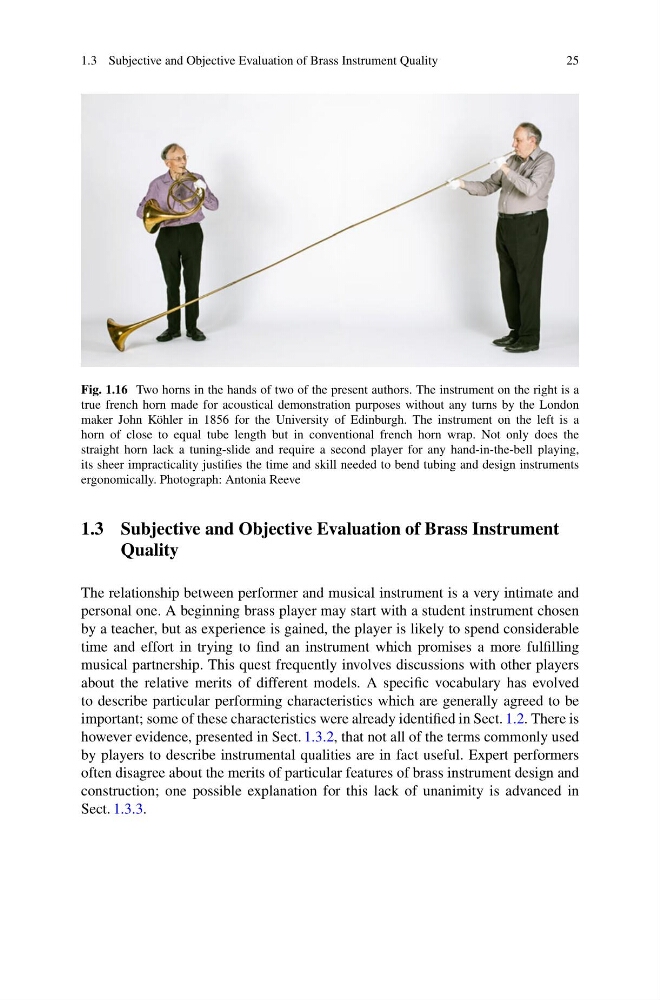
Fig. 1.16 Two horns in the hands of two of the present authors. The instrument on the right is a
true french horn made for acoustical demonstration purposes without any turns by the London
maker John Köhler in 1856 for the University of Edinburgh. The instrument on the left is a
horn of close to equal tube length but in conventional french horn wrap. Not only does the
straight horn lack a tuning-slide and require a second player for any hand-in-the-bell playing,
its sheer impracticality justifies the time and skill needed to bend tubing and design instruments
ergonomically. Photograph: Antonia Reeve
1.3 Subjective and Objective Evaluation of Brass Instrument
Quality
The relationship between performer and musical instrument is a very intimate and
personal one. A beginning brass player may start with a student instrument chosen
by a teacher, but as experience is gained, the player is likely to spend considerable
time and effort in trying to find an instrument which promises a more fulfilling
musical partnership. This quest frequently involves discussions with other players
about the relative merits of different models. A specific vocabulary has evolved
to describe particular performing characteristics which are generally agreed to be
important; some of these characteristics were already identified in Sect. 1.2. There is
however evidence, presented in Sect. 1.3.2, that not all of the terms commonly used
by players to describe instrumental qualities are in fact useful. Expert performers
often disagree about the merits of particular features of brass instrument design and
construction; one possible explanation for this lack of unanimity is advanced in
Sect. 1.3.3.
25
Fig. 1.16 Two horns in the hands of two of the present authors. The instrument on the right is a
true french horn made for acoustical demonstration purposes without any turns by the London
maker John Köhler in 1856 for the University of Edinburgh. The instrument on the left is a
horn of close to equal tube length but in conventional french horn wrap. Not only does the
straight horn lack a tuning-slide and require a second player for any hand-in-the-bell playing,
its sheer impracticality justifies the time and skill needed to bend tubing and design instruments
ergonomically. Photograph: Antonia Reeve
1.3 Subjective and Objective Evaluation of Brass Instrument
Quality
The relationship between performer and musical instrument is a very intimate and
personal one. A beginning brass player may start with a student instrument chosen
by a teacher, but as experience is gained, the player is likely to spend considerable
time and effort in trying to find an instrument which promises a more fulfilling
musical partnership. This quest frequently involves discussions with other players
about the relative merits of different models. A specific vocabulary has evolved
to describe particular performing characteristics which are generally agreed to be
important; some of these characteristics were already identified in Sect. 1.2. There is
however evidence, presented in Sect. 1.3.2, that not all of the terms commonly used
by players to describe instrumental qualities are in fact useful. Expert performers
often disagree about the merits of particular features of brass instrument design and
construction; one possible explanation for this lack of unanimity is advanced in
Sect. 1.3.3.