

8.3 Metal Forming
395
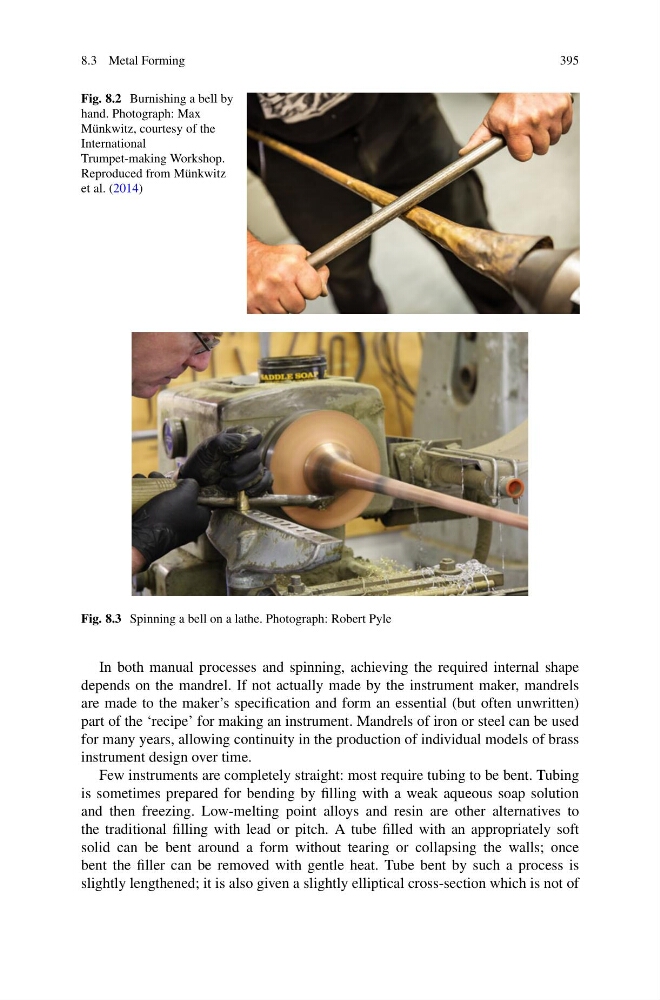
Fig. 8.2 Burnishing a bell by
hand. Photograph: Max
Münkwitz, courtesy of the
International
Trumpet-making Workshop.
Reproduced from Münkwitz
et al. (2014)
Fig. 8.3 Spinning a bell on a lathe. Photograph: Robert Pyle
In both manual processes and spinning, achieving the required internal shape
depends on the mandrel. If not actually made by the instrument maker, mandrels
are made to the maker’s specification and form an essential (but often unwritten)
part of the ‘recipe’ for making an instrument. Mandrels of iron or steel can be used
for many years, allowing continuity in the production of individual models of brass
instrument design over time.
Few instruments are completely straight: most require tubing to be bent. Tubing
is sometimes prepared for bending by filling with a weak aqueous soap solution
and then freezing. Low-melting point alloys and resin are other alternatives to
the traditional filling with lead or pitch. A tube filled with an appropriately soft
solid can be bent around a form without tearing or collapsing the walls; once
bent the filler can be removed with gentle heat. Tube bent by such a process is
slightly lengthened; it is also given a slightly elliptical cross-section which is not of
395
Fig. 8.2 Burnishing a bell by
hand. Photograph: Max
Münkwitz, courtesy of the
International
Trumpet-making Workshop.
Reproduced from Münkwitz
et al. (2014)
Fig. 8.3 Spinning a bell on a lathe. Photograph: Robert Pyle
In both manual processes and spinning, achieving the required internal shape
depends on the mandrel. If not actually made by the instrument maker, mandrels
are made to the maker’s specification and form an essential (but often unwritten)
part of the ‘recipe’ for making an instrument. Mandrels of iron or steel can be used
for many years, allowing continuity in the production of individual models of brass
instrument design over time.
Few instruments are completely straight: most require tubing to be bent. Tubing
is sometimes prepared for bending by filling with a weak aqueous soap solution
and then freezing. Low-melting point alloys and resin are other alternatives to
the traditional filling with lead or pitch. A tube filled with an appropriately soft
solid can be bent around a form without tearing or collapsing the walls; once
bent the filler can be removed with gentle heat. Tube bent by such a process is
slightly lengthened; it is also given a slightly elliptical cross-section which is not of