

394
8 How Brass Instruments Are Made
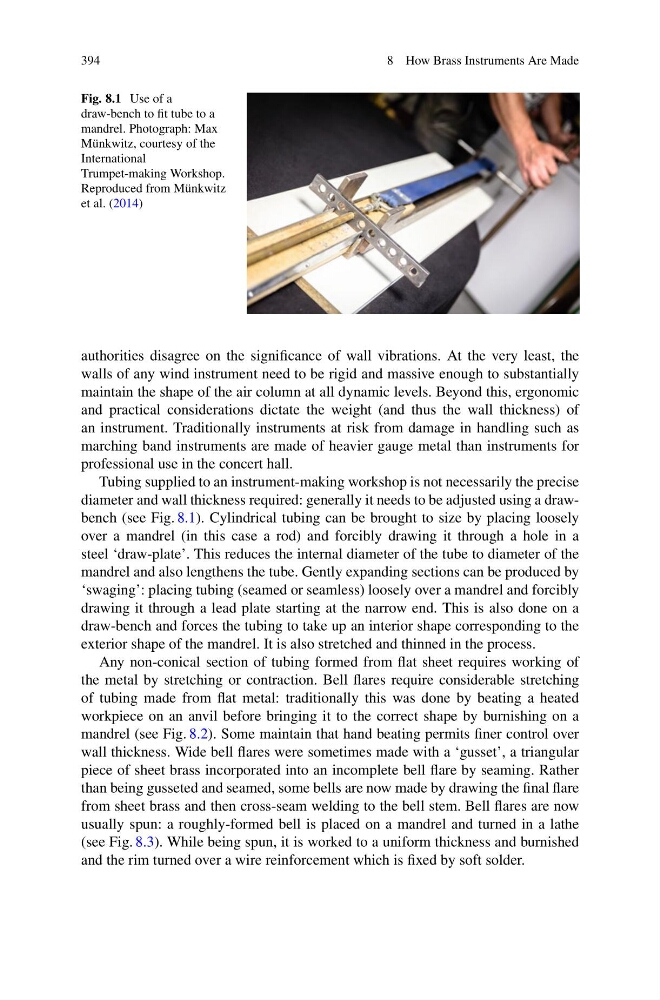
Fig. 8.1 Use of a
draw-bench to fit tube to a
mandrel. Photograph: Max
Münkwitz, courtesy of the
International
Trumpet-making Workshop.
Reproduced from Münkwitz
et al. (2014)
authorities disagree on the significance of wall vibrations. At the very least, the
walls of any wind instrument need to be rigid and massive enough to substantially
maintain the shape of the air column at all dynamic levels. Beyond this, ergonomic
and practical considerations dictate the weight (and thus the wall thickness) of
an instrument. Traditionally instruments at risk from damage in handling such as
marching band instruments are made of heavier gauge metal than instruments for
professional use in the concert hall.
Tubing supplied to an instrument-making workshop is not necessarily the precise
diameter and wall thickness required: generally it needs to be adjusted using a drawbench (see Fig. 8.1). Cylindrical tubing can be brought to size by placing loosely
over a mandrel (in this case a rod) and forcibly drawing it through a hole in a
steel ‘draw-plate’. This reduces the internal diameter of the tube to diameter of the
mandrel and also lengthens the tube. Gently expanding sections can be produced by
‘swaging’: placing tubing (seamed or seamless) loosely over a mandrel and forcibly
drawing it through a lead plate starting at the narrow end. This is also done on a
draw-bench and forces the tubing to take up an interior shape corresponding to the
exterior shape of the mandrel. It is also stretched and thinned in the process.
Any non-conical section of tubing formed from flat sheet requires working of
the metal by stretching or contraction. Bell flares require considerable stretching
of tubing made from flat metal: traditionally this was done by beating a heated
workpiece on an anvil before bringing it to the correct shape by burnishing on a
mandrel (see Fig. 8.2). Some maintain that hand beating permits finer control over
wall thickness. Wide bell flares were sometimes made with a ‘gusset’, a triangular
piece of sheet brass incorporated into an incomplete bell flare by seaming. Rather
than being gusseted and seamed, some bells are now made by drawing the final flare
from sheet brass and then cross-seam welding to the bell stem. Bell flares are now
usually spun: a roughly-formed bell is placed on a mandrel and turned in a lathe
(see Fig. 8.3). While being spun, it is worked to a uniform thickness and burnished
and the rim turned over a wire reinforcement which is fixed by soft solder.
8 How Brass Instruments Are Made
Fig. 8.1 Use of a
draw-bench to fit tube to a
mandrel. Photograph: Max
Münkwitz, courtesy of the
International
Trumpet-making Workshop.
Reproduced from Münkwitz
et al. (2014)
authorities disagree on the significance of wall vibrations. At the very least, the
walls of any wind instrument need to be rigid and massive enough to substantially
maintain the shape of the air column at all dynamic levels. Beyond this, ergonomic
and practical considerations dictate the weight (and thus the wall thickness) of
an instrument. Traditionally instruments at risk from damage in handling such as
marching band instruments are made of heavier gauge metal than instruments for
professional use in the concert hall.
Tubing supplied to an instrument-making workshop is not necessarily the precise
diameter and wall thickness required: generally it needs to be adjusted using a drawbench (see Fig. 8.1). Cylindrical tubing can be brought to size by placing loosely
over a mandrel (in this case a rod) and forcibly drawing it through a hole in a
steel ‘draw-plate’. This reduces the internal diameter of the tube to diameter of the
mandrel and also lengthens the tube. Gently expanding sections can be produced by
‘swaging’: placing tubing (seamed or seamless) loosely over a mandrel and forcibly
drawing it through a lead plate starting at the narrow end. This is also done on a
draw-bench and forces the tubing to take up an interior shape corresponding to the
exterior shape of the mandrel. It is also stretched and thinned in the process.
Any non-conical section of tubing formed from flat sheet requires working of
the metal by stretching or contraction. Bell flares require considerable stretching
of tubing made from flat metal: traditionally this was done by beating a heated
workpiece on an anvil before bringing it to the correct shape by burnishing on a
mandrel (see Fig. 8.2). Some maintain that hand beating permits finer control over
wall thickness. Wide bell flares were sometimes made with a ‘gusset’, a triangular
piece of sheet brass incorporated into an incomplete bell flare by seaming. Rather
than being gusseted and seamed, some bells are now made by drawing the final flare
from sheet brass and then cross-seam welding to the bell stem. Bell flares are now
usually spun: a roughly-formed bell is placed on a mandrel and turned in a lathe
(see Fig. 8.3). While being spun, it is worked to a uniform thickness and burnished
and the rim turned over a wire reinforcement which is fixed by soft solder.