

386
7 The Amazing Diversity of Brass Instruments
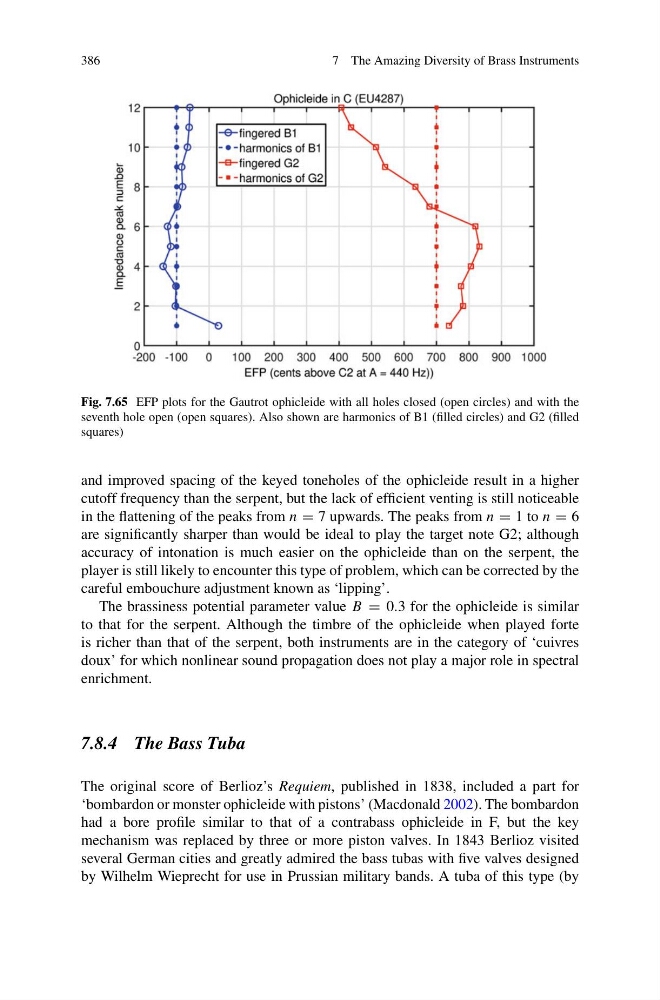
Fig. 7.65 EFP plots for the Gautrot ophicleide with all holes closed (open circles) and with the
seventh hole open (open squares). Also shown are harmonics of B1 (filled circles) and G2 (filled
squares)
and improved spacing of the keyed toneholes of the ophicleide result in a higher
cutoff frequency than the serpent, but the lack of efficient venting is still noticeable
in the flattening of the peaks from n = 7 upwards. The peaks from n = 1 to n = 6
are significantly sharper than would be ideal to play the target note G2; although
accuracy of intonation is much easier on the ophicleide than on the serpent, the
player is still likely to encounter this type of problem, which can be corrected by the
careful embouchure adjustment known as ‘lipping’.
The brassiness potential parameter value B = 0.3 for the ophicleide is similar
to that for the serpent. Although the timbre of the ophicleide when played forte
is richer than that of the serpent, both instruments are in the category of ‘cuivres
doux’ for which nonlinear sound propagation does not play a major role in spectral
enrichment.
7.8.4 The Bass Tuba
The original score of Berlioz’s Requiem, published in 1838, included a part for
‘bombardon or monster ophicleide with pistons’ (Macdonald 2002). The bombardon
had a bore profile similar to that of a contrabass ophicleide in F, but the key
mechanism was replaced by three or more piston valves. In 1843 Berlioz visited
several German cities and greatly admired the bass tubas with five valves designed
by Wilhelm Wieprecht for use in Prussian military bands. A tuba of this type (by
7 The Amazing Diversity of Brass Instruments
Fig. 7.65 EFP plots for the Gautrot ophicleide with all holes closed (open circles) and with the
seventh hole open (open squares). Also shown are harmonics of B1 (filled circles) and G2 (filled
squares)
and improved spacing of the keyed toneholes of the ophicleide result in a higher
cutoff frequency than the serpent, but the lack of efficient venting is still noticeable
in the flattening of the peaks from n = 7 upwards. The peaks from n = 1 to n = 6
are significantly sharper than would be ideal to play the target note G2; although
accuracy of intonation is much easier on the ophicleide than on the serpent, the
player is still likely to encounter this type of problem, which can be corrected by the
careful embouchure adjustment known as ‘lipping’.
The brassiness potential parameter value B = 0.3 for the ophicleide is similar
to that for the serpent. Although the timbre of the ophicleide when played forte
is richer than that of the serpent, both instruments are in the category of ‘cuivres
doux’ for which nonlinear sound propagation does not play a major role in spectral
enrichment.
7.8.4 The Bass Tuba
The original score of Berlioz’s Requiem, published in 1838, included a part for
‘bombardon or monster ophicleide with pistons’ (Macdonald 2002). The bombardon
had a bore profile similar to that of a contrabass ophicleide in F, but the key
mechanism was replaced by three or more piston valves. In 1843 Berlioz visited
several German cities and greatly admired the bass tubas with five valves designed
by Wilhelm Wieprecht for use in Prussian military bands. A tuba of this type (by