

7.8 Going Further: The Bass Brass Instruments of Berlioz
385
The steadily widening conical bore of the serpent results in a low value
(B = 0.29) of the brassiness potential parameter. The relative unimportance of
nonlinear propagation in serpent timbre means that the sound does not develop a
brassy edge even when played at maximum volume.
7.8.3 The Ophicleide
The instrument illustrated in Fig. 7.57c is a nine key ophicleide (by Gautrot, Paris,
mid-nineteenth century); its bore profile is shown by the magenta curve in Fig. 7.58.
The first half of the tube has a conical profile similar to that of the serpent, as
illustrated in Fig. 7.61, but the bore then flares out and ends in a 200 mm diameter
bell. The nominal pitch of this ophicleide is C2, although closing all the keys lowers
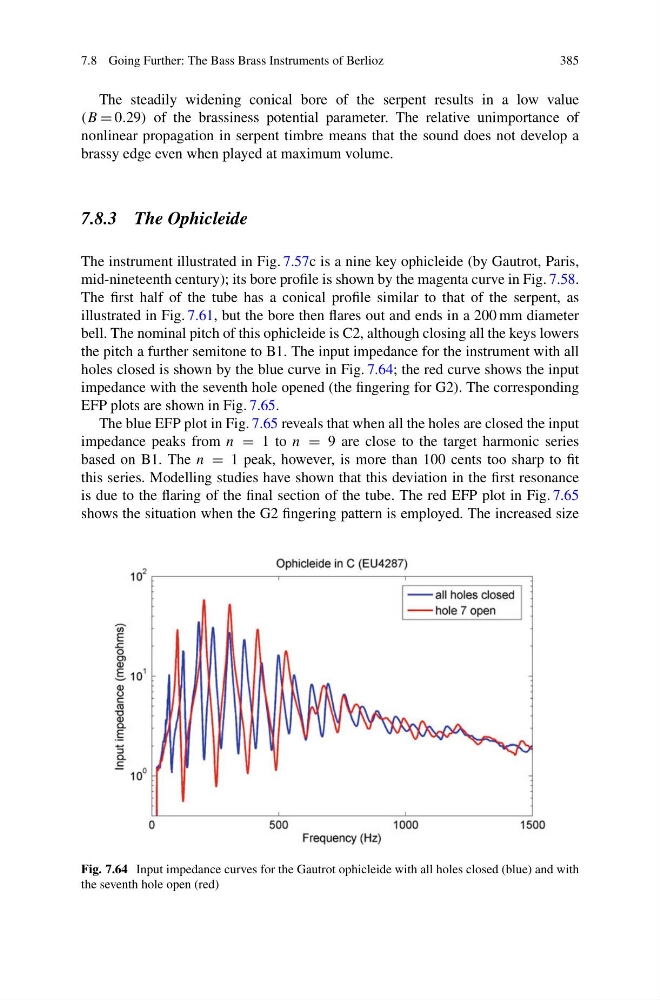
the pitch a further semitone to B1. The input impedance for the instrument with all
holes closed is shown by the blue curve in Fig. 7.64; the red curve shows the input
impedance with the seventh hole opened (the fingering for G2). The corresponding
EFP plots are shown in Fig. 7.65.
The blue EFP plot in Fig. 7.65 reveals that when all the holes are closed the input
impedance peaks from n = 1 to n = 9 are close to the target harmonic series
based on B1. The n = 1 peak, however, is more than 100 cents too sharp to fit
this series. Modelling studies have shown that this deviation in the first resonance
is due to the flaring of the final section of the tube. The red EFP plot in Fig. 7.65
shows the situation when the G2 fingering pattern is employed. The increased size
Fig. 7.64 Input impedance curves for the Gautrot ophicleide with all holes closed (blue) and with
the seventh hole open (red)
385
The steadily widening conical bore of the serpent results in a low value
(B = 0.29) of the brassiness potential parameter. The relative unimportance of
nonlinear propagation in serpent timbre means that the sound does not develop a
brassy edge even when played at maximum volume.
7.8.3 The Ophicleide
The instrument illustrated in Fig. 7.57c is a nine key ophicleide (by Gautrot, Paris,
mid-nineteenth century); its bore profile is shown by the magenta curve in Fig. 7.58.
The first half of the tube has a conical profile similar to that of the serpent, as
illustrated in Fig. 7.61, but the bore then flares out and ends in a 200 mm diameter
bell. The nominal pitch of this ophicleide is C2, although closing all the keys lowers
the pitch a further semitone to B1. The input impedance for the instrument with all
holes closed is shown by the blue curve in Fig. 7.64; the red curve shows the input
impedance with the seventh hole opened (the fingering for G2). The corresponding
EFP plots are shown in Fig. 7.65.
The blue EFP plot in Fig. 7.65 reveals that when all the holes are closed the input
impedance peaks from n = 1 to n = 9 are close to the target harmonic series
based on B1. The n = 1 peak, however, is more than 100 cents too sharp to fit
this series. Modelling studies have shown that this deviation in the first resonance
is due to the flaring of the final section of the tube. The red EFP plot in Fig. 7.65
shows the situation when the G2 fingering pattern is employed. The increased size
Fig. 7.64 Input impedance curves for the Gautrot ophicleide with all holes closed (blue) and with
the seventh hole open (red)