

7.8 Going Further: The Bass Brass Instruments of Berlioz
383
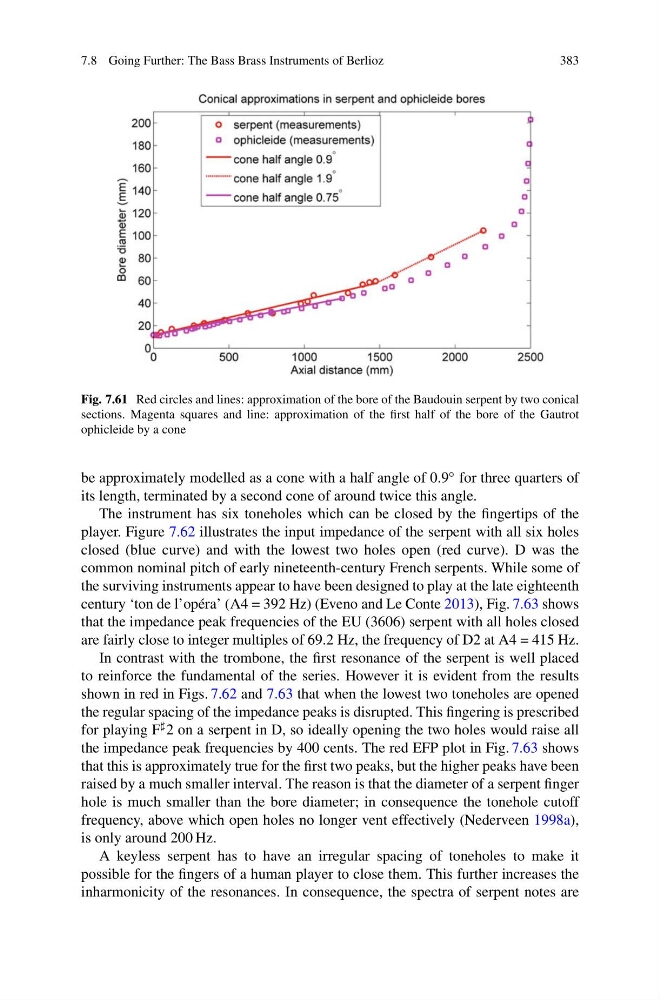
Fig. 7.61 Red circles and lines: approximation of the bore of the Baudouin serpent by two conical
sections. Magenta squares and line: approximation of the first half of the bore of the Gautrot
ophicleide by a cone
be approximately modelled as a cone with a half angle of 0.9 ◦ for three quarters of
its length, terminated by a second cone of around twice this angle.
The instrument has six toneholes which can be closed by the fingertips of the
player. Figure 7.62 illustrates the input impedance of the serpent with all six holes
closed (blue curve) and with the lowest two holes open (red curve). D was the
common nominal pitch of early nineteenth-century French serpents. While some of
the surviving instruments appear to have been designed to play at the late eighteenth
century ‘ton de l’opéra’ (A4 = 392 Hz) (Eveno and Le Conte 2013), Fig. 7.63 shows
that the impedance peak frequencies of the EU (3606) serpent with all holes closed
are fairly close to integer multiples of 69.2 Hz, the frequency of D2 at A4 = 415 Hz.
In contrast with the trombone, the first resonance of the serpent is well placed
to reinforce the fundamental of the series. However it is evident from the results
shown in red in Figs. 7.62 and 7.63 that when the lowest two toneholes are opened
the regular spacing of the impedance peaks is disrupted. This fingering is prescribed
for playing F 2 on a serpent in D, so ideally opening the two holes would raise all
the impedance peak frequencies by 400 cents. The red EFP plot in Fig. 7.63 shows
that this is approximately true for the first two peaks, but the higher peaks have been
raised by a much smaller interval. The reason is that the diameter of a serpent finger
hole is much smaller than the bore diameter; in consequence the tonehole cutoff
frequency, above which open holes no longer vent effectively (Nederveen 1998a),
is only around 200 Hz.
A keyless serpent has to have an irregular spacing of toneholes to make it
possible for the fingers of a human player to close them. This further increases the
inharmonicity of the resonances. In consequence, the spectra of serpent notes are
383
Fig. 7.61 Red circles and lines: approximation of the bore of the Baudouin serpent by two conical
sections. Magenta squares and line: approximation of the first half of the bore of the Gautrot
ophicleide by a cone
be approximately modelled as a cone with a half angle of 0.9 ◦ for three quarters of
its length, terminated by a second cone of around twice this angle.
The instrument has six toneholes which can be closed by the fingertips of the
player. Figure 7.62 illustrates the input impedance of the serpent with all six holes
closed (blue curve) and with the lowest two holes open (red curve). D was the
common nominal pitch of early nineteenth-century French serpents. While some of
the surviving instruments appear to have been designed to play at the late eighteenth
century ‘ton de l’opéra’ (A4 = 392 Hz) (Eveno and Le Conte 2013), Fig. 7.63 shows
that the impedance peak frequencies of the EU (3606) serpent with all holes closed
are fairly close to integer multiples of 69.2 Hz, the frequency of D2 at A4 = 415 Hz.
In contrast with the trombone, the first resonance of the serpent is well placed
to reinforce the fundamental of the series. However it is evident from the results
shown in red in Figs. 7.62 and 7.63 that when the lowest two toneholes are opened
the regular spacing of the impedance peaks is disrupted. This fingering is prescribed
for playing F 2 on a serpent in D, so ideally opening the two holes would raise all
the impedance peak frequencies by 400 cents. The red EFP plot in Fig. 7.63 shows
that this is approximately true for the first two peaks, but the higher peaks have been
raised by a much smaller interval. The reason is that the diameter of a serpent finger
hole is much smaller than the bore diameter; in consequence the tonehole cutoff
frequency, above which open holes no longer vent effectively (Nederveen 1998a),
is only around 200 Hz.
A keyless serpent has to have an irregular spacing of toneholes to make it
possible for the fingers of a human player to close them. This further increases the
inharmonicity of the resonances. In consequence, the spectra of serpent notes are