

382
7 The Amazing Diversity of Brass Instruments
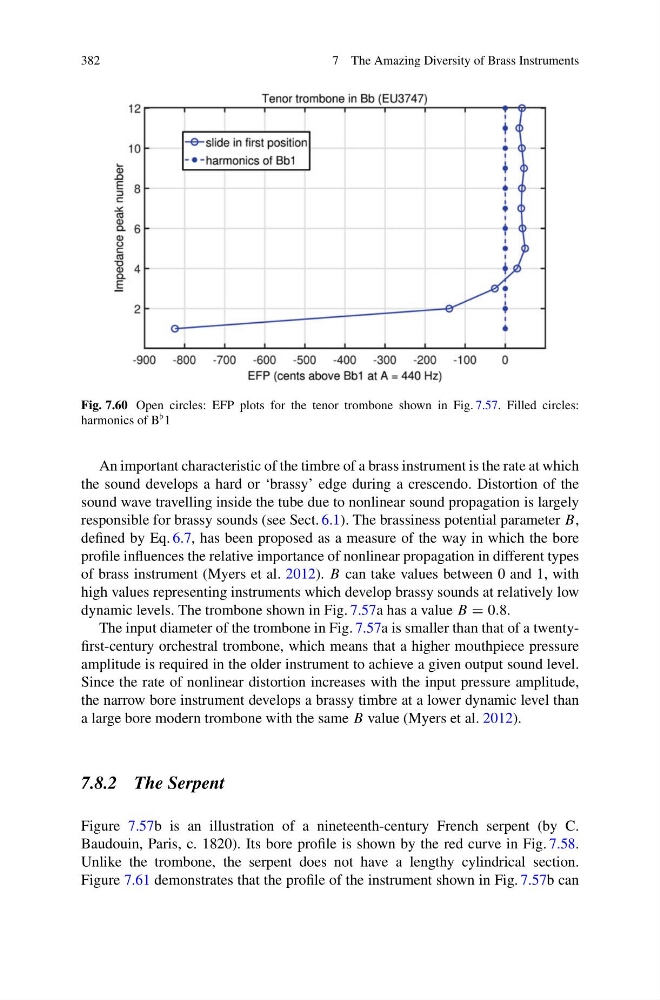
Fig. 7.60 Open circles: EFP plots for the tenor trombone shown in Fig. 7.57. Filled circles:
harmonics of B 1
An important characteristic of the timbre of a brass instrument is the rate at which
the sound develops a hard or ‘brassy’ edge during a crescendo. Distortion of the
sound wave travelling inside the tube due to nonlinear sound propagation is largely
responsible for brassy sounds (see Sect. 6.1). The brassiness potential parameter B,
defined by Eq. 6.7, has been proposed as a measure of the way in which the bore
profile influences the relative importance of nonlinear propagation in different types
of brass instrument (Myers et al. 2012). B can take values between 0 and 1, with
high values representing instruments which develop brassy sounds at relatively low
dynamic levels. The trombone shown in Fig. 7.57a has a value B = 0.8.
The input diameter of the trombone in Fig. 7.57a is smaller than that of a twentyfirst-century orchestral trombone, which means that a higher mouthpiece pressure
amplitude is required in the older instrument to achieve a given output sound level.
Since the rate of nonlinear distortion increases with the input pressure amplitude,
the narrow bore instrument develops a brassy timbre at a lower dynamic level than
a large bore modern trombone with the same B value (Myers et al. 2012).
7.8.2 The Serpent
Figure 7.57b is an illustration of a nineteenth-century French serpent (by C.
Baudouin, Paris, c. 1820). Its bore profile is shown by the red curve in Fig. 7.58.
Unlike the trombone, the serpent does not have a lengthy cylindrical section.
Figure 7.61 demonstrates that the profile of the instrument shown in Fig. 7.57b can
7 The Amazing Diversity of Brass Instruments
Fig. 7.60 Open circles: EFP plots for the tenor trombone shown in Fig. 7.57. Filled circles:
harmonics of B 1
An important characteristic of the timbre of a brass instrument is the rate at which
the sound develops a hard or ‘brassy’ edge during a crescendo. Distortion of the
sound wave travelling inside the tube due to nonlinear sound propagation is largely
responsible for brassy sounds (see Sect. 6.1). The brassiness potential parameter B,
defined by Eq. 6.7, has been proposed as a measure of the way in which the bore
profile influences the relative importance of nonlinear propagation in different types
of brass instrument (Myers et al. 2012). B can take values between 0 and 1, with
high values representing instruments which develop brassy sounds at relatively low
dynamic levels. The trombone shown in Fig. 7.57a has a value B = 0.8.
The input diameter of the trombone in Fig. 7.57a is smaller than that of a twentyfirst-century orchestral trombone, which means that a higher mouthpiece pressure
amplitude is required in the older instrument to achieve a given output sound level.
Since the rate of nonlinear distortion increases with the input pressure amplitude,
the narrow bore instrument develops a brassy timbre at a lower dynamic level than
a large bore modern trombone with the same B value (Myers et al. 2012).
7.8.2 The Serpent
Figure 7.57b is an illustration of a nineteenth-century French serpent (by C.
Baudouin, Paris, c. 1820). Its bore profile is shown by the red curve in Fig. 7.58.
Unlike the trombone, the serpent does not have a lengthy cylindrical section.
Figure 7.61 demonstrates that the profile of the instrument shown in Fig. 7.57b can