

376
7 The Amazing Diversity of Brass Instruments
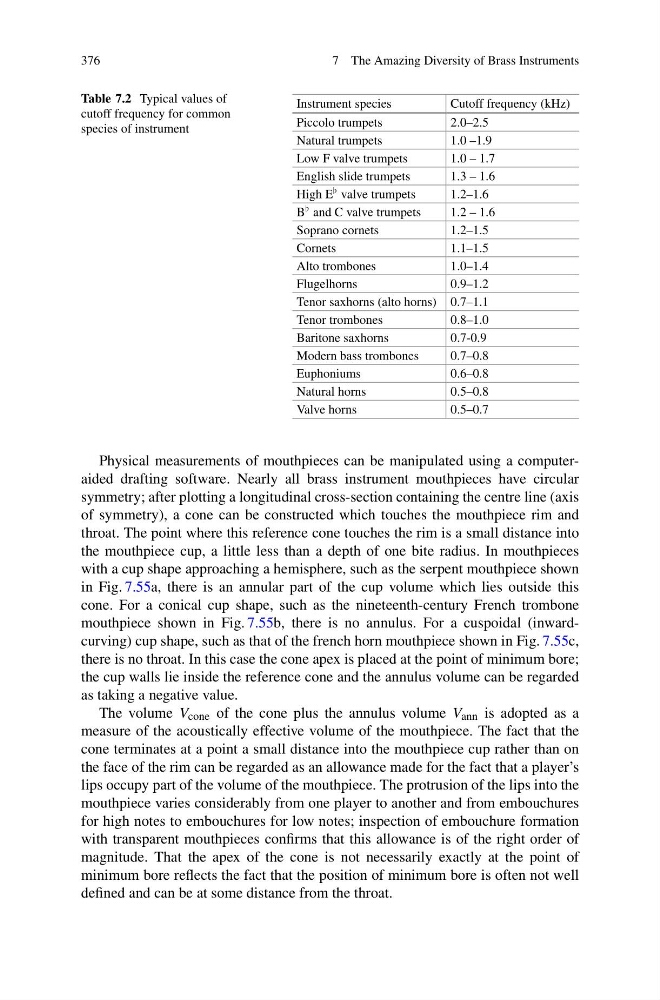
Table 7.2 Typical values of
cutoff frequency for common
species of instrument
Instrument species
Cutoff frequency (kHz)
Piccolo trumpets
2.0–2.5
Natural trumpets
1.0 –1.9
Low F valve trumpets
1.0 – 1.7
English slide trumpets
1.3 – 1.6
High E valve trumpets
1.2–1.6
B and C valve trumpets
1.2 – 1.6
Soprano cornets
1.2–1.5
Cornets
1.1–1.5
Alto trombones
1.0–1.4
Flugelhorns
0.9–1.2
Tenor saxhorns (alto horns) 0.7–1.1
Tenor trombones
0.8–1.0
Baritone saxhorns
0.7-0.9
Modern bass trombones
0.7–0.8
Euphoniums
0.6–0.8
Natural horns
0.5–0.8
Valve horns
0.5–0.7
Physical measurements of mouthpieces can be manipulated using a computeraided drafting software. Nearly all brass instrument mouthpieces have circular
symmetry; after plotting a longitudinal cross-section containing the centre line (axis
of symmetry), a cone can be constructed which touches the mouthpiece rim and
throat. The point where this reference cone touches the rim is a small distance into
the mouthpiece cup, a little less than a depth of one bite radius. In mouthpieces
with a cup shape approaching a hemisphere, such as the serpent mouthpiece shown
in Fig. 7.55a, there is an annular part of the cup volume which lies outside this
cone. For a conical cup shape, such as the nineteenth-century French trombone
mouthpiece shown in Fig. 7.55b, there is no annulus. For a cuspoidal (inwardcurving) cup shape, such as that of the french horn mouthpiece shown in Fig. 7.55c,
there is no throat. In this case the cone apex is placed at the point of minimum bore;
the cup walls lie inside the reference cone and the annulus volume can be regarded
as taking a negative value.
The volume V cone of the cone plus the annulus volume V ann is adopted as a
measure of the acoustically effective volume of the mouthpiece. The fact that the
cone terminates at a point a small distance into the mouthpiece cup rather than on
the face of the rim can be regarded as an allowance made for the fact that a player’s
lips occupy part of the volume of the mouthpiece. The protrusion of the lips into the
mouthpiece varies considerably from one player to another and from embouchures
for high notes to embouchures for low notes; inspection of embouchure formation
with transparent mouthpieces confirms that this allowance is of the right order of
magnitude. That the apex of the cone is not necessarily exactly at the point of
minimum bore reflects the fact that the position of minimum bore is often not well
defined and can be at some distance from the throat.
7 The Amazing Diversity of Brass Instruments
Table 7.2 Typical values of
cutoff frequency for common
species of instrument
Instrument species
Cutoff frequency (kHz)
Piccolo trumpets
2.0–2.5
Natural trumpets
1.0 –1.9
Low F valve trumpets
1.0 – 1.7
English slide trumpets
1.3 – 1.6
High E valve trumpets
1.2–1.6
B and C valve trumpets
1.2 – 1.6
Soprano cornets
1.2–1.5
Cornets
1.1–1.5
Alto trombones
1.0–1.4
Flugelhorns
0.9–1.2
Tenor saxhorns (alto horns) 0.7–1.1
Tenor trombones
0.8–1.0
Baritone saxhorns
0.7-0.9
Modern bass trombones
0.7–0.8
Euphoniums
0.6–0.8
Natural horns
0.5–0.8
Valve horns
0.5–0.7
Physical measurements of mouthpieces can be manipulated using a computeraided drafting software. Nearly all brass instrument mouthpieces have circular
symmetry; after plotting a longitudinal cross-section containing the centre line (axis
of symmetry), a cone can be constructed which touches the mouthpiece rim and
throat. The point where this reference cone touches the rim is a small distance into
the mouthpiece cup, a little less than a depth of one bite radius. In mouthpieces
with a cup shape approaching a hemisphere, such as the serpent mouthpiece shown
in Fig. 7.55a, there is an annular part of the cup volume which lies outside this
cone. For a conical cup shape, such as the nineteenth-century French trombone
mouthpiece shown in Fig. 7.55b, there is no annulus. For a cuspoidal (inwardcurving) cup shape, such as that of the french horn mouthpiece shown in Fig. 7.55c,
there is no throat. In this case the cone apex is placed at the point of minimum bore;
the cup walls lie inside the reference cone and the annulus volume can be regarded
as taking a negative value.
The volume V cone of the cone plus the annulus volume V ann is adopted as a
measure of the acoustically effective volume of the mouthpiece. The fact that the
cone terminates at a point a small distance into the mouthpiece cup rather than on
the face of the rim can be regarded as an allowance made for the fact that a player’s
lips occupy part of the volume of the mouthpiece. The protrusion of the lips into the
mouthpiece varies considerably from one player to another and from embouchures
for high notes to embouchures for low notes; inspection of embouchure formation
with transparent mouthpieces confirms that this allowance is of the right order of
magnitude. That the apex of the cone is not necessarily exactly at the point of
minimum bore reflects the fact that the position of minimum bore is often not well
defined and can be at some distance from the throat.