

7.7 Going Further: Mouthpiece Parameters
375
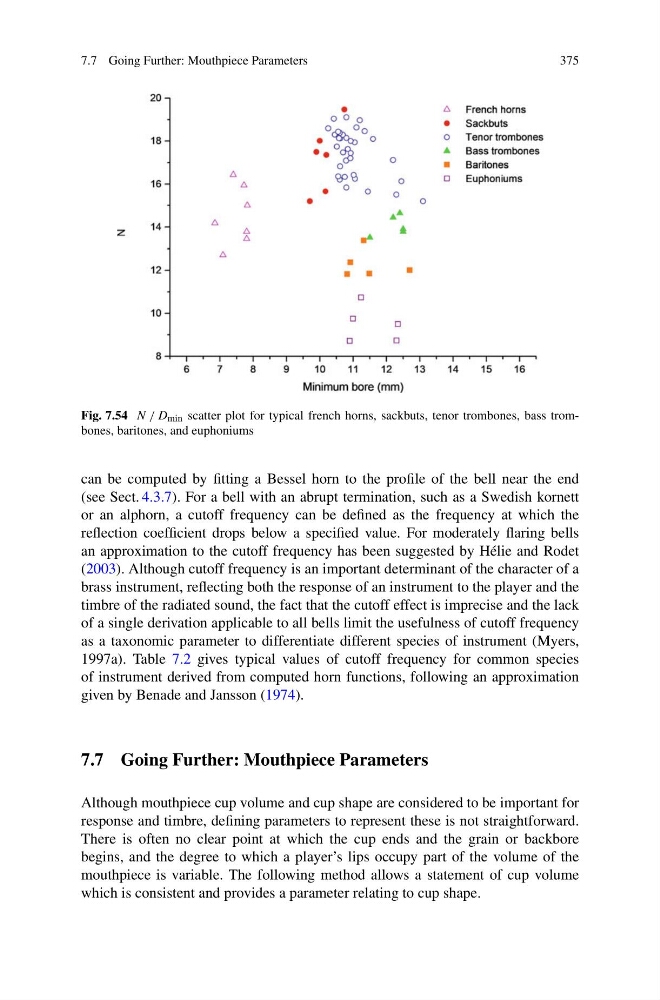
Fig. 7.54 N / D min scatter plot for typical french horns, sackbuts, tenor trombones, bass trombones, baritones, and euphoniums
can be computed by fitting a Bessel horn to the profile of the bell near the end
(see Sect. 4.3.7). For a bell with an abrupt termination, such as a Swedish kornett
or an alphorn, a cutoff frequency can be defined as the frequency at which the
reflection coefficient drops below a specified value. For moderately flaring bells
an approximation to the cutoff frequency has been suggested by Hélie and Rodet
(2003). Although cutoff frequency is an important determinant of the character of a
brass instrument, reflecting both the response of an instrument to the player and the
timbre of the radiated sound, the fact that the cutoff effect is imprecise and the lack
of a single derivation applicable to all bells limit the usefulness of cutoff frequency
as a taxonomic parameter to differentiate different species of instrument (Myers,
1997a). Table 7.2 gives typical values of cutoff frequency for common species
of instrument derived from computed horn functions, following an approximation
given by Benade and Jansson (1974).
7.7 Going Further: Mouthpiece Parameters
Although mouthpiece cup volume and cup shape are considered to be important for
response and timbre, defining parameters to represent these is not straightforward.
There is often no clear point at which the cup ends and the grain or backbore
begins, and the degree to which a player’s lips occupy part of the volume of the
mouthpiece is variable. The following method allows a statement of cup volume
which is consistent and provides a parameter relating to cup shape.
375
Fig. 7.54 N / D min scatter plot for typical french horns, sackbuts, tenor trombones, bass trombones, baritones, and euphoniums
can be computed by fitting a Bessel horn to the profile of the bell near the end
(see Sect. 4.3.7). For a bell with an abrupt termination, such as a Swedish kornett
or an alphorn, a cutoff frequency can be defined as the frequency at which the
reflection coefficient drops below a specified value. For moderately flaring bells
an approximation to the cutoff frequency has been suggested by Hélie and Rodet
(2003). Although cutoff frequency is an important determinant of the character of a
brass instrument, reflecting both the response of an instrument to the player and the
timbre of the radiated sound, the fact that the cutoff effect is imprecise and the lack
of a single derivation applicable to all bells limit the usefulness of cutoff frequency
as a taxonomic parameter to differentiate different species of instrument (Myers,
1997a). Table 7.2 gives typical values of cutoff frequency for common species
of instrument derived from computed horn functions, following an approximation
given by Benade and Jansson (1974).
7.7 Going Further: Mouthpiece Parameters
Although mouthpiece cup volume and cup shape are considered to be important for
response and timbre, defining parameters to represent these is not straightforward.
There is often no clear point at which the cup ends and the grain or backbore
begins, and the degree to which a player’s lips occupy part of the volume of the
mouthpiece is variable. The following method allows a statement of cup volume
which is consistent and provides a parameter relating to cup shape.