

7.2 The Different Kinds of Brass Instrument
365
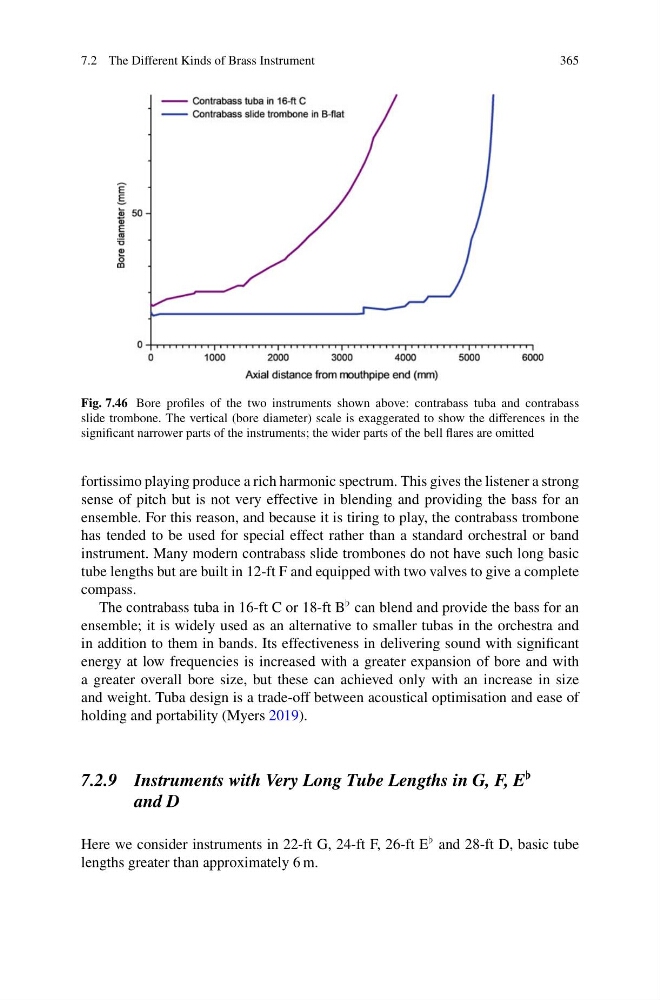
Fig. 7.46 Bore profiles of the two instruments shown above: contrabass tuba and contrabass
slide trombone. The vertical (bore diameter) scale is exaggerated to show the differences in the
significant narrower parts of the instruments; the wider parts of the bell flares are omitted
fortissimo playing produce a rich harmonic spectrum. This gives the listener a strong
sense of pitch but is not very effective in blending and providing the bass for an
ensemble. For this reason, and because it is tiring to play, the contrabass trombone
has tended to be used for special effect rather than a standard orchestral or band
instrument. Many modern contrabass slide trombones do not have such long basic
tube lengths but are built in 12-ft F and equipped with two valves to give a complete
compass.
The contrabass tuba in 16-ft C or 18-ft B can blend and provide the bass for an
ensemble; it is widely used as an alternative to smaller tubas in the orchestra and
in addition to them in bands. Its effectiveness in delivering sound with significant
energy at low frequencies is increased with a greater expansion of bore and with
a greater overall bore size, but these can achieved only with an increase in size
and weight. Tuba design is a trade-off between acoustical optimisation and ease of
holding and portability (Myers 2019).
7.2.9 Instruments with Very Long Tube Lengths in G, F, E
and D
Here we consider instruments in 22-ft G, 24-ft F, 26-ft E and 28-ft D, basic tube
lengths greater than approximately 6 m.
365
Fig. 7.46 Bore profiles of the two instruments shown above: contrabass tuba and contrabass
slide trombone. The vertical (bore diameter) scale is exaggerated to show the differences in the
significant narrower parts of the instruments; the wider parts of the bell flares are omitted
fortissimo playing produce a rich harmonic spectrum. This gives the listener a strong
sense of pitch but is not very effective in blending and providing the bass for an
ensemble. For this reason, and because it is tiring to play, the contrabass trombone
has tended to be used for special effect rather than a standard orchestral or band
instrument. Many modern contrabass slide trombones do not have such long basic
tube lengths but are built in 12-ft F and equipped with two valves to give a complete
compass.
The contrabass tuba in 16-ft C or 18-ft B can blend and provide the bass for an
ensemble; it is widely used as an alternative to smaller tubas in the orchestra and
in addition to them in bands. Its effectiveness in delivering sound with significant
energy at low frequencies is increased with a greater expansion of bore and with
a greater overall bore size, but these can achieved only with an increase in size
and weight. Tuba design is a trade-off between acoustical optimisation and ease of
holding and portability (Myers 2019).
7.2.9 Instruments with Very Long Tube Lengths in G, F, E
and D
Here we consider instruments in 22-ft G, 24-ft F, 26-ft E and 28-ft D, basic tube
lengths greater than approximately 6 m.