

364
7 The Amazing Diversity of Brass Instruments
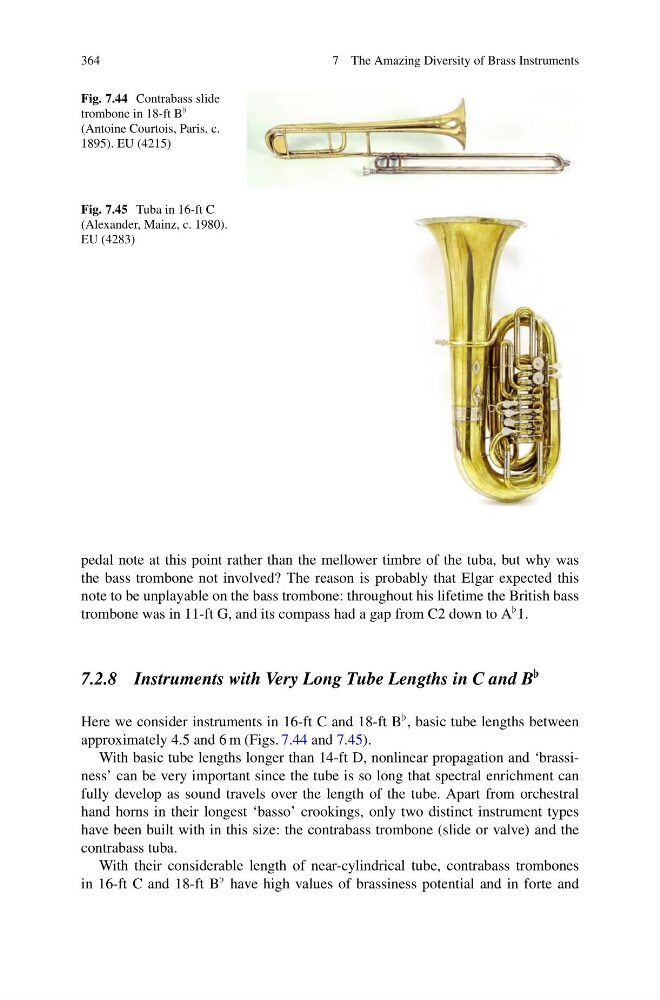
Fig. 7.44 Contrabass slide
trombone in 18-ft B
(Antoine Courtois, Paris, c.
1895). EU (4215)
Fig. 7.45 Tuba in 16-ft C
(Alexander, Mainz, c. 1980).
EU (4283)
pedal note at this point rather than the mellower timbre of the tuba, but why was
the bass trombone not involved? The reason is probably that Elgar expected this
note to be unplayable on the bass trombone: throughout his lifetime the British bass
trombone was in 11-ft G, and its compass had a gap from C2 down to A 1.
7.2.8 Instruments with Very Long Tube Lengths in C and B
Here we consider instruments in 16-ft C and 18-ft B , basic tube lengths between
approximately 4.5 and 6 m (Figs. 7.44 and 7.45).
With basic tube lengths longer than 14-ft D, nonlinear propagation and ‘brassiness’ can be very important since the tube is so long that spectral enrichment can
fully develop as sound travels over the length of the tube. Apart from orchestral
hand horns in their longest ‘basso’ crookings, only two distinct instrument types
have been built with in this size: the contrabass trombone (slide or valve) and the
contrabass tuba.
With their considerable length of near-cylindrical tube, contrabass trombones
in 16-ft C and 18-ft B have high values of brassiness potential and in forte and
7 The Amazing Diversity of Brass Instruments
Fig. 7.44 Contrabass slide
trombone in 18-ft B
(Antoine Courtois, Paris, c.
1895). EU (4215)
Fig. 7.45 Tuba in 16-ft C
(Alexander, Mainz, c. 1980).
EU (4283)
pedal note at this point rather than the mellower timbre of the tuba, but why was
the bass trombone not involved? The reason is probably that Elgar expected this
note to be unplayable on the bass trombone: throughout his lifetime the British bass
trombone was in 11-ft G, and its compass had a gap from C2 down to A 1.
7.2.8 Instruments with Very Long Tube Lengths in C and B
Here we consider instruments in 16-ft C and 18-ft B , basic tube lengths between
approximately 4.5 and 6 m (Figs. 7.44 and 7.45).
With basic tube lengths longer than 14-ft D, nonlinear propagation and ‘brassiness’ can be very important since the tube is so long that spectral enrichment can
fully develop as sound travels over the length of the tube. Apart from orchestral
hand horns in their longest ‘basso’ crookings, only two distinct instrument types
have been built with in this size: the contrabass trombone (slide or valve) and the
contrabass tuba.
With their considerable length of near-cylindrical tube, contrabass trombones
in 16-ft C and 18-ft B have high values of brassiness potential and in forte and