

7.2 The Different Kinds of Brass Instrument
355
weak distinction between the kinds of instrument, which include not only tenor
saxhorns and mellophones but also alto cornophones, néocors, clavicors, Koenig
horns, and other instruments differentiated more by their name than any acoustical
properties (Figs. 7.29 and 7.30).
7.2.6 Instruments with Long Tube Lengths in C and B
The principal tenor and harmony instruments are today in 9-ft B . Tenor and bass
trombones (both with nominal fundamental pitch B 1) form the trombone sections
in orchestras and bands of many kinds; the B french horn and the B side of the
double horn are the most regularly used horns; the tenor solo instrument in the brass
band and many military bands is the euphonium, and the B baritone is a traditional
member of the brass band.
In this Section we consider instruments in 8-ft C and 9-ft B , with basic tube
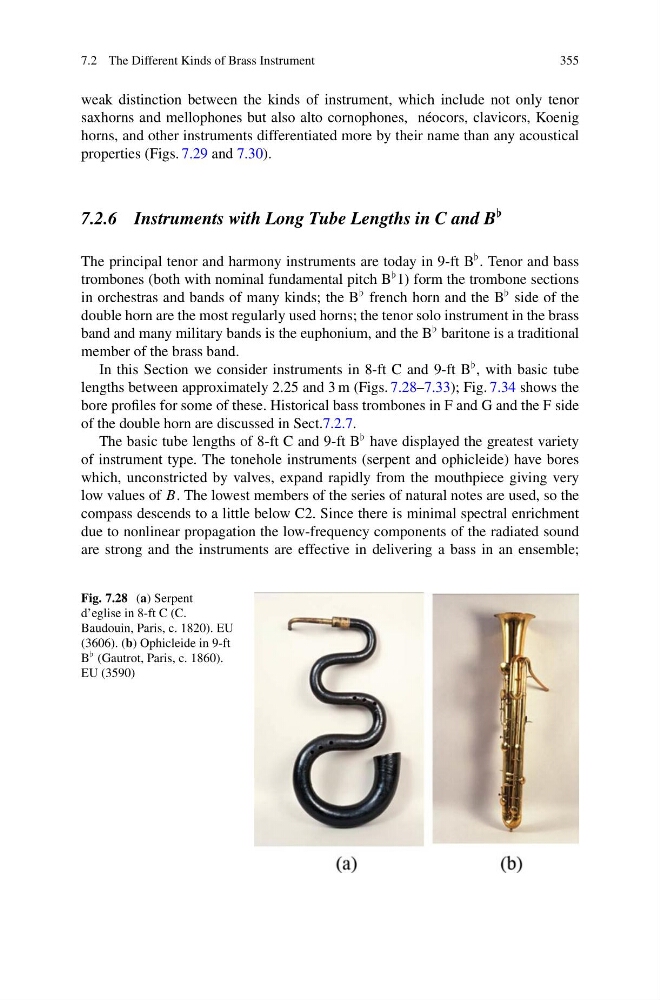
lengths between approximately 2.25 and 3 m (Figs. 7.28–7.33); Fig. 7.34 shows the
bore profiles for some of these. Historical bass trombones in F and G and the F side
of the double horn are discussed in Sect.7.2.7.
The basic tube lengths of 8-ft C and 9-ft B have displayed the greatest variety
of instrument type. The tonehole instruments (serpent and ophicleide) have bores
which, unconstricted by valves, expand rapidly from the mouthpiece giving very
low values of B. The lowest members of the series of natural notes are used, so the
compass descends to a little below C2. Since there is minimal spectral enrichment
due to nonlinear propagation the low-frequency components of the radiated sound
are strong and the instruments are effective in delivering a bass in an ensemble;
Fig. 7.28 (a) Serpent
d’eglise in 8-ft C (C.
Baudouin, Paris, c. 1820). EU
(3606). (b) Ophicleide in 9-ft
B (Gautrot, Paris, c. 1860).
EU (3590)
355
weak distinction between the kinds of instrument, which include not only tenor
saxhorns and mellophones but also alto cornophones, néocors, clavicors, Koenig
horns, and other instruments differentiated more by their name than any acoustical
properties (Figs. 7.29 and 7.30).
7.2.6 Instruments with Long Tube Lengths in C and B
The principal tenor and harmony instruments are today in 9-ft B . Tenor and bass
trombones (both with nominal fundamental pitch B 1) form the trombone sections
in orchestras and bands of many kinds; the B french horn and the B side of the
double horn are the most regularly used horns; the tenor solo instrument in the brass
band and many military bands is the euphonium, and the B baritone is a traditional
member of the brass band.
In this Section we consider instruments in 8-ft C and 9-ft B , with basic tube
lengths between approximately 2.25 and 3 m (Figs. 7.28–7.33); Fig. 7.34 shows the
bore profiles for some of these. Historical bass trombones in F and G and the F side
of the double horn are discussed in Sect.7.2.7.
The basic tube lengths of 8-ft C and 9-ft B have displayed the greatest variety
of instrument type. The tonehole instruments (serpent and ophicleide) have bores
which, unconstricted by valves, expand rapidly from the mouthpiece giving very
low values of B. The lowest members of the series of natural notes are used, so the
compass descends to a little below C2. Since there is minimal spectral enrichment
due to nonlinear propagation the low-frequency components of the radiated sound
are strong and the instruments are effective in delivering a bass in an ensemble;
Fig. 7.28 (a) Serpent
d’eglise in 8-ft C (C.
Baudouin, Paris, c. 1820). EU
(3606). (b) Ophicleide in 9-ft
B (Gautrot, Paris, c. 1860).
EU (3590)