

7.2 The Different Kinds of Brass Instrument
353
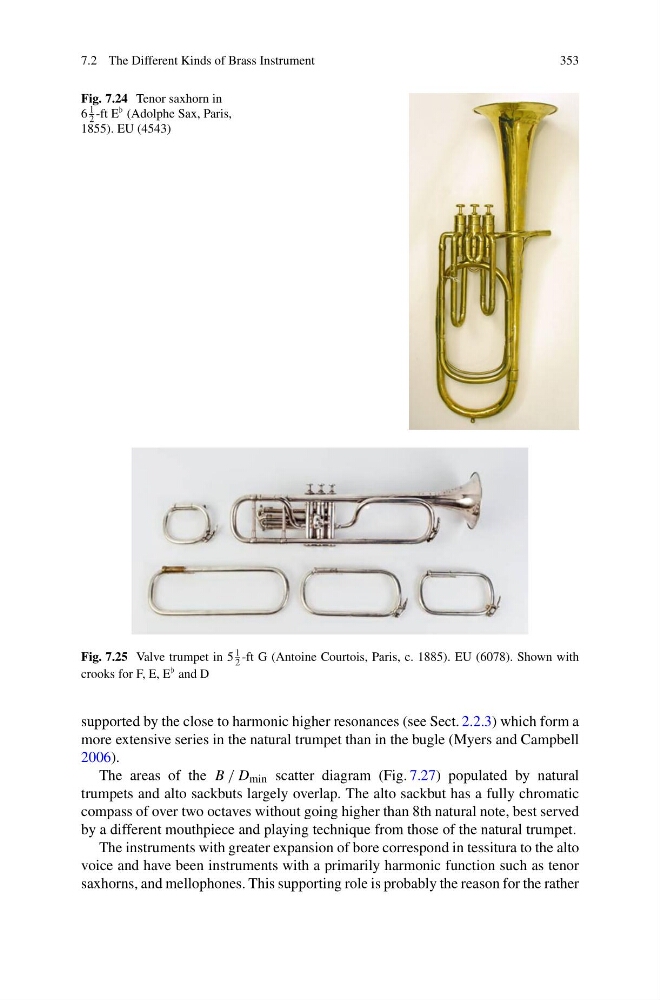
Fig. 7.24 Tenor saxhorn in
6
1
2 -ft E (Adolphe Sax, Paris,
1855). EU (4543)
Fig. 7.25 Valve trumpet in 5
1
2 -ft G (Antoine Courtois, Paris, c. 1885). EU (6078). Shown with
crooks for F, E, E and D
supported by the close to harmonic higher resonances (see Sect. 2.2.3) which form a
more extensive series in the natural trumpet than in the bugle (Myers and Campbell
2006).
The areas of the B / D min scatter diagram (Fig. 7.27) populated by natural
trumpets and alto sackbuts largely overlap. The alto sackbut has a fully chromatic
compass of over two octaves without going higher than 8th natural note, best served
by a different mouthpiece and playing technique from those of the natural trumpet.
The instruments with greater expansion of bore correspond in tessitura to the alto
voice and have been instruments with a primarily harmonic function such as tenor
saxhorns, and mellophones. This supporting role is probably the reason for the rather
353
Fig. 7.24 Tenor saxhorn in
6
1
2 -ft E (Adolphe Sax, Paris,
1855). EU (4543)
Fig. 7.25 Valve trumpet in 5
1
2 -ft G (Antoine Courtois, Paris, c. 1885). EU (6078). Shown with
crooks for F, E, E and D
supported by the close to harmonic higher resonances (see Sect. 2.2.3) which form a
more extensive series in the natural trumpet than in the bugle (Myers and Campbell
2006).
The areas of the B / D min scatter diagram (Fig. 7.27) populated by natural
trumpets and alto sackbuts largely overlap. The alto sackbut has a fully chromatic
compass of over two octaves without going higher than 8th natural note, best served
by a different mouthpiece and playing technique from those of the natural trumpet.
The instruments with greater expansion of bore correspond in tessitura to the alto
voice and have been instruments with a primarily harmonic function such as tenor
saxhorns, and mellophones. This supporting role is probably the reason for the rather