

7.2 The Different Kinds of Brass Instrument
351
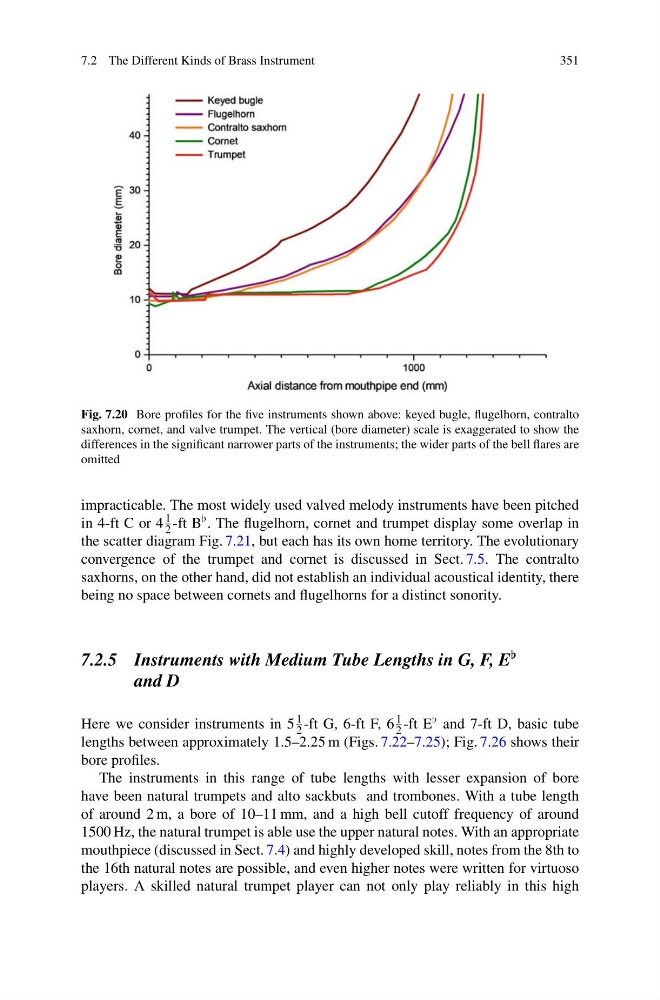
Fig. 7.20 Bore profiles for the five instruments shown above: keyed bugle, flugelhorn, contralto
saxhorn, cornet, and valve trumpet. The vertical (bore diameter) scale is exaggerated to show the
differences in the significant narrower parts of the instruments; the wider parts of the bell flares are
omitted
impracticable. The most widely used valved melody instruments have been pitched
in 4-ft C or 4
1
2 -ft B . The flugelhorn, cornet and trumpet display some overlap in
the scatter diagram Fig. 7.21, but each has its own home territory. The evolutionary
convergence of the trumpet and cornet is discussed in Sect. 7.5. The contralto
saxhorns, on the other hand, did not establish an individual acoustical identity, there
being no space between cornets and flugelhorns for a distinct sonority.
7.2.5 Instruments with Medium Tube Lengths in G, F, E
and D
Here we consider instruments in 5
1
2 -ft G, 6-ft F, 6
1
2 -ft E and 7-ft D, basic tube
lengths between approximately 1.5–2.25 m (Figs. 7.22–7.25); Fig. 7.26 shows their
bore profiles.
The instruments in this range of tube lengths with lesser expansion of bore
have been natural trumpets and alto sackbuts and trombones. With a tube length
of around 2 m, a bore of 10–11 mm, and a high bell cutoff frequency of around
1500 Hz, the natural trumpet is able use the upper natural notes. With an appropriate
mouthpiece (discussed in Sect. 7.4) and highly developed skill, notes from the 8th to
the 16th natural notes are possible, and even higher notes were written for virtuoso
players. A skilled natural trumpet player can not only play reliably in this high
351
Fig. 7.20 Bore profiles for the five instruments shown above: keyed bugle, flugelhorn, contralto
saxhorn, cornet, and valve trumpet. The vertical (bore diameter) scale is exaggerated to show the
differences in the significant narrower parts of the instruments; the wider parts of the bell flares are
omitted
impracticable. The most widely used valved melody instruments have been pitched
in 4-ft C or 4
1
2 -ft B . The flugelhorn, cornet and trumpet display some overlap in
the scatter diagram Fig. 7.21, but each has its own home territory. The evolutionary
convergence of the trumpet and cornet is discussed in Sect. 7.5. The contralto
saxhorns, on the other hand, did not establish an individual acoustical identity, there
being no space between cornets and flugelhorns for a distinct sonority.
7.2.5 Instruments with Medium Tube Lengths in G, F, E
and D
Here we consider instruments in 5
1
2 -ft G, 6-ft F, 6
1
2 -ft E and 7-ft D, basic tube
lengths between approximately 1.5–2.25 m (Figs. 7.22–7.25); Fig. 7.26 shows their
bore profiles.
The instruments in this range of tube lengths with lesser expansion of bore
have been natural trumpets and alto sackbuts and trombones. With a tube length
of around 2 m, a bore of 10–11 mm, and a high bell cutoff frequency of around
1500 Hz, the natural trumpet is able use the upper natural notes. With an appropriate
mouthpiece (discussed in Sect. 7.4) and highly developed skill, notes from the 8th to
the 16th natural notes are possible, and even higher notes were written for virtuoso
players. A skilled natural trumpet player can not only play reliably in this high