

6.6 The Influence of Wall Material on Brass Instrument Performance
325
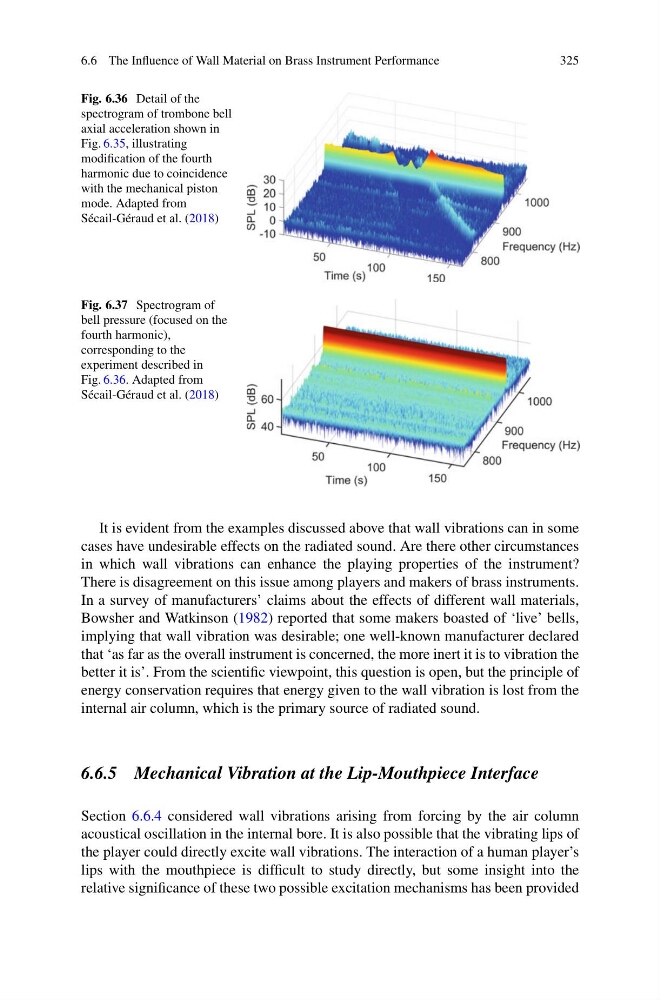
Fig. 6.36 Detail of the
spectrogram of trombone bell
axial acceleration shown in
Fig. 6.35, illustrating
modification of the fourth
harmonic due to coincidence
with the mechanical piston
mode. Adapted from
Sécail-Géraud et al. (2018)
Fig. 6.37 Spectrogram of
bell pressure (focused on the
fourth harmonic),
corresponding to the
experiment described in
Fig. 6.36. Adapted from
Sécail-Géraud et al. (2018)
It is evident from the examples discussed above that wall vibrations can in some
cases have undesirable effects on the radiated sound. Are there other circumstances
in which wall vibrations can enhance the playing properties of the instrument?
There is disagreement on this issue among players and makers of brass instruments.
In a survey of manufacturers’ claims about the effects of different wall materials,
Bowsher and Watkinson (1982) reported that some makers boasted of ‘live’ bells,
implying that wall vibration was desirable; one well-known manufacturer declared
that ‘as far as the overall instrument is concerned, the more inert it is to vibration the
better it is’. From the scientific viewpoint, this question is open, but the principle of
energy conservation requires that energy given to the wall vibration is lost from the
internal air column, which is the primary source of radiated sound.
6.6.5 Mechanical Vibration at the Lip-Mouthpiece Interface
Section 6.6.4 considered wall vibrations arising from forcing by the air column
acoustical oscillation in the internal bore. It is also possible that the vibrating lips of
the player could directly excite wall vibrations. The interaction of a human player’s
lips with the mouthpiece is difficult to study directly, but some insight into the
relative significance of these two possible excitation mechanisms has been provided
325
Fig. 6.36 Detail of the
spectrogram of trombone bell
axial acceleration shown in
Fig. 6.35, illustrating
modification of the fourth
harmonic due to coincidence
with the mechanical piston
mode. Adapted from
Sécail-Géraud et al. (2018)
Fig. 6.37 Spectrogram of
bell pressure (focused on the
fourth harmonic),
corresponding to the
experiment described in
Fig. 6.36. Adapted from
Sécail-Géraud et al. (2018)
It is evident from the examples discussed above that wall vibrations can in some
cases have undesirable effects on the radiated sound. Are there other circumstances
in which wall vibrations can enhance the playing properties of the instrument?
There is disagreement on this issue among players and makers of brass instruments.
In a survey of manufacturers’ claims about the effects of different wall materials,
Bowsher and Watkinson (1982) reported that some makers boasted of ‘live’ bells,
implying that wall vibration was desirable; one well-known manufacturer declared
that ‘as far as the overall instrument is concerned, the more inert it is to vibration the
better it is’. From the scientific viewpoint, this question is open, but the principle of
energy conservation requires that energy given to the wall vibration is lost from the
internal air column, which is the primary source of radiated sound.
6.6.5 Mechanical Vibration at the Lip-Mouthpiece Interface
Section 6.6.4 considered wall vibrations arising from forcing by the air column
acoustical oscillation in the internal bore. It is also possible that the vibrating lips of
the player could directly excite wall vibrations. The interaction of a human player’s
lips with the mouthpiece is difficult to study directly, but some insight into the
relative significance of these two possible excitation mechanisms has been provided