

6.6 The Influence of Wall Material on Brass Instrument Performance
323
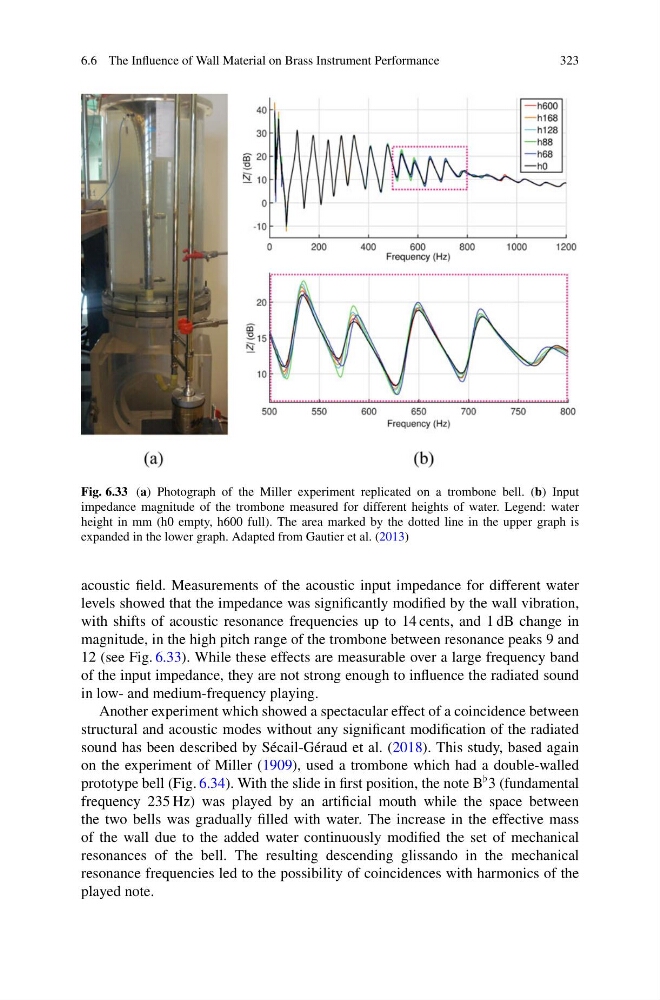
Fig. 6.33 (a) Photograph of the Miller experiment replicated on a trombone bell. (b) Input
impedance magnitude of the trombone measured for different heights of water. Legend: water
height in mm (h0 empty, h600 full). The area marked by the dotted line in the upper graph is
expanded in the lower graph. Adapted from Gautier et al. (2013)
acoustic field. Measurements of the acoustic input impedance for different water
levels showed that the impedance was significantly modified by the wall vibration,
with shifts of acoustic resonance frequencies up to 14 cents, and 1 dB change in
magnitude, in the high pitch range of the trombone between resonance peaks 9 and
12 (see Fig. 6.33). While these effects are measurable over a large frequency band
of the input impedance, they are not strong enough to influence the radiated sound
in low- and medium-frequency playing.
Another experiment which showed a spectacular effect of a coincidence between
structural and acoustic modes without any significant modification of the radiated
sound has been described by Sécail-Géraud et al. (2018). This study, based again
on the experiment of Miller (1909), used a trombone which had a double-walled
prototype bell (Fig. 6.34). With the slide in first position, the note B 3 (fundamental
frequency 235 Hz) was played by an artificial mouth while the space between
the two bells was gradually filled with water. The increase in the effective mass
of the wall due to the added water continuously modified the set of mechanical
resonances of the bell. The resulting descending glissando in the mechanical
resonance frequencies led to the possibility of coincidences with harmonics of the
played note.
323
Fig. 6.33 (a) Photograph of the Miller experiment replicated on a trombone bell. (b) Input
impedance magnitude of the trombone measured for different heights of water. Legend: water
height in mm (h0 empty, h600 full). The area marked by the dotted line in the upper graph is
expanded in the lower graph. Adapted from Gautier et al. (2013)
acoustic field. Measurements of the acoustic input impedance for different water
levels showed that the impedance was significantly modified by the wall vibration,
with shifts of acoustic resonance frequencies up to 14 cents, and 1 dB change in
magnitude, in the high pitch range of the trombone between resonance peaks 9 and
12 (see Fig. 6.33). While these effects are measurable over a large frequency band
of the input impedance, they are not strong enough to influence the radiated sound
in low- and medium-frequency playing.
Another experiment which showed a spectacular effect of a coincidence between
structural and acoustic modes without any significant modification of the radiated
sound has been described by Sécail-Géraud et al. (2018). This study, based again
on the experiment of Miller (1909), used a trombone which had a double-walled
prototype bell (Fig. 6.34). With the slide in first position, the note B 3 (fundamental
frequency 235 Hz) was played by an artificial mouth while the space between
the two bells was gradually filled with water. The increase in the effective mass
of the wall due to the added water continuously modified the set of mechanical
resonances of the bell. The resulting descending glissando in the mechanical
resonance frequencies led to the possibility of coincidences with harmonics of the
played note.