

6.6 The Influence of Wall Material on Brass Instrument Performance
319
30
20
10
0
-10
-20
-30
0
500
1000
1500
2000
2500
Frequency (Hz)
20 log(|Z|/Zc)
20 log(|Z|/Zc)
30
25
20
15
10
5
0
-5
-10
1500
1600
1700
1800
1900
2000
Frequency (Hz)
(a)
(b)
30
20
10
0
-10
-20
-30
0
500
1000
1500
2000
2500
Frequency (Hz)
20 log(|Z|/Zc)
1500
1600
1700
1800
1900
2000
Frequency (Hz)
20 log(|Z|/Zc)
25
20
15
10
5
0
-5
-10
-15
(2,2,0)
(2,1,0)
(2,2,1)
(2,1,1)
(2,3,0)(2,3,1)
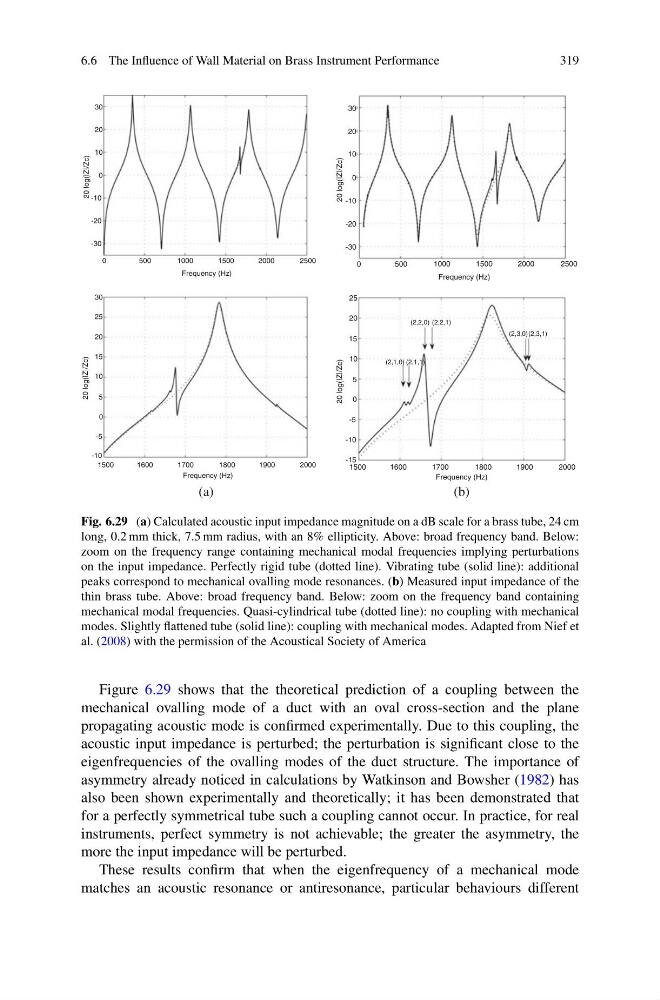
Fig. 6.29 (a) Calculated acoustic input impedance magnitude on a dB scale for a brass tube, 24 cm
long, 0.2 mm thick, 7.5 mm radius, with an 8% ellipticity. Above: broad frequency band. Below:
zoom on the frequency range containing mechanical modal frequencies implying perturbations
on the input impedance. Perfectly rigid tube (dotted line). Vibrating tube (solid line): additional
peaks correspond to mechanical ovalling mode resonances. (b) Measured input impedance of the
thin brass tube. Above: broad frequency band. Below: zoom on the frequency band containing
mechanical modal frequencies. Quasi-cylindrical tube (dotted line): no coupling with mechanical
modes. Slightly flattened tube (solid line): coupling with mechanical modes. Adapted from Nief et
al. (2008) with the permission of the Acoustical Society of America
Figure 6.29 shows that the theoretical prediction of a coupling between the
mechanical ovalling mode of a duct with an oval cross-section and the plane
propagating acoustic mode is confirmed experimentally. Due to this coupling, the
acoustic input impedance is perturbed; the perturbation is significant close to the
eigenfrequencies of the ovalling modes of the duct structure. The importance of
asymmetry already noticed in calculations by Watkinson and Bowsher (1982) has
also been shown experimentally and theoretically; it has been demonstrated that
for a perfectly symmetrical tube such a coupling cannot occur. In practice, for real
instruments, perfect symmetry is not achievable; the greater the asymmetry, the
more the input impedance will be perturbed.
These results confirm that when the eigenfrequency of a mechanical mode
matches an acoustic resonance or antiresonance, particular behaviours different
319
30
20
10
0
-10
-20
-30
0
500
1000
1500
2000
2500
Frequency (Hz)
20 log(|Z|/Zc)
20 log(|Z|/Zc)
30
25
20
15
10
5
0
-5
-10
1500
1600
1700
1800
1900
2000
Frequency (Hz)
(a)
(b)
30
20
10
0
-10
-20
-30
0
500
1000
1500
2000
2500
Frequency (Hz)
20 log(|Z|/Zc)
1500
1600
1700
1800
1900
2000
Frequency (Hz)
20 log(|Z|/Zc)
25
20
15
10
5
0
-5
-10
-15
(2,2,0)
(2,1,0)
(2,2,1)
(2,1,1)
(2,3,0)(2,3,1)
Fig. 6.29 (a) Calculated acoustic input impedance magnitude on a dB scale for a brass tube, 24 cm
long, 0.2 mm thick, 7.5 mm radius, with an 8% ellipticity. Above: broad frequency band. Below:
zoom on the frequency range containing mechanical modal frequencies implying perturbations
on the input impedance. Perfectly rigid tube (dotted line). Vibrating tube (solid line): additional
peaks correspond to mechanical ovalling mode resonances. (b) Measured input impedance of the
thin brass tube. Above: broad frequency band. Below: zoom on the frequency band containing
mechanical modal frequencies. Quasi-cylindrical tube (dotted line): no coupling with mechanical
modes. Slightly flattened tube (solid line): coupling with mechanical modes. Adapted from Nief et
al. (2008) with the permission of the Acoustical Society of America
Figure 6.29 shows that the theoretical prediction of a coupling between the
mechanical ovalling mode of a duct with an oval cross-section and the plane
propagating acoustic mode is confirmed experimentally. Due to this coupling, the
acoustic input impedance is perturbed; the perturbation is significant close to the
eigenfrequencies of the ovalling modes of the duct structure. The importance of
asymmetry already noticed in calculations by Watkinson and Bowsher (1982) has
also been shown experimentally and theoretically; it has been demonstrated that
for a perfectly symmetrical tube such a coupling cannot occur. In practice, for real
instruments, perfect symmetry is not achievable; the greater the asymmetry, the
more the input impedance will be perturbed.
These results confirm that when the eigenfrequency of a mechanical mode
matches an acoustic resonance or antiresonance, particular behaviours different