

318
6 Shocks and Surprises: Refining the Elementary Model
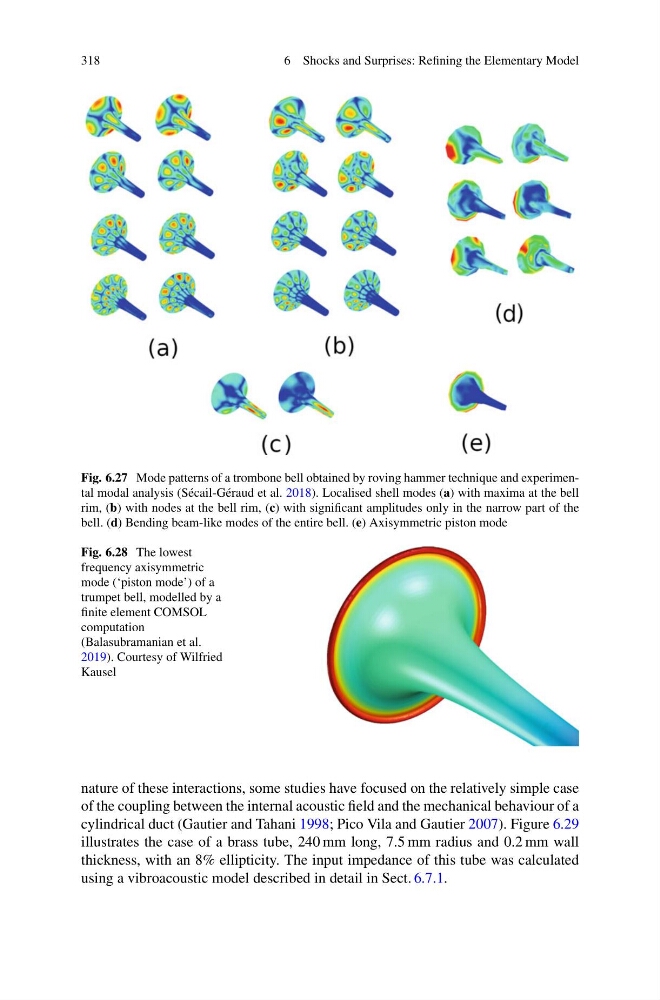
Fig. 6.27 Mode patterns of a trombone bell obtained by roving hammer technique and experimental modal analysis (Sécail-Géraud et al. 2018). Localised shell modes (a) with maxima at the bell
rim, (b) with nodes at the bell rim, (c) with significant amplitudes only in the narrow part of the
bell. (d) Bending beam-like modes of the entire bell. (e) Axisymmetric piston mode
Fig. 6.28 The lowest
frequency axisymmetric
mode (‘piston mode’) of a
trumpet bell, modelled by a
finite element COMSOL
computation
(Balasubramanian et al.
2019). Courtesy of Wilfried
Kausel
nature of these interactions, some studies have focused on the relatively simple case
of the coupling between the internal acoustic field and the mechanical behaviour of a
cylindrical duct (Gautier and Tahani 1998; Pico Vila and Gautier 2007). Figure 6.29
illustrates the case of a brass tube, 240 mm long, 7.5 mm radius and 0.2 mm wall
thickness, with an 8% ellipticity. The input impedance of this tube was calculated
using a vibroacoustic model described in detail in Sect. 6.7.1.
6 Shocks and Surprises: Refining the Elementary Model
Fig. 6.27 Mode patterns of a trombone bell obtained by roving hammer technique and experimental modal analysis (Sécail-Géraud et al. 2018). Localised shell modes (a) with maxima at the bell
rim, (b) with nodes at the bell rim, (c) with significant amplitudes only in the narrow part of the
bell. (d) Bending beam-like modes of the entire bell. (e) Axisymmetric piston mode
Fig. 6.28 The lowest
frequency axisymmetric
mode (‘piston mode’) of a
trumpet bell, modelled by a
finite element COMSOL
computation
(Balasubramanian et al.
2019). Courtesy of Wilfried
Kausel
nature of these interactions, some studies have focused on the relatively simple case
of the coupling between the internal acoustic field and the mechanical behaviour of a
cylindrical duct (Gautier and Tahani 1998; Pico Vila and Gautier 2007). Figure 6.29
illustrates the case of a brass tube, 240 mm long, 7.5 mm radius and 0.2 mm wall
thickness, with an 8% ellipticity. The input impedance of this tube was calculated
using a vibroacoustic model described in detail in Sect. 6.7.1.