

6.4 Improving the Lip Model
305
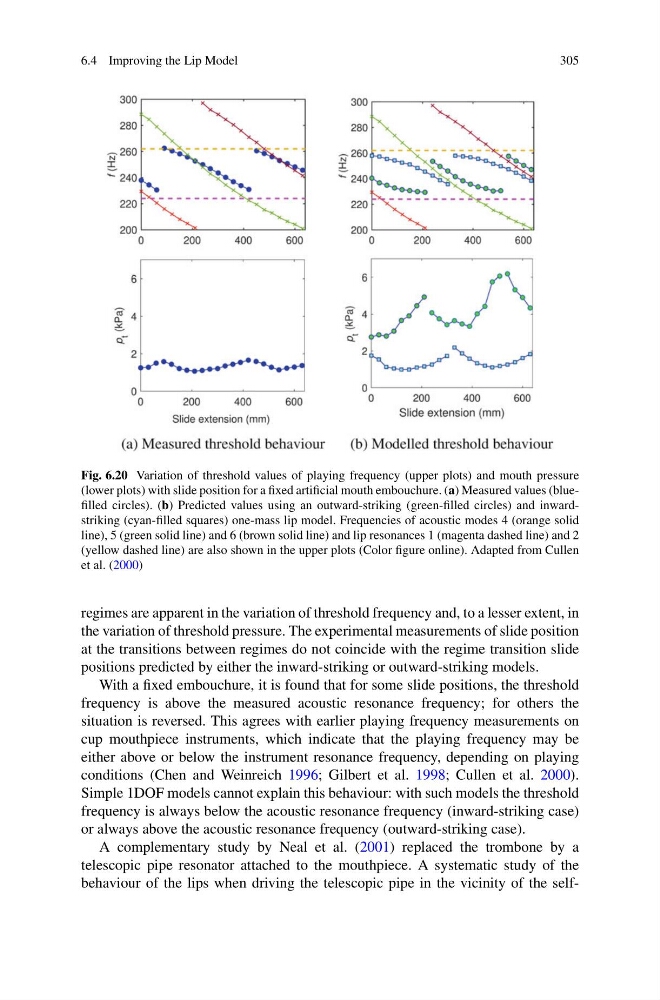
Fig. 6.20 Variation of threshold values of playing frequency (upper plots) and mouth pressure
(lower plots) with slide position for a fixed artificial mouth embouchure. (a) Measured values (bluefilled circles). (b) Predicted values using an outward-striking (green-filled circles) and inwardstriking (cyan-filled squares) one-mass lip model. Frequencies of acoustic modes 4 (orange solid
line), 5 (green solid line) and 6 (brown solid line) and lip resonances 1 (magenta dashed line) and 2
(yellow dashed line) are also shown in the upper plots (Color figure online). Adapted from Cullen
et al. (2000)
regimes are apparent in the variation of threshold frequency and, to a lesser extent, in
the variation of threshold pressure. The experimental measurements of slide position
at the transitions between regimes do not coincide with the regime transition slide
positions predicted by either the inward-striking or outward-striking models.
With a fixed embouchure, it is found that for some slide positions, the threshold
frequency is above the measured acoustic resonance frequency; for others the
situation is reversed. This agrees with earlier playing frequency measurements on
cup mouthpiece instruments, which indicate that the playing frequency may be
either above or below the instrument resonance frequency, depending on playing
conditions (Chen and Weinreich 1996; Gilbert et al. 1998; Cullen et al. 2000).
Simple 1DOF models cannot explain this behaviour: with such models the threshold
frequency is always below the acoustic resonance frequency (inward-striking case)
or always above the acoustic resonance frequency (outward-striking case).
A complementary study by Neal et al. (2001) replaced the trombone by a
telescopic pipe resonator attached to the mouthpiece. A systematic study of the
behaviour of the lips when driving the telescopic pipe in the vicinity of the self-
305
Fig. 6.20 Variation of threshold values of playing frequency (upper plots) and mouth pressure
(lower plots) with slide position for a fixed artificial mouth embouchure. (a) Measured values (bluefilled circles). (b) Predicted values using an outward-striking (green-filled circles) and inwardstriking (cyan-filled squares) one-mass lip model. Frequencies of acoustic modes 4 (orange solid
line), 5 (green solid line) and 6 (brown solid line) and lip resonances 1 (magenta dashed line) and 2
(yellow dashed line) are also shown in the upper plots (Color figure online). Adapted from Cullen
et al. (2000)
regimes are apparent in the variation of threshold frequency and, to a lesser extent, in
the variation of threshold pressure. The experimental measurements of slide position
at the transitions between regimes do not coincide with the regime transition slide
positions predicted by either the inward-striking or outward-striking models.
With a fixed embouchure, it is found that for some slide positions, the threshold
frequency is above the measured acoustic resonance frequency; for others the
situation is reversed. This agrees with earlier playing frequency measurements on
cup mouthpiece instruments, which indicate that the playing frequency may be
either above or below the instrument resonance frequency, depending on playing
conditions (Chen and Weinreich 1996; Gilbert et al. 1998; Cullen et al. 2000).
Simple 1DOF models cannot explain this behaviour: with such models the threshold
frequency is always below the acoustic resonance frequency (inward-striking case)
or always above the acoustic resonance frequency (outward-striking case).
A complementary study by Neal et al. (2001) replaced the trombone by a
telescopic pipe resonator attached to the mouthpiece. A systematic study of the
behaviour of the lips when driving the telescopic pipe in the vicinity of the self-