

6.2 Going Further: Nonlinear Propagation
293
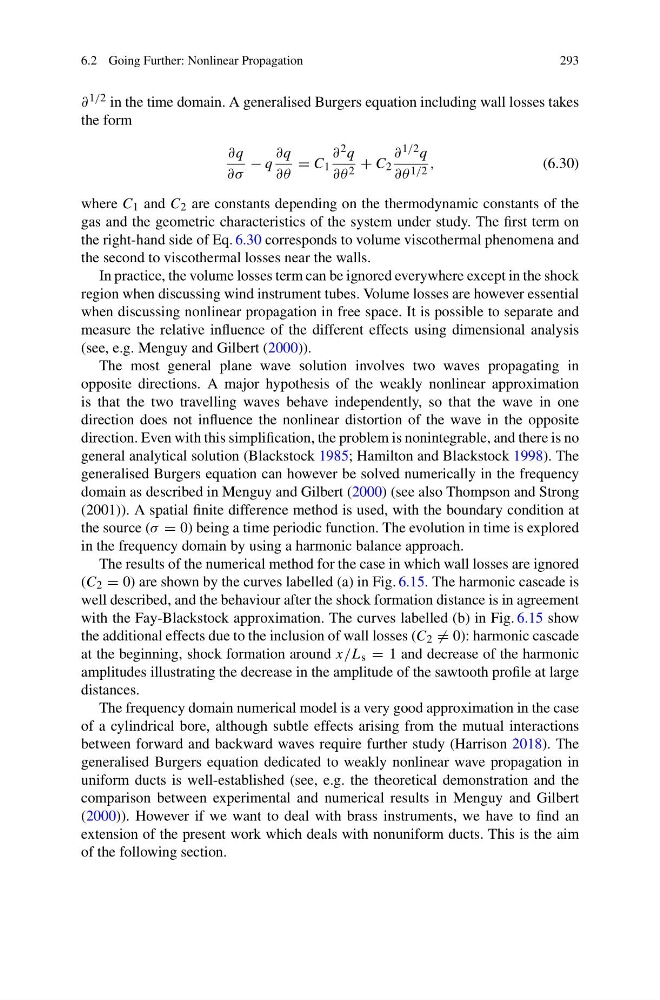
∂ 1/2 in the time domain. A generalised Burgers equation including wall losses takes
the form
∂q
∂σ
− q
∂q
∂θ
= C 1
∂ 2 q
∂θ 2 + C 2
∂ 1/2 q
∂θ 1/2 ,
(6.30)
where C 1 and C 2 are constants depending on the thermodynamic constants of the
gas and the geometric characteristics of the system under study. The first term on
the right-hand side of Eq. 6.30 corresponds to volume viscothermal phenomena and
the second to viscothermal losses near the walls.
In practice, the volume losses term can be ignored everywhere except in the shock
region when discussing wind instrument tubes. Volume losses are however essential
when discussing nonlinear propagation in free space. It is possible to separate and
measure the relative influence of the different effects using dimensional analysis
(see, e.g. Menguy and Gilbert (2000)).
The most general plane wave solution involves two waves propagating in
opposite directions. A major hypothesis of the weakly nonlinear approximation
is that the two travelling waves behave independently, so that the wave in one
direction does not influence the nonlinear distortion of the wave in the opposite
direction. Even with this simplification, the problem is nonintegrable, and there is no
general analytical solution (Blackstock 1985; Hamilton and Blackstock 1998). The
generalised Burgers equation can however be solved numerically in the frequency
domain as described in Menguy and Gilbert (2000) (see also Thompson and Strong
(2001)). A spatial finite difference method is used, with the boundary condition at
the source (σ = 0) being a time periodic function. The evolution in time is explored
in the frequency domain by using a harmonic balance approach.
The results of the numerical method for the case in which wall losses are ignored
(C 2 = 0) are shown by the curves labelled (a) in Fig. 6.15. The harmonic cascade is
well described, and the behaviour after the shock formation distance is in agreement
with the Fay-Blackstock approximation. The curves labelled (b) in Fig. 6.15 show
the additional effects due to the inclusion of wall losses (C 2 = 0): harmonic cascade
at the beginning, shock formation around x/L s = 1 and decrease of the harmonic
amplitudes illustrating the decrease in the amplitude of the sawtooth profile at large
distances.
The frequency domain numerical model is a very good approximation in the case
of a cylindrical bore, although subtle effects arising from the mutual interactions
between forward and backward waves require further study (Harrison 2018). The
generalised Burgers equation dedicated to weakly nonlinear wave propagation in
uniform ducts is well-established (see, e.g. the theoretical demonstration and the
comparison between experimental and numerical results in Menguy and Gilbert
(2000)). However if we want to deal with brass instruments, we have to find an
extension of the present work which deals with nonuniform ducts. This is the aim
of the following section.
293
∂ 1/2 in the time domain. A generalised Burgers equation including wall losses takes
the form
∂q
∂σ
− q
∂q
∂θ
= C 1
∂ 2 q
∂θ 2 + C 2
∂ 1/2 q
∂θ 1/2 ,
(6.30)
where C 1 and C 2 are constants depending on the thermodynamic constants of the
gas and the geometric characteristics of the system under study. The first term on
the right-hand side of Eq. 6.30 corresponds to volume viscothermal phenomena and
the second to viscothermal losses near the walls.
In practice, the volume losses term can be ignored everywhere except in the shock
region when discussing wind instrument tubes. Volume losses are however essential
when discussing nonlinear propagation in free space. It is possible to separate and
measure the relative influence of the different effects using dimensional analysis
(see, e.g. Menguy and Gilbert (2000)).
The most general plane wave solution involves two waves propagating in
opposite directions. A major hypothesis of the weakly nonlinear approximation
is that the two travelling waves behave independently, so that the wave in one
direction does not influence the nonlinear distortion of the wave in the opposite
direction. Even with this simplification, the problem is nonintegrable, and there is no
general analytical solution (Blackstock 1985; Hamilton and Blackstock 1998). The
generalised Burgers equation can however be solved numerically in the frequency
domain as described in Menguy and Gilbert (2000) (see also Thompson and Strong
(2001)). A spatial finite difference method is used, with the boundary condition at
the source (σ = 0) being a time periodic function. The evolution in time is explored
in the frequency domain by using a harmonic balance approach.
The results of the numerical method for the case in which wall losses are ignored
(C 2 = 0) are shown by the curves labelled (a) in Fig. 6.15. The harmonic cascade is
well described, and the behaviour after the shock formation distance is in agreement
with the Fay-Blackstock approximation. The curves labelled (b) in Fig. 6.15 show
the additional effects due to the inclusion of wall losses (C 2 = 0): harmonic cascade
at the beginning, shock formation around x/L s = 1 and decrease of the harmonic
amplitudes illustrating the decrease in the amplitude of the sawtooth profile at large
distances.
The frequency domain numerical model is a very good approximation in the case
of a cylindrical bore, although subtle effects arising from the mutual interactions
between forward and backward waves require further study (Harrison 2018). The
generalised Burgers equation dedicated to weakly nonlinear wave propagation in
uniform ducts is well-established (see, e.g. the theoretical demonstration and the
comparison between experimental and numerical results in Menguy and Gilbert
(2000)). However if we want to deal with brass instruments, we have to find an
extension of the present work which deals with nonuniform ducts. This is the aim
of the following section.