

6.1 Why Brass Instruments Sound Brassy
281
As the sound energy spreads across the increasing cross-section of this outwardly
flaring horn, the particle velocity decreases. If we neglect losses within the horn and
assume that the sound energy is spread uniformly across the tube, conservation of
energy leads to
v(x)
v min
=
D min
D(x)
,
(6.4)
where D min and v min are D(x) and v(x) at a reference point. For an entire brass
instrument, the reference point is defined to be the point near the input end where
the diameter of the instrument is minimum. This is not at the input end, which forms
the mouthpiece receiver, but (usually) just beyond the point where the mouthpiece
stem ends when the mouthpiece is inserted into the instrument.
According to Eq. 6.1, the rate of nonlinear distortion of the wave depends on the
value of the particle velocity v. The maximum rate of distortion will occur at the
point of minimum diameter, where the particle velocity has its largest value v min .
Substituting the value of v(x) derived from Eq. 6.4 in 6.1 gives an expression for
the speed of travel of a given point on the wave at a distance x along the bore:
dx
dt
= c 0 +
γ + 1
2
D min
D(x)
v min .
(6.5)
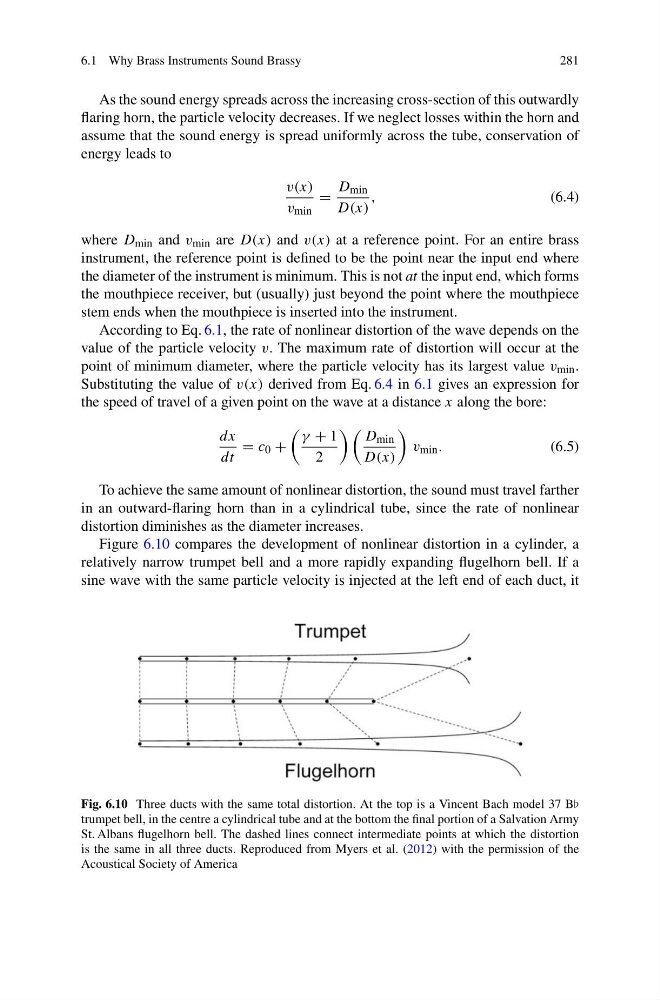
To achieve the same amount of nonlinear distortion, the sound must travel farther
in an outward-flaring horn than in a cylindrical tube, since the rate of nonlinear
distortion diminishes as the diameter increases.
Figure 6.10 compares the development of nonlinear distortion in a cylinder, a
relatively narrow trumpet bell and a more rapidly expanding flugelhorn bell. If a
sine wave with the same particle velocity is injected at the left end of each duct, it
Fig. 6.10 Three ducts with the same total distortion. At the top is a Vincent Bach model 37 B
trumpet bell, in the centre a cylindrical tube and at the bottom the final portion of a Salvation Army
St. Albans flugelhorn bell. The dashed lines connect intermediate points at which the distortion
is the same in all three ducts. Reproduced from Myers et al. (2012) with the permission of the
Acoustical Society of America
281
As the sound energy spreads across the increasing cross-section of this outwardly
flaring horn, the particle velocity decreases. If we neglect losses within the horn and
assume that the sound energy is spread uniformly across the tube, conservation of
energy leads to
v(x)
v min
=
D min
D(x)
,
(6.4)
where D min and v min are D(x) and v(x) at a reference point. For an entire brass
instrument, the reference point is defined to be the point near the input end where
the diameter of the instrument is minimum. This is not at the input end, which forms
the mouthpiece receiver, but (usually) just beyond the point where the mouthpiece
stem ends when the mouthpiece is inserted into the instrument.
According to Eq. 6.1, the rate of nonlinear distortion of the wave depends on the
value of the particle velocity v. The maximum rate of distortion will occur at the
point of minimum diameter, where the particle velocity has its largest value v min .
Substituting the value of v(x) derived from Eq. 6.4 in 6.1 gives an expression for
the speed of travel of a given point on the wave at a distance x along the bore:
dx
dt
= c 0 +
γ + 1
2
D min
D(x)
v min .
(6.5)
To achieve the same amount of nonlinear distortion, the sound must travel farther
in an outward-flaring horn than in a cylindrical tube, since the rate of nonlinear
distortion diminishes as the diameter increases.
Figure 6.10 compares the development of nonlinear distortion in a cylinder, a
relatively narrow trumpet bell and a more rapidly expanding flugelhorn bell. If a
sine wave with the same particle velocity is injected at the left end of each duct, it
Fig. 6.10 Three ducts with the same total distortion. At the top is a Vincent Bach model 37 B
trumpet bell, in the centre a cylindrical tube and at the bottom the final portion of a Salvation Army
St. Albans flugelhorn bell. The dashed lines connect intermediate points at which the distortion
is the same in all three ducts. Reproduced from Myers et al. (2012) with the permission of the
Acoustical Society of America