

280
6 Shocks and Surprises: Refining the Elementary Model
pp and mf, the brightness increases with dynamic level, but this is mainly due to the
nonlinear behaviour of the lip valve (see Chap. 3). At high dynamic level (ff ), L s is
shorter than L and the sound cannot be other than brassy. At intermediate dynamic
level (mf or f ), the brightness of the sound is mainly due to the effect of nonlinear
propagation: even if the shock waves are not fully developed in the tube, the sound is
already significantly affected by wave steepening. At these intermediate dynamics,
the player can slightly control the sound brightness by controlling the shape of the
input pressure waveform (Norman et al. 2010).
The shock length formation distance L s is theoretically derived from nonlinear
propagation in cylindrical pipes. If the guide is nonuniform, as it is in all realistic
brass instruments, nonlinear propagation is present, but its effect is reduced as
the cross-sectional area of the tube increases. By quantifying the relationship
between the bore profile of an instrument and its relative susceptibility to nonlinear
propagation, it is possible to use this property in order to classify brass instruments
(Myers et al. 2012). An approach along these lines is described in Sect. 6.1.4.
6.1.4 The Brassiness Potential Parameter
The relative importance of spectral enrichment due to nonlinear propagation in brass
instruments with different bore profiles can be estimated using a brassiness potential
parameter B which can be calculated from the bore dimensions (Gilbert et al. 2007).
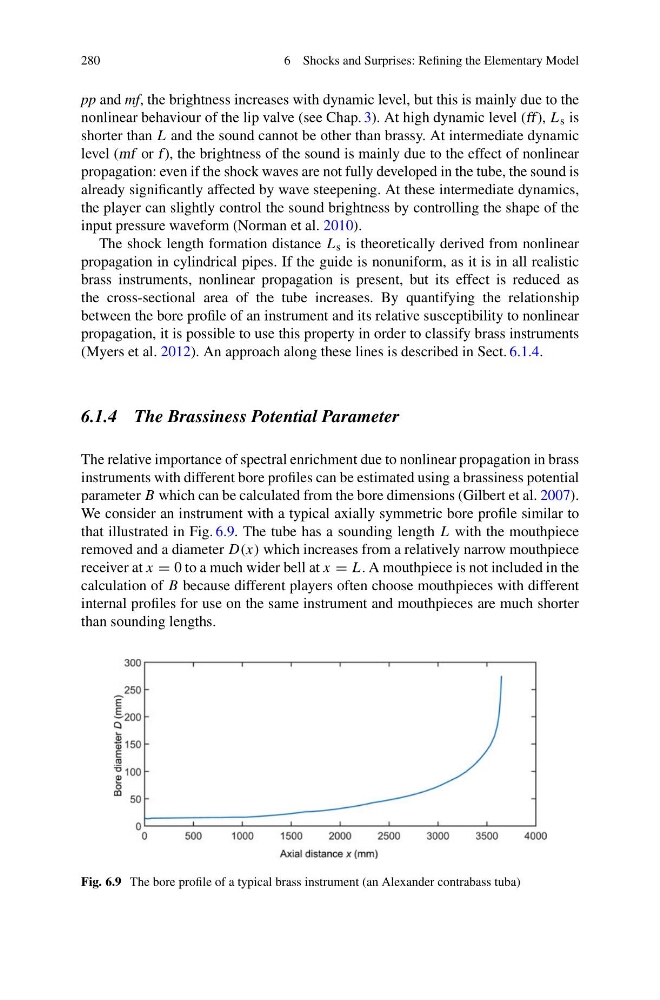
We consider an instrument with a typical axially symmetric bore profile similar to
that illustrated in Fig. 6.9. The tube has a sounding length L with the mouthpiece
removed and a diameter D(x) which increases from a relatively narrow mouthpiece
receiver at x = 0 to a much wider bell at x = L. A mouthpiece is not included in the
calculation of B because different players often choose mouthpieces with different
internal profiles for use on the same instrument and mouthpieces are much shorter
than sounding lengths.
Fig. 6.9 The bore profile of a typical brass instrument (an Alexander contrabass tuba)
6 Shocks and Surprises: Refining the Elementary Model
pp and mf, the brightness increases with dynamic level, but this is mainly due to the
nonlinear behaviour of the lip valve (see Chap. 3). At high dynamic level (ff ), L s is
shorter than L and the sound cannot be other than brassy. At intermediate dynamic
level (mf or f ), the brightness of the sound is mainly due to the effect of nonlinear
propagation: even if the shock waves are not fully developed in the tube, the sound is
already significantly affected by wave steepening. At these intermediate dynamics,
the player can slightly control the sound brightness by controlling the shape of the
input pressure waveform (Norman et al. 2010).
The shock length formation distance L s is theoretically derived from nonlinear
propagation in cylindrical pipes. If the guide is nonuniform, as it is in all realistic
brass instruments, nonlinear propagation is present, but its effect is reduced as
the cross-sectional area of the tube increases. By quantifying the relationship
between the bore profile of an instrument and its relative susceptibility to nonlinear
propagation, it is possible to use this property in order to classify brass instruments
(Myers et al. 2012). An approach along these lines is described in Sect. 6.1.4.
6.1.4 The Brassiness Potential Parameter
The relative importance of spectral enrichment due to nonlinear propagation in brass
instruments with different bore profiles can be estimated using a brassiness potential
parameter B which can be calculated from the bore dimensions (Gilbert et al. 2007).
We consider an instrument with a typical axially symmetric bore profile similar to
that illustrated in Fig. 6.9. The tube has a sounding length L with the mouthpiece
removed and a diameter D(x) which increases from a relatively narrow mouthpiece
receiver at x = 0 to a much wider bell at x = L. A mouthpiece is not included in the
calculation of B because different players often choose mouthpieces with different
internal profiles for use on the same instrument and mouthpieces are much shorter
than sounding lengths.
Fig. 6.9 The bore profile of a typical brass instrument (an Alexander contrabass tuba)