

6.1 Why Brass Instruments Sound Brassy
275
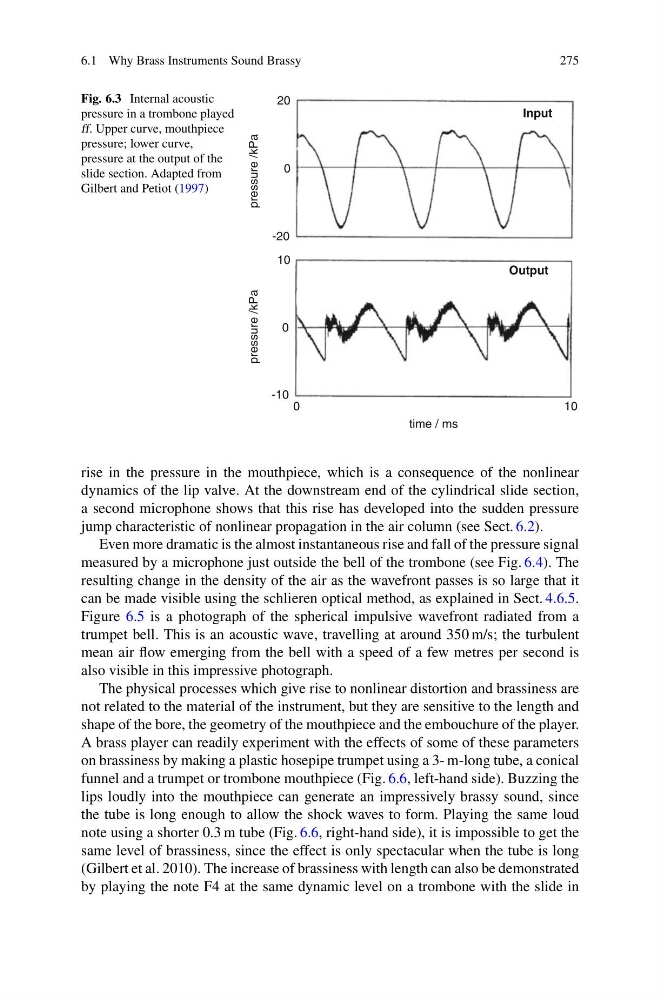
Fig. 6.3 Internal acoustic
pressure in a trombone played
ff. Upper curve, mouthpiece
pressure; lower curve,
pressure at the output of the
slide section. Adapted from
Gilbert and Petiot (1997)
Input
Output
pressure /kPa
20
0
-20
10
0
-10
pressure /kPa
0
1 0
time / ms
rise in the pressure in the mouthpiece, which is a consequence of the nonlinear
dynamics of the lip valve. At the downstream end of the cylindrical slide section,
a second microphone shows that this rise has developed into the sudden pressure
jump characteristic of nonlinear propagation in the air column (see Sect. 6.2).
Even more dramatic is the almost instantaneous rise and fall of the pressure signal
measured by a microphone just outside the bell of the trombone (see Fig. 6.4). The
resulting change in the density of the air as the wavefront passes is so large that it
can be made visible using the schlieren optical method, as explained in Sect. 4.6.5.
Figure 6.5 is a photograph of the spherical impulsive wavefront radiated from a
trumpet bell. This is an acoustic wave, travelling at around 350 m/s; the turbulent
mean air flow emerging from the bell with a speed of a few metres per second is
also visible in this impressive photograph.
The physical processes which give rise to nonlinear distortion and brassiness are
not related to the material of the instrument, but they are sensitive to the length and
shape of the bore, the geometry of the mouthpiece and the embouchure of the player.
A brass player can readily experiment with the effects of some of these parameters
on brassiness by making a plastic hosepipe trumpet using a 3- m-long tube, a conical
funnel and a trumpet or trombone mouthpiece (Fig. 6.6, left-hand side). Buzzing the
lips loudly into the mouthpiece can generate an impressively brassy sound, since
the tube is long enough to allow the shock waves to form. Playing the same loud
note using a shorter 0.3 m tube (Fig. 6.6, right-hand side), it is impossible to get the
same level of brassiness, since the effect is only spectacular when the tube is long
(Gilbert et al. 2010). The increase of brassiness with length can also be demonstrated
by playing the note F4 at the same dynamic level on a trombone with the slide in
275
Fig. 6.3 Internal acoustic
pressure in a trombone played
ff. Upper curve, mouthpiece
pressure; lower curve,
pressure at the output of the
slide section. Adapted from
Gilbert and Petiot (1997)
Input
Output
pressure /kPa
20
0
-20
10
0
-10
pressure /kPa
0
1 0
time / ms
rise in the pressure in the mouthpiece, which is a consequence of the nonlinear
dynamics of the lip valve. At the downstream end of the cylindrical slide section,
a second microphone shows that this rise has developed into the sudden pressure
jump characteristic of nonlinear propagation in the air column (see Sect. 6.2).
Even more dramatic is the almost instantaneous rise and fall of the pressure signal
measured by a microphone just outside the bell of the trombone (see Fig. 6.4). The
resulting change in the density of the air as the wavefront passes is so large that it
can be made visible using the schlieren optical method, as explained in Sect. 4.6.5.
Figure 6.5 is a photograph of the spherical impulsive wavefront radiated from a
trumpet bell. This is an acoustic wave, travelling at around 350 m/s; the turbulent
mean air flow emerging from the bell with a speed of a few metres per second is
also visible in this impressive photograph.
The physical processes which give rise to nonlinear distortion and brassiness are
not related to the material of the instrument, but they are sensitive to the length and
shape of the bore, the geometry of the mouthpiece and the embouchure of the player.
A brass player can readily experiment with the effects of some of these parameters
on brassiness by making a plastic hosepipe trumpet using a 3- m-long tube, a conical
funnel and a trumpet or trombone mouthpiece (Fig. 6.6, left-hand side). Buzzing the
lips loudly into the mouthpiece can generate an impressively brassy sound, since
the tube is long enough to allow the shock waves to form. Playing the same loud
note using a shorter 0.3 m tube (Fig. 6.6, right-hand side), it is impossible to get the
same level of brassiness, since the effect is only spectacular when the tube is long
(Gilbert et al. 2010). The increase of brassiness with length can also be demonstrated
by playing the note F4 at the same dynamic level on a trombone with the slide in