

6.1 Why Brass Instruments Sound Brassy
273
trumpets, trombones and french horns develop a brassy edge at much lower dynamic
levels than do bugles, euphoniums and tubas.
The dramatic possibilities of brassy timbre have been imaginatively exploited
by many composers, notably Gustav Mahler. Sometimes the player is specifically
instructed to ensure that the sound is brassy: the muted trumpet call which interrupts
the famous flugelhorn solo in the third movement of Mahler’s Third Symphony is
marked schnell und schmetterd wie ein Fanfare (‘fast and brassy like a fanfare’).
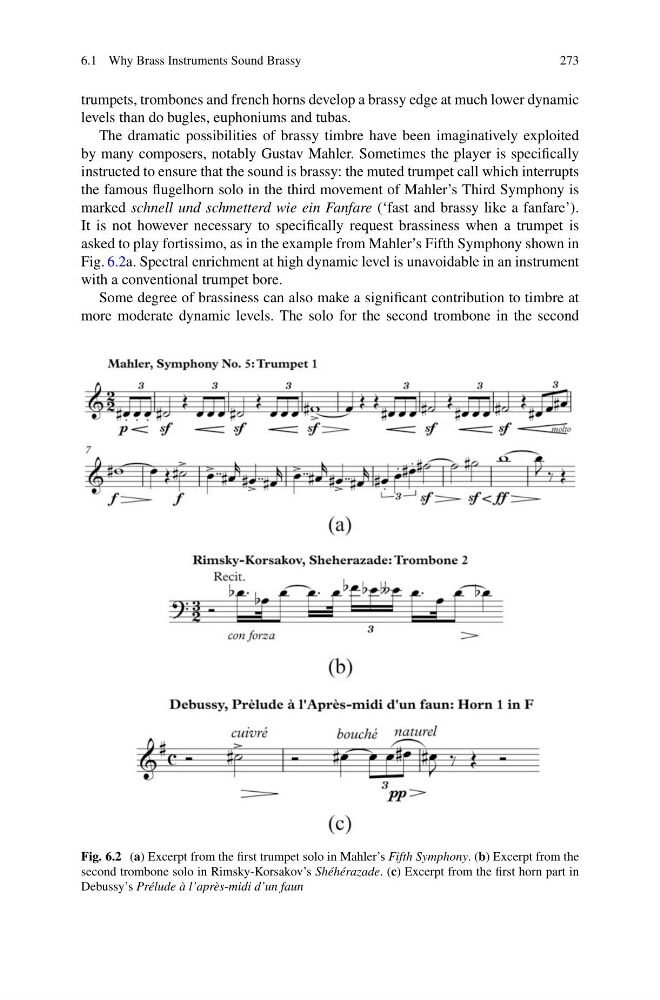
It is not however necessary to specifically request brassiness when a trumpet is
asked to play fortissimo, as in the example from Mahler’s Fifth Symphony shown in
Fig. 6.2a. Spectral enrichment at high dynamic level is unavoidable in an instrument
with a conventional trumpet bore.
Some degree of brassiness can also make a significant contribution to timbre at
more moderate dynamic levels. The solo for the second trombone in the second
Fig. 6.2 (a) Excerpt from the first trumpet solo in Mahler’s Fifth Symphony. (b) Excerpt from the
second trombone solo in Rimsky-Korsakov’s Shéhérazade. (c) Excerpt from the first horn part in
Debussy’s Prélude à l’après-midi d’un faun
273
trumpets, trombones and french horns develop a brassy edge at much lower dynamic
levels than do bugles, euphoniums and tubas.
The dramatic possibilities of brassy timbre have been imaginatively exploited
by many composers, notably Gustav Mahler. Sometimes the player is specifically
instructed to ensure that the sound is brassy: the muted trumpet call which interrupts
the famous flugelhorn solo in the third movement of Mahler’s Third Symphony is
marked schnell und schmetterd wie ein Fanfare (‘fast and brassy like a fanfare’).
It is not however necessary to specifically request brassiness when a trumpet is
asked to play fortissimo, as in the example from Mahler’s Fifth Symphony shown in
Fig. 6.2a. Spectral enrichment at high dynamic level is unavoidable in an instrument
with a conventional trumpet bore.
Some degree of brassiness can also make a significant contribution to timbre at
more moderate dynamic levels. The solo for the second trombone in the second
Fig. 6.2 (a) Excerpt from the first trumpet solo in Mahler’s Fifth Symphony. (b) Excerpt from the
second trombone solo in Rimsky-Korsakov’s Shéhérazade. (c) Excerpt from the first horn part in
Debussy’s Prélude à l’après-midi d’un faun