

272
6 Shocks and Surprises: Refining the Elementary Model
to classify different brass instruments (see Chap. 7). A more detailed explanation of
nonlinear propagation theory is presented in the Going Further Sect. 6.2.
6.1.1 Brassy Sounds in Music
The tone colour of a brass instrument note is strongly related to the steady state
frequency spectrum, although the starting transient and other time-dependent factors
are also significant timbral features. One of the most characteristic aspects of brass
instrument timbre is the way in which the spectrum is increasingly enriched by
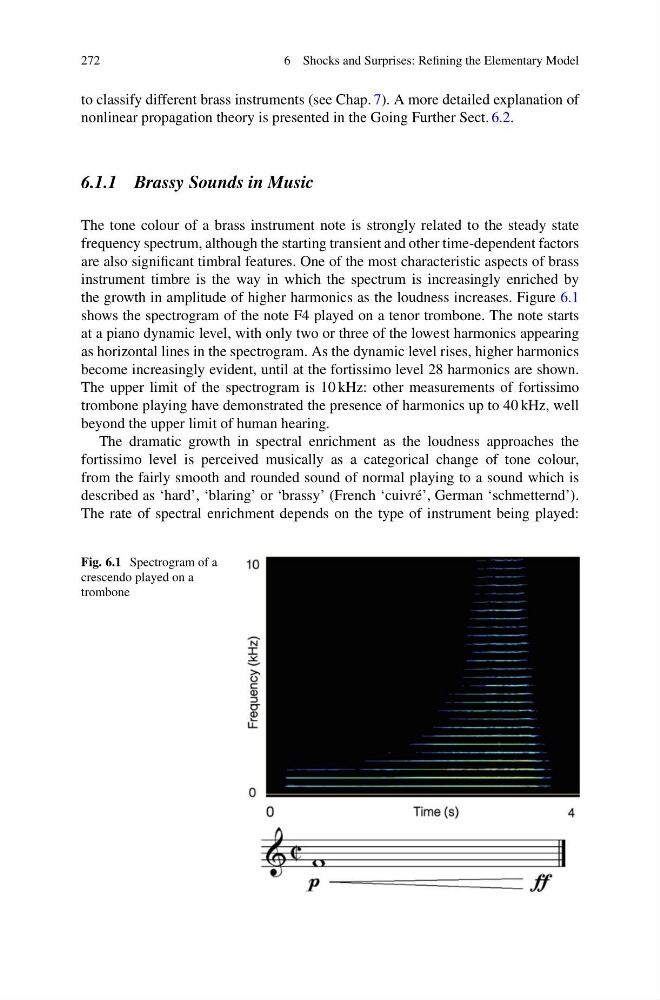
the growth in amplitude of higher harmonics as the loudness increases. Figure 6.1
shows the spectrogram of the note F4 played on a tenor trombone. The note starts
at a piano dynamic level, with only two or three of the lowest harmonics appearing
as horizontal lines in the spectrogram. As the dynamic level rises, higher harmonics
become increasingly evident, until at the fortissimo level 28 harmonics are shown.
The upper limit of the spectrogram is 10 kHz: other measurements of fortissimo
trombone playing have demonstrated the presence of harmonics up to 40 kHz, well
beyond the upper limit of human hearing.
The dramatic growth in spectral enrichment as the loudness approaches the
fortissimo level is perceived musically as a categorical change of tone colour,
from the fairly smooth and rounded sound of normal playing to a sound which is
described as ‘hard’, ‘blaring’ or ‘brassy’ (French ‘cuivré’, German ‘schmetternd’).
The rate of spectral enrichment depends on the type of instrument being played:
Fig. 6.1 Spectrogram of a
crescendo played on a
trombone
6 Shocks and Surprises: Refining the Elementary Model
to classify different brass instruments (see Chap. 7). A more detailed explanation of
nonlinear propagation theory is presented in the Going Further Sect. 6.2.
6.1.1 Brassy Sounds in Music
The tone colour of a brass instrument note is strongly related to the steady state
frequency spectrum, although the starting transient and other time-dependent factors
are also significant timbral features. One of the most characteristic aspects of brass
instrument timbre is the way in which the spectrum is increasingly enriched by
the growth in amplitude of higher harmonics as the loudness increases. Figure 6.1
shows the spectrogram of the note F4 played on a tenor trombone. The note starts
at a piano dynamic level, with only two or three of the lowest harmonics appearing
as horizontal lines in the spectrogram. As the dynamic level rises, higher harmonics
become increasingly evident, until at the fortissimo level 28 harmonics are shown.
The upper limit of the spectrogram is 10 kHz: other measurements of fortissimo
trombone playing have demonstrated the presence of harmonics up to 40 kHz, well
beyond the upper limit of human hearing.
The dramatic growth in spectral enrichment as the loudness approaches the
fortissimo level is perceived musically as a categorical change of tone colour,
from the fairly smooth and rounded sound of normal playing to a sound which is
described as ‘hard’, ‘blaring’ or ‘brassy’ (French ‘cuivré’, German ‘schmetternd’).
The rate of spectral enrichment depends on the type of instrument being played:
Fig. 6.1 Spectrogram of a
crescendo played on a
trombone