

5.3 Beyond Pianissimo: Modelling Realistic Playing Amplitudes
235
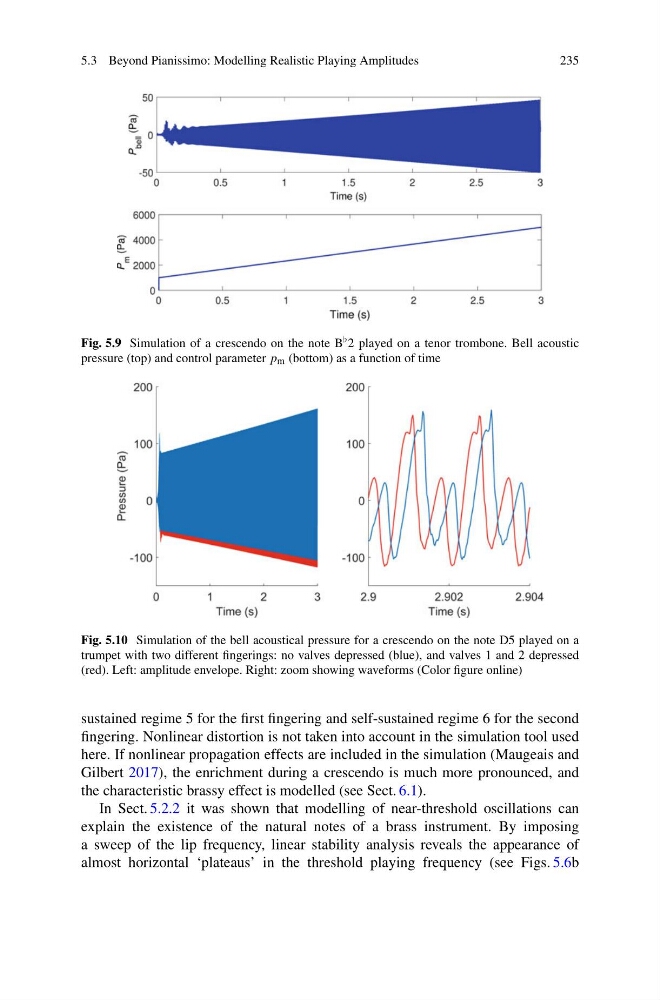
Fig. 5.9 Simulation of a crescendo on the note B 2 played on a tenor trombone. Bell acoustic
pressure (top) and control parameter p m (bottom) as a function of time
Fig. 5.10 Simulation of the bell acoustical pressure for a crescendo on the note D5 played on a
trumpet with two different fingerings: no valves depressed (blue), and valves 1 and 2 depressed
(red). Left: amplitude envelope. Right: zoom showing waveforms (Color figure online)
sustained regime 5 for the first fingering and self-sustained regime 6 for the second
fingering. Nonlinear distortion is not taken into account in the simulation tool used
here. If nonlinear propagation effects are included in the simulation (Maugeais and
Gilbert 2017), the enrichment during a crescendo is much more pronounced, and
the characteristic brassy effect is modelled (see Sect. 6.1).
In Sect. 5.2.2 it was shown that modelling of near-threshold oscillations can
explain the existence of the natural notes of a brass instrument. By imposing
a sweep of the lip frequency, linear stability analysis reveals the appearance of
almost horizontal ‘plateaus’ in the threshold playing frequency (see Figs. 5.6b
235
Fig. 5.9 Simulation of a crescendo on the note B 2 played on a tenor trombone. Bell acoustic
pressure (top) and control parameter p m (bottom) as a function of time
Fig. 5.10 Simulation of the bell acoustical pressure for a crescendo on the note D5 played on a
trumpet with two different fingerings: no valves depressed (blue), and valves 1 and 2 depressed
(red). Left: amplitude envelope. Right: zoom showing waveforms (Color figure online)
sustained regime 5 for the first fingering and self-sustained regime 6 for the second
fingering. Nonlinear distortion is not taken into account in the simulation tool used
here. If nonlinear propagation effects are included in the simulation (Maugeais and
Gilbert 2017), the enrichment during a crescendo is much more pronounced, and
the characteristic brassy effect is modelled (see Sect. 6.1).
In Sect. 5.2.2 it was shown that modelling of near-threshold oscillations can
explain the existence of the natural notes of a brass instrument. By imposing
a sweep of the lip frequency, linear stability analysis reveals the appearance of
almost horizontal ‘plateaus’ in the threshold playing frequency (see Figs. 5.6b