

234
5 Blow That Horn: An Elementary Model of Brass Playing
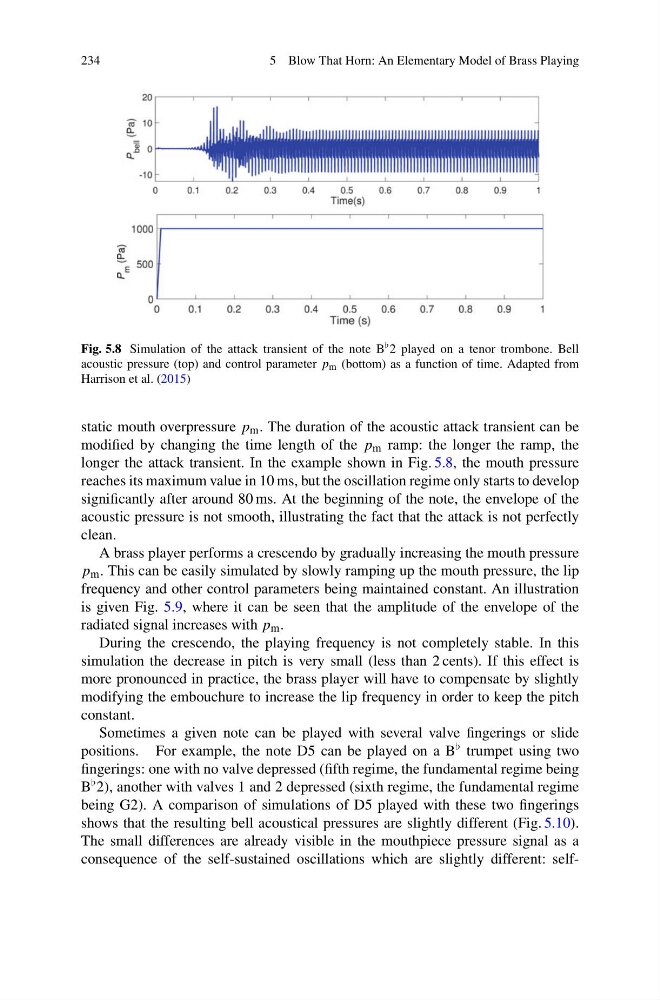
Fig. 5.8 Simulation of the attack transient of the note B 2 played on a tenor trombone. Bell
acoustic pressure (top) and control parameter p m (bottom) as a function of time. Adapted from
Harrison et al. (2015)
static mouth overpressure p m . The duration of the acoustic attack transient can be
modified by changing the time length of the p m ramp: the longer the ramp, the
longer the attack transient. In the example shown in Fig. 5.8, the mouth pressure
reaches its maximum value in 10 ms, but the oscillation regime only starts to develop
significantly after around 80 ms. At the beginning of the note, the envelope of the
acoustic pressure is not smooth, illustrating the fact that the attack is not perfectly
clean.
A brass player performs a crescendo by gradually increasing the mouth pressure
p m . This can be easily simulated by slowly ramping up the mouth pressure, the lip
frequency and other control parameters being maintained constant. An illustration
is given Fig. 5.9, where it can be seen that the amplitude of the envelope of the
radiated signal increases with p m .
During the crescendo, the playing frequency is not completely stable. In this
simulation the decrease in pitch is very small (less than 2 cents). If this effect is
more pronounced in practice, the brass player will have to compensate by slightly
modifying the embouchure to increase the lip frequency in order to keep the pitch
constant.
Sometimes a given note can be played with several valve fingerings or slide
positions. For example, the note D5 can be played on a B trumpet using two
fingerings: one with no valve depressed (fifth regime, the fundamental regime being
B 2), another with valves 1 and 2 depressed (sixth regime, the fundamental regime
being G2). A comparison of simulations of D5 played with these two fingerings
shows that the resulting bell acoustical pressures are slightly different (Fig. 5.10).
The small differences are already visible in the mouthpiece pressure signal as a
consequence of the self-sustained oscillations which are slightly different: self-
5 Blow That Horn: An Elementary Model of Brass Playing
Fig. 5.8 Simulation of the attack transient of the note B 2 played on a tenor trombone. Bell
acoustic pressure (top) and control parameter p m (bottom) as a function of time. Adapted from
Harrison et al. (2015)
static mouth overpressure p m . The duration of the acoustic attack transient can be
modified by changing the time length of the p m ramp: the longer the ramp, the
longer the attack transient. In the example shown in Fig. 5.8, the mouth pressure
reaches its maximum value in 10 ms, but the oscillation regime only starts to develop
significantly after around 80 ms. At the beginning of the note, the envelope of the
acoustic pressure is not smooth, illustrating the fact that the attack is not perfectly
clean.
A brass player performs a crescendo by gradually increasing the mouth pressure
p m . This can be easily simulated by slowly ramping up the mouth pressure, the lip
frequency and other control parameters being maintained constant. An illustration
is given Fig. 5.9, where it can be seen that the amplitude of the envelope of the
radiated signal increases with p m .
During the crescendo, the playing frequency is not completely stable. In this
simulation the decrease in pitch is very small (less than 2 cents). If this effect is
more pronounced in practice, the brass player will have to compensate by slightly
modifying the embouchure to increase the lip frequency in order to keep the pitch
constant.
Sometimes a given note can be played with several valve fingerings or slide
positions. For example, the note D5 can be played on a B trumpet using two
fingerings: one with no valve depressed (fifth regime, the fundamental regime being
B 2), another with valves 1 and 2 depressed (sixth regime, the fundamental regime
being G2). A comparison of simulations of D5 played with these two fingerings
shows that the resulting bell acoustical pressures are slightly different (Fig. 5.10).
The small differences are already visible in the mouthpiece pressure signal as a
consequence of the self-sustained oscillations which are slightly different: self-