

232
5 Blow That Horn: An Elementary Model of Brass Playing
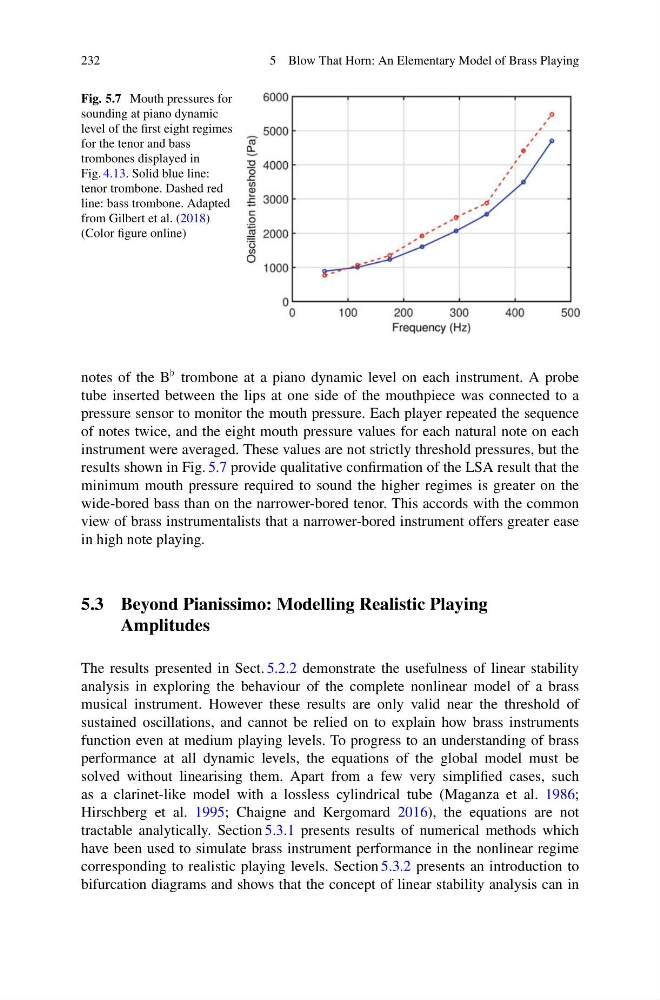
Fig. 5.7 Mouth pressures for
sounding at piano dynamic
level of the first eight regimes
for the tenor and bass
trombones displayed in
Fig. 4.13. Solid blue line:
tenor trombone. Dashed red
line: bass trombone. Adapted
from Gilbert et al. (2018)
(Color figure online)
notes of the B trombone at a piano dynamic level on each instrument. A probe
tube inserted between the lips at one side of the mouthpiece was connected to a
pressure sensor to monitor the mouth pressure. Each player repeated the sequence
of notes twice, and the eight mouth pressure values for each natural note on each
instrument were averaged. These values are not strictly threshold pressures, but the
results shown in Fig. 5.7 provide qualitative confirmation of the LSA result that the
minimum mouth pressure required to sound the higher regimes is greater on the
wide-bored bass than on the narrower-bored tenor. This accords with the common
view of brass instrumentalists that a narrower-bored instrument offers greater ease
in high note playing.
5.3 Beyond Pianissimo: Modelling Realistic Playing
Amplitudes
The results presented in Sect. 5.2.2 demonstrate the usefulness of linear stability
analysis in exploring the behaviour of the complete nonlinear model of a brass
musical instrument. However these results are only valid near the threshold of
sustained oscillations, and cannot be relied on to explain how brass instruments
function even at medium playing levels. To progress to an understanding of brass
performance at all dynamic levels, the equations of the global model must be
solved without linearising them. Apart from a few very simplified cases, such
as a clarinet-like model with a lossless cylindrical tube (Maganza et al. 1986;
Hirschberg et al. 1995; Chaigne and Kergomard 2016), the equations are not
tractable analytically. Section 5.3.1 presents results of numerical methods which
have been used to simulate brass instrument performance in the nonlinear regime
corresponding to realistic playing levels. Section 5.3.2 presents an introduction to
bifurcation diagrams and shows that the concept of linear stability analysis can in
5 Blow That Horn: An Elementary Model of Brass Playing
Fig. 5.7 Mouth pressures for
sounding at piano dynamic
level of the first eight regimes
for the tenor and bass
trombones displayed in
Fig. 4.13. Solid blue line:
tenor trombone. Dashed red
line: bass trombone. Adapted
from Gilbert et al. (2018)
(Color figure online)
notes of the B trombone at a piano dynamic level on each instrument. A probe
tube inserted between the lips at one side of the mouthpiece was connected to a
pressure sensor to monitor the mouth pressure. Each player repeated the sequence
of notes twice, and the eight mouth pressure values for each natural note on each
instrument were averaged. These values are not strictly threshold pressures, but the
results shown in Fig. 5.7 provide qualitative confirmation of the LSA result that the
minimum mouth pressure required to sound the higher regimes is greater on the
wide-bored bass than on the narrower-bored tenor. This accords with the common
view of brass instrumentalists that a narrower-bored instrument offers greater ease
in high note playing.
5.3 Beyond Pianissimo: Modelling Realistic Playing
Amplitudes
The results presented in Sect. 5.2.2 demonstrate the usefulness of linear stability
analysis in exploring the behaviour of the complete nonlinear model of a brass
musical instrument. However these results are only valid near the threshold of
sustained oscillations, and cannot be relied on to explain how brass instruments
function even at medium playing levels. To progress to an understanding of brass
performance at all dynamic levels, the equations of the global model must be
solved without linearising them. Apart from a few very simplified cases, such
as a clarinet-like model with a lossless cylindrical tube (Maganza et al. 1986;
Hirschberg et al. 1995; Chaigne and Kergomard 2016), the equations are not
tractable analytically. Section 5.3.1 presents results of numerical methods which
have been used to simulate brass instrument performance in the nonlinear regime
corresponding to realistic playing levels. Section 5.3.2 presents an introduction to
bifurcation diagrams and shows that the concept of linear stability analysis can in