

214
4 After the Lips: Acoustic Resonances and Radiation
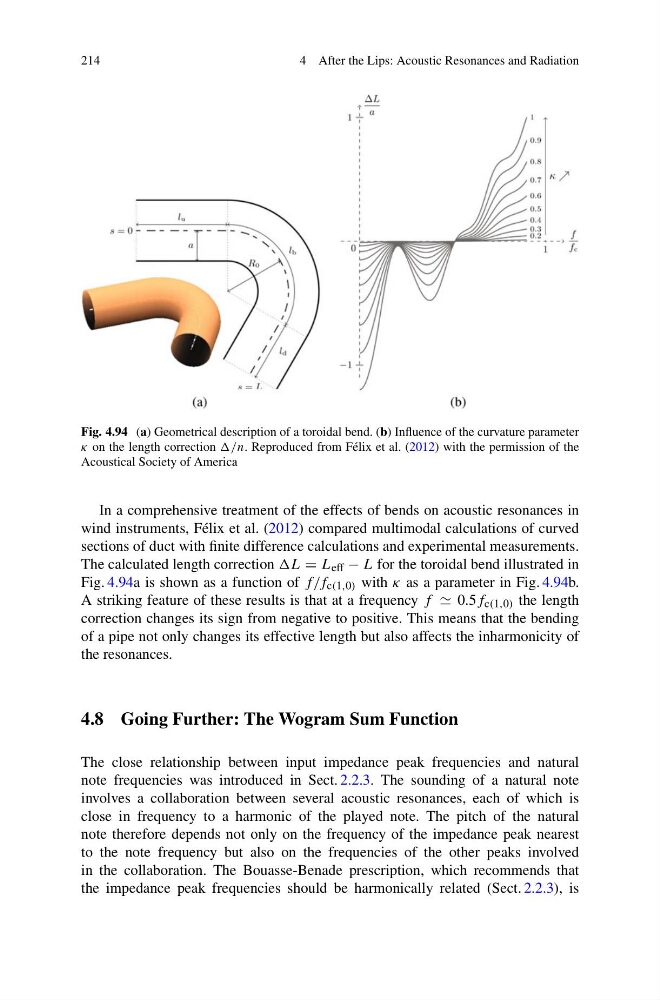
Fig. 4.94 (a) Geometrical description of a toroidal bend. (b) Influence of the curvature parameter
κ on the length correction /n. Reproduced from Félix et al. (2012) with the permission of the
Acoustical Society of America
In a comprehensive treatment of the effects of bends on acoustic resonances in
wind instruments, Félix et al. (2012) compared multimodal calculations of curved
sections of duct with finite difference calculations and experimental measurements.
The calculated length correction L = L eff − L for the toroidal bend illustrated in
Fig. 4.94a is shown as a function of f/f c(1,0) with κ as a parameter in Fig. 4.94b.
A striking feature of these results is that at a frequency f 0.5f c(1,0) the length
correction changes its sign from negative to positive. This means that the bending
of a pipe not only changes its effective length but also affects the inharmonicity of
the resonances.
4.8 Going Further: The Wogram Sum Function
The close relationship between input impedance peak frequencies and natural
note frequencies was introduced in Sect. 2.2.3. The sounding of a natural note
involves a collaboration between several acoustic resonances, each of which is
close in frequency to a harmonic of the played note. The pitch of the natural
note therefore depends not only on the frequency of the impedance peak nearest
to the note frequency but also on the frequencies of the other peaks involved
in the collaboration. The Bouasse-Benade prescription, which recommends that
the impedance peak frequencies should be harmonically related (Sect. 2.2.3), is
4 After the Lips: Acoustic Resonances and Radiation
Fig. 4.94 (a) Geometrical description of a toroidal bend. (b) Influence of the curvature parameter
κ on the length correction /n. Reproduced from Félix et al. (2012) with the permission of the
Acoustical Society of America
In a comprehensive treatment of the effects of bends on acoustic resonances in
wind instruments, Félix et al. (2012) compared multimodal calculations of curved
sections of duct with finite difference calculations and experimental measurements.
The calculated length correction L = L eff − L for the toroidal bend illustrated in
Fig. 4.94a is shown as a function of f/f c(1,0) with κ as a parameter in Fig. 4.94b.
A striking feature of these results is that at a frequency f 0.5f c(1,0) the length
correction changes its sign from negative to positive. This means that the bending
of a pipe not only changes its effective length but also affects the inharmonicity of
the resonances.
4.8 Going Further: The Wogram Sum Function
The close relationship between input impedance peak frequencies and natural
note frequencies was introduced in Sect. 2.2.3. The sounding of a natural note
involves a collaboration between several acoustic resonances, each of which is
close in frequency to a harmonic of the played note. The pitch of the natural
note therefore depends not only on the frequency of the impedance peak nearest
to the note frequency but also on the frequencies of the other peaks involved
in the collaboration. The Bouasse-Benade prescription, which recommends that
the impedance peak frequencies should be harmonically related (Sect. 2.2.3), is