

4.7 Going Further: Calculating Input Impedance
213
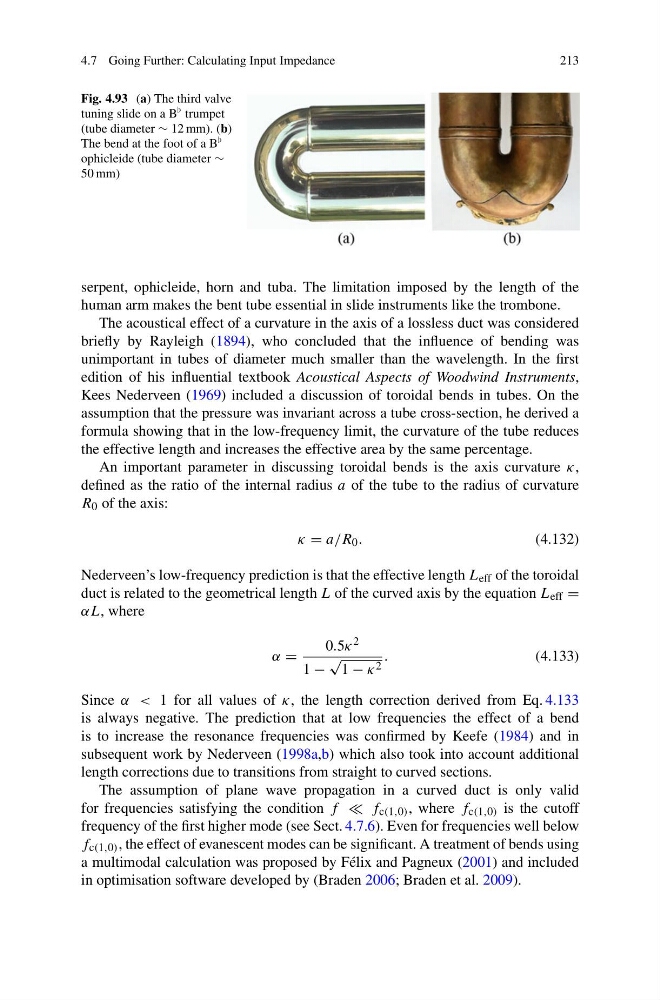
Fig. 4.93 (a) The third valve
tuning slide on a B trumpet
(tube diameter ∼ 12 mm). (b)
The bend at the foot of a B
ophicleide (tube diameter ∼
50 mm)
serpent, ophicleide, horn and tuba. The limitation imposed by the length of the
human arm makes the bent tube essential in slide instruments like the trombone.
The acoustical effect of a curvature in the axis of a lossless duct was considered
briefly by Rayleigh (1894), who concluded that the influence of bending was
unimportant in tubes of diameter much smaller than the wavelength. In the first
edition of his influential textbook Acoustical Aspects of Woodwind Instruments,
Kees Nederveen (1969) included a discussion of toroidal bends in tubes. On the
assumption that the pressure was invariant across a tube cross-section, he derived a
formula showing that in the low-frequency limit, the curvature of the tube reduces
the effective length and increases the effective area by the same percentage.
An important parameter in discussing toroidal bends is the axis curvature κ,
defined as the ratio of the internal radius a of the tube to the radius of curvature
R 0 of the axis:
κ = a/R 0 .
(4.132)
Nederveen’s low-frequency prediction is that the effective length L eff of the toroidal
duct is related to the geometrical length L of the curved axis by the equation L eff =
αL, where
α =
0.5κ 2
1 −
√
1 − κ 2
.
(4.133)
Since α < 1 for all values of κ, the length correction derived from Eq. 4.133
is always negative. The prediction that at low frequencies the effect of a bend
is to increase the resonance frequencies was confirmed by Keefe (1984) and in
subsequent work by Nederveen (1998a,b) which also took into account additional
length corrections due to transitions from straight to curved sections.
The assumption of plane wave propagation in a curved duct is only valid
for frequencies satisfying the condition f f c(1,0) , where f c(1,0) is the cutoff
frequency of the first higher mode (see Sect. 4.7.6). Even for frequencies well below
f c(1,0) , the effect of evanescent modes can be significant. A treatment of bends using
a multimodal calculation was proposed by Félix and Pagneux (2001) and included
in optimisation software developed by (Braden 2006; Braden et al. 2009).
213
Fig. 4.93 (a) The third valve
tuning slide on a B trumpet
(tube diameter ∼ 12 mm). (b)
The bend at the foot of a B
ophicleide (tube diameter ∼
50 mm)
serpent, ophicleide, horn and tuba. The limitation imposed by the length of the
human arm makes the bent tube essential in slide instruments like the trombone.
The acoustical effect of a curvature in the axis of a lossless duct was considered
briefly by Rayleigh (1894), who concluded that the influence of bending was
unimportant in tubes of diameter much smaller than the wavelength. In the first
edition of his influential textbook Acoustical Aspects of Woodwind Instruments,
Kees Nederveen (1969) included a discussion of toroidal bends in tubes. On the
assumption that the pressure was invariant across a tube cross-section, he derived a
formula showing that in the low-frequency limit, the curvature of the tube reduces
the effective length and increases the effective area by the same percentage.
An important parameter in discussing toroidal bends is the axis curvature κ,
defined as the ratio of the internal radius a of the tube to the radius of curvature
R 0 of the axis:
κ = a/R 0 .
(4.132)
Nederveen’s low-frequency prediction is that the effective length L eff of the toroidal
duct is related to the geometrical length L of the curved axis by the equation L eff =
αL, where
α =
0.5κ 2
1 −
√
1 − κ 2
.
(4.133)
Since α < 1 for all values of κ, the length correction derived from Eq. 4.133
is always negative. The prediction that at low frequencies the effect of a bend
is to increase the resonance frequencies was confirmed by Keefe (1984) and in
subsequent work by Nederveen (1998a,b) which also took into account additional
length corrections due to transitions from straight to curved sections.
The assumption of plane wave propagation in a curved duct is only valid
for frequencies satisfying the condition f f c(1,0) , where f c(1,0) is the cutoff
frequency of the first higher mode (see Sect. 4.7.6). Even for frequencies well below
f c(1,0) , the effect of evanescent modes can be significant. A treatment of bends using
a multimodal calculation was proposed by Félix and Pagneux (2001) and included
in optimisation software developed by (Braden 2006; Braden et al. 2009).