

4.7 Going Further: Calculating Input Impedance
211
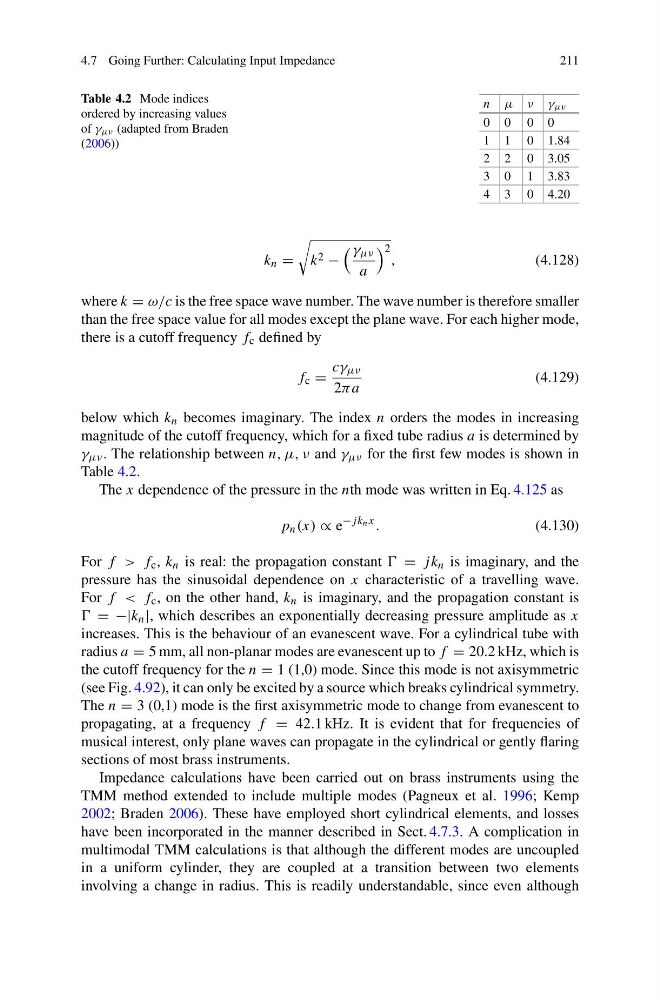
Table 4.2 Mode indices
ordered by increasing values
of γ μν (adapted from Braden
(2006))
n μ ν γ μν
0 0 0 0
1 1 0 1.84
2 2 0 3.05
3 0 1 3.83
4 3 0 4.20
k n =
k 2 −
γ μν
a
2
,
(4.128)
where k = ω/c is the free space wave number. The wave number is therefore smaller
than the free space value for all modes except the plane wave. For each higher mode,
there is a cutoff frequency f c defined by
f c =
cγ μν
2πa
(4.129)
below which k n becomes imaginary. The index n orders the modes in increasing
magnitude of the cutoff frequency, which for a fixed tube radius a is determined by
γ μν . The relationship between n, μ, ν and γ μν for the first few modes is shown in
Table 4.2.
The x dependence of the pressure in the nth mode was written in Eq. 4.125 as
p n (x) ∝ e
−jk n x .
(4.130)
For f > f c , k n is real: the propagation constant = jk n is imaginary, and the
pressure has the sinusoidal dependence on x characteristic of a travelling wave.
For f < f c , on the other hand, k n is imaginary, and the propagation constant is
= −|k n |, which describes an exponentially decreasing pressure amplitude as x
increases. This is the behaviour of an evanescent wave. For a cylindrical tube with
radius a = 5 mm, all non-planar modes are evanescent up to f = 20.2 kHz, which is
the cutoff frequency for the n = 1 (1,0) mode. Since this mode is not axisymmetric
(see Fig. 4.92), it can only be excited by a source which breaks cylindrical symmetry.
The n = 3 (0,1) mode is the first axisymmetric mode to change from evanescent to
propagating, at a frequency f = 42.1 kHz. It is evident that for frequencies of
musical interest, only plane waves can propagate in the cylindrical or gently flaring
sections of most brass instruments.
Impedance calculations have been carried out on brass instruments using the
TMM method extended to include multiple modes (Pagneux et al. 1996; Kemp
2002; Braden 2006). These have employed short cylindrical elements, and losses
have been incorporated in the manner described in Sect. 4.7.3. A complication in
multimodal TMM calculations is that although the different modes are uncoupled
in a uniform cylinder, they are coupled at a transition between two elements
involving a change in radius. This is readily understandable, since even although
211
Table 4.2 Mode indices
ordered by increasing values
of γ μν (adapted from Braden
(2006))
n μ ν γ μν
0 0 0 0
1 1 0 1.84
2 2 0 3.05
3 0 1 3.83
4 3 0 4.20
k n =
k 2 −
γ μν
a
2
,
(4.128)
where k = ω/c is the free space wave number. The wave number is therefore smaller
than the free space value for all modes except the plane wave. For each higher mode,
there is a cutoff frequency f c defined by
f c =
cγ μν
2πa
(4.129)
below which k n becomes imaginary. The index n orders the modes in increasing
magnitude of the cutoff frequency, which for a fixed tube radius a is determined by
γ μν . The relationship between n, μ, ν and γ μν for the first few modes is shown in
Table 4.2.
The x dependence of the pressure in the nth mode was written in Eq. 4.125 as
p n (x) ∝ e
−jk n x .
(4.130)
For f > f c , k n is real: the propagation constant = jk n is imaginary, and the
pressure has the sinusoidal dependence on x characteristic of a travelling wave.
For f < f c , on the other hand, k n is imaginary, and the propagation constant is
= −|k n |, which describes an exponentially decreasing pressure amplitude as x
increases. This is the behaviour of an evanescent wave. For a cylindrical tube with
radius a = 5 mm, all non-planar modes are evanescent up to f = 20.2 kHz, which is
the cutoff frequency for the n = 1 (1,0) mode. Since this mode is not axisymmetric
(see Fig. 4.92), it can only be excited by a source which breaks cylindrical symmetry.
The n = 3 (0,1) mode is the first axisymmetric mode to change from evanescent to
propagating, at a frequency f = 42.1 kHz. It is evident that for frequencies of
musical interest, only plane waves can propagate in the cylindrical or gently flaring
sections of most brass instruments.
Impedance calculations have been carried out on brass instruments using the
TMM method extended to include multiple modes (Pagneux et al. 1996; Kemp
2002; Braden 2006). These have employed short cylindrical elements, and losses
have been incorporated in the manner described in Sect. 4.7.3. A complication in
multimodal TMM calculations is that although the different modes are uncoupled
in a uniform cylinder, they are coupled at a transition between two elements
involving a change in radius. This is readily understandable, since even although