

204
4 After the Lips: Acoustic Resonances and Radiation
The acoustic pressure in a plane wave propagating without losses along the x
axis was expressed in Sect. 4.1.2 as
p + = Ae
j (ωt−kx) .
(4.3)
Since the argument of the exponential function on the right-hand side of Eq. 4.3 is
purely imaginary, the pressure is an oscillating quantity of constant magnitude. The
major effect of viscothermal losses is to add a negative real component −α to the
argument, corresponding to a exponential decay of the pressure magnitude as the
wave propagates. There is also a small reduction in the phase velocity v p from its
free space value c.
These viscothermal effects can be incorporated into the expression for a travelling wave by rewriting it in terms of the propagation constant :
p + = Ae
jωt e
−x .
(4.103)
In the lossless case, = jk = j (ω/c). When losses are included,
= α + j
ω
v p
.
(4.104)
For the tube diameters and playing frequencies typical of brass instruments,
Keefe (1984) gives the following approximate expressions for α and v p :
α =
ω
c
1.045 r
−1
v + 1.080 r
−2
v + 0.303 r
−3
v
(4.105)
v p =
c
1.045 r
−1
v
.
(4.106)
The parameter in Keefe’s equations is
r v =
a
b v
= a
ωρ
η
1/2
,
(4.107)
where a is the tube radius, b v is the viscous boundary layer thickness, ρ is the density
of air and η is the coefficient of viscosity. Using the values ρ = 1.1769 Kg m −3 and
η = 1.846.10 −5 Kg m −1 s −1 listed by Keefe for a temperature of 300 K,
r v = 632.8 f
1/2 a.
(4.108)
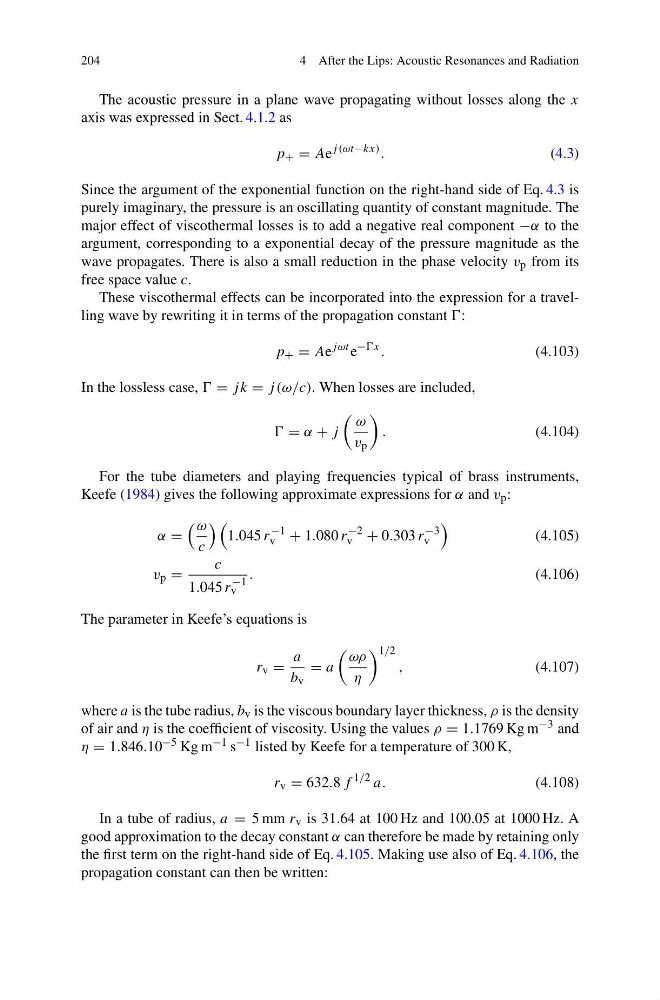
In a tube of radius, a = 5 mm r v is 31.64 at 100 Hz and 100.05 at 1000 Hz. A
good approximation to the decay constant α can therefore be made by retaining only
the first term on the right-hand side of Eq. 4.105. Making use also of Eq. 4.106, the
propagation constant can then be written:
4 After the Lips: Acoustic Resonances and Radiation
The acoustic pressure in a plane wave propagating without losses along the x
axis was expressed in Sect. 4.1.2 as
p + = Ae
j (ωt−kx) .
(4.3)
Since the argument of the exponential function on the right-hand side of Eq. 4.3 is
purely imaginary, the pressure is an oscillating quantity of constant magnitude. The
major effect of viscothermal losses is to add a negative real component −α to the
argument, corresponding to a exponential decay of the pressure magnitude as the
wave propagates. There is also a small reduction in the phase velocity v p from its
free space value c.
These viscothermal effects can be incorporated into the expression for a travelling wave by rewriting it in terms of the propagation constant :
p + = Ae
jωt e
−x .
(4.103)
In the lossless case, = jk = j (ω/c). When losses are included,
= α + j
ω
v p
.
(4.104)
For the tube diameters and playing frequencies typical of brass instruments,
Keefe (1984) gives the following approximate expressions for α and v p :
α =
ω
c
1.045 r
−1
v + 1.080 r
−2
v + 0.303 r
−3
v
(4.105)
v p =
c
1.045 r
−1
v
.
(4.106)
The parameter in Keefe’s equations is
r v =
a
b v
= a
ωρ
η
1/2
,
(4.107)
where a is the tube radius, b v is the viscous boundary layer thickness, ρ is the density
of air and η is the coefficient of viscosity. Using the values ρ = 1.1769 Kg m −3 and
η = 1.846.10 −5 Kg m −1 s −1 listed by Keefe for a temperature of 300 K,
r v = 632.8 f
1/2 a.
(4.108)
In a tube of radius, a = 5 mm r v is 31.64 at 100 Hz and 100.05 at 1000 Hz. A
good approximation to the decay constant α can therefore be made by retaining only
the first term on the right-hand side of Eq. 4.105. Making use also of Eq. 4.106, the
propagation constant can then be written: