

4.6 Radiation of Sound from Brass Instruments
195
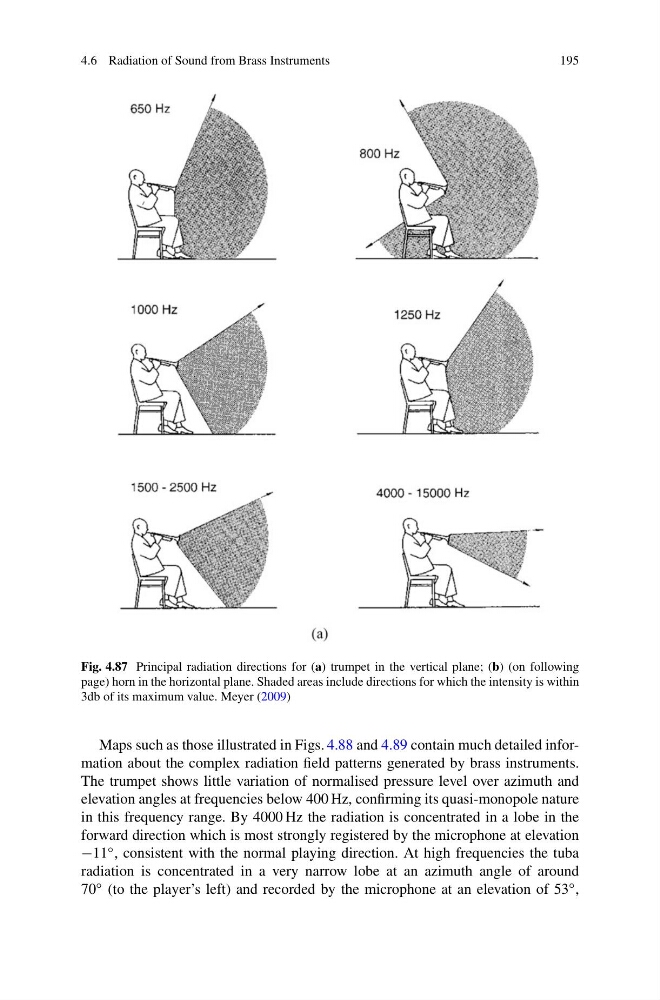
Fig. 4.87 Principal radiation directions for (a) trumpet in the vertical plane; (b) (on following
page) horn in the horizontal plane. Shaded areas include directions for which the intensity is within
3db of its maximum value. Meyer (2009)
Maps such as those illustrated in Figs. 4.88 and 4.89 contain much detailed information about the complex radiation field patterns generated by brass instruments.
The trumpet shows little variation of normalised pressure level over azimuth and
elevation angles at frequencies below 400 Hz, confirming its quasi-monopole nature
in this frequency range. By 4000 Hz the radiation is concentrated in a lobe in the
forward direction which is most strongly registered by the microphone at elevation
−11 ◦ , consistent with the normal playing direction. At high frequencies the tuba
radiation is concentrated in a very narrow lobe at an azimuth angle of around
70 ◦ (to the player’s left) and recorded by the microphone at an elevation of 53 ◦ ,
195
Fig. 4.87 Principal radiation directions for (a) trumpet in the vertical plane; (b) (on following
page) horn in the horizontal plane. Shaded areas include directions for which the intensity is within
3db of its maximum value. Meyer (2009)
Maps such as those illustrated in Figs. 4.88 and 4.89 contain much detailed information about the complex radiation field patterns generated by brass instruments.
The trumpet shows little variation of normalised pressure level over azimuth and
elevation angles at frequencies below 400 Hz, confirming its quasi-monopole nature
in this frequency range. By 4000 Hz the radiation is concentrated in a lobe in the
forward direction which is most strongly registered by the microphone at elevation
−11 ◦ , consistent with the normal playing direction. At high frequencies the tuba
radiation is concentrated in a very narrow lobe at an azimuth angle of around
70 ◦ (to the player’s left) and recorded by the microphone at an elevation of 53 ◦ ,