

166
4 After the Lips: Acoustic Resonances and Radiation
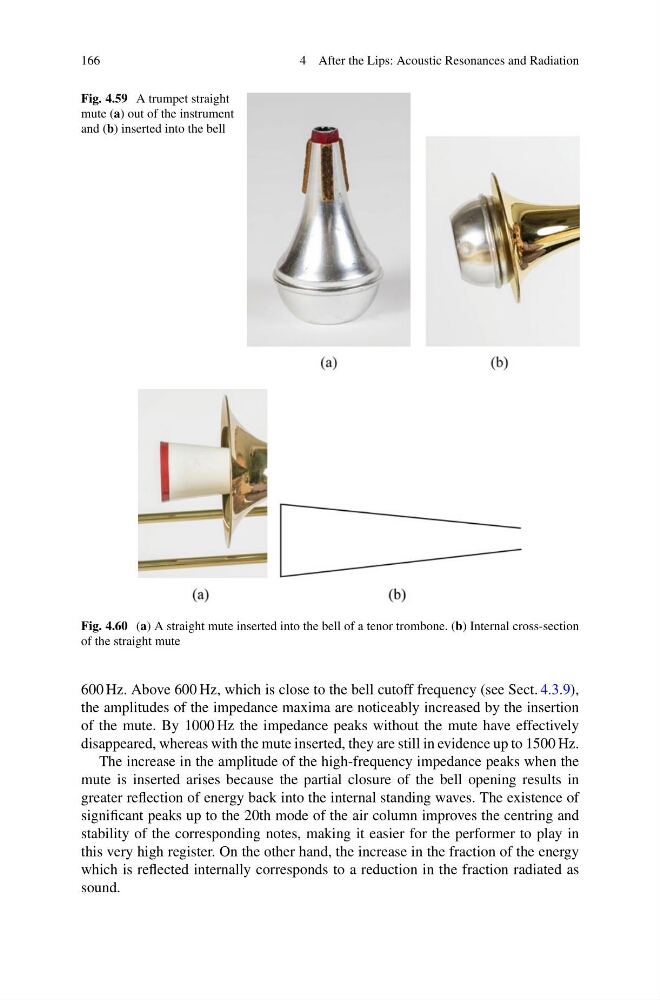
Fig. 4.59 A trumpet straight
mute (a) out of the instrument
and (b) inserted into the bell
Fig. 4.60 (a) A straight mute inserted into the bell of a tenor trombone. (b) Internal cross-section
of the straight mute
600 Hz. Above 600 Hz, which is close to the bell cutoff frequency (see Sect. 4.3.9),
the amplitudes of the impedance maxima are noticeably increased by the insertion
of the mute. By 1000 Hz the impedance peaks without the mute have effectively
disappeared, whereas with the mute inserted, they are still in evidence up to 1500 Hz.
The increase in the amplitude of the high-frequency impedance peaks when the
mute is inserted arises because the partial closure of the bell opening results in
greater reflection of energy back into the internal standing waves. The existence of
significant peaks up to the 20th mode of the air column improves the centring and
stability of the corresponding notes, making it easier for the performer to play in
this very high register. On the other hand, the increase in the fraction of the energy
which is reflected internally corresponds to a reduction in the fraction radiated as
sound.
4 After the Lips: Acoustic Resonances and Radiation
Fig. 4.59 A trumpet straight
mute (a) out of the instrument
and (b) inserted into the bell
Fig. 4.60 (a) A straight mute inserted into the bell of a tenor trombone. (b) Internal cross-section
of the straight mute
600 Hz. Above 600 Hz, which is close to the bell cutoff frequency (see Sect. 4.3.9),
the amplitudes of the impedance maxima are noticeably increased by the insertion
of the mute. By 1000 Hz the impedance peaks without the mute have effectively
disappeared, whereas with the mute inserted, they are still in evidence up to 1500 Hz.
The increase in the amplitude of the high-frequency impedance peaks when the
mute is inserted arises because the partial closure of the bell opening results in
greater reflection of energy back into the internal standing waves. The existence of
significant peaks up to the 20th mode of the air column improves the centring and
stability of the corresponding notes, making it easier for the performer to play in
this very high register. On the other hand, the increase in the fraction of the energy
which is reflected internally corresponds to a reduction in the fraction radiated as
sound.