

4.4 Toneholes
159
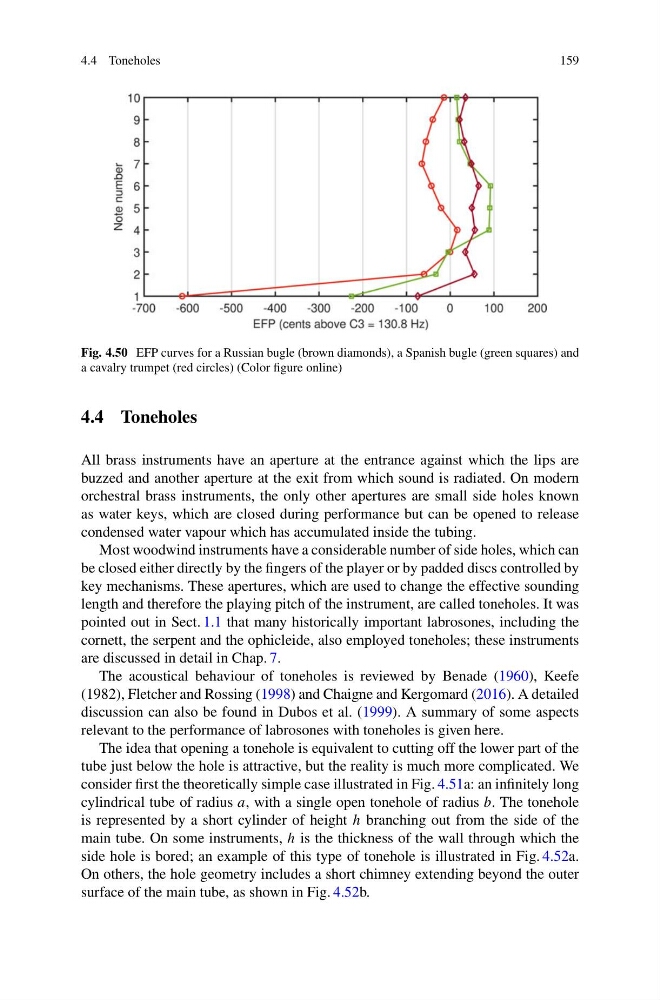
Fig. 4.50 EFP curves for a Russian bugle (brown diamonds), a Spanish bugle (green squares) and
a cavalry trumpet (red circles) (Color figure online)
4.4 Toneholes
All brass instruments have an aperture at the entrance against which the lips are
buzzed and another aperture at the exit from which sound is radiated. On modern
orchestral brass instruments, the only other apertures are small side holes known
as water keys, which are closed during performance but can be opened to release
condensed water vapour which has accumulated inside the tubing.
Most woodwind instruments have a considerable number of side holes, which can
be closed either directly by the fingers of the player or by padded discs controlled by
key mechanisms. These apertures, which are used to change the effective sounding
length and therefore the playing pitch of the instrument, are called toneholes. It was
pointed out in Sect. 1.1 that many historically important labrosones, including the
cornett, the serpent and the ophicleide, also employed toneholes; these instruments
are discussed in detail in Chap. 7.
The acoustical behaviour of toneholes is reviewed by Benade (1960), Keefe
(1982), Fletcher and Rossing (1998) and Chaigne and Kergomard (2016). A detailed
discussion can also be found in Dubos et al. (1999). A summary of some aspects
relevant to the performance of labrosones with toneholes is given here.
The idea that opening a tonehole is equivalent to cutting off the lower part of the
tube just below the hole is attractive, but the reality is much more complicated. We
consider first the theoretically simple case illustrated in Fig. 4.51a: an infinitely long
cylindrical tube of radius a, with a single open tonehole of radius b. The tonehole
is represented by a short cylinder of height h branching out from the side of the
main tube. On some instruments, h is the thickness of the wall through which the
side hole is bored; an example of this type of tonehole is illustrated in Fig. 4.52a.
On others, the hole geometry includes a short chimney extending beyond the outer
surface of the main tube, as shown in Fig. 4.52b.
159
Fig. 4.50 EFP curves for a Russian bugle (brown diamonds), a Spanish bugle (green squares) and
a cavalry trumpet (red circles) (Color figure online)
4.4 Toneholes
All brass instruments have an aperture at the entrance against which the lips are
buzzed and another aperture at the exit from which sound is radiated. On modern
orchestral brass instruments, the only other apertures are small side holes known
as water keys, which are closed during performance but can be opened to release
condensed water vapour which has accumulated inside the tubing.
Most woodwind instruments have a considerable number of side holes, which can
be closed either directly by the fingers of the player or by padded discs controlled by
key mechanisms. These apertures, which are used to change the effective sounding
length and therefore the playing pitch of the instrument, are called toneholes. It was
pointed out in Sect. 1.1 that many historically important labrosones, including the
cornett, the serpent and the ophicleide, also employed toneholes; these instruments
are discussed in detail in Chap. 7.
The acoustical behaviour of toneholes is reviewed by Benade (1960), Keefe
(1982), Fletcher and Rossing (1998) and Chaigne and Kergomard (2016). A detailed
discussion can also be found in Dubos et al. (1999). A summary of some aspects
relevant to the performance of labrosones with toneholes is given here.
The idea that opening a tonehole is equivalent to cutting off the lower part of the
tube just below the hole is attractive, but the reality is much more complicated. We
consider first the theoretically simple case illustrated in Fig. 4.51a: an infinitely long
cylindrical tube of radius a, with a single open tonehole of radius b. The tonehole
is represented by a short cylinder of height h branching out from the side of the
main tube. On some instruments, h is the thickness of the wall through which the
side hole is bored; an example of this type of tonehole is illustrated in Fig. 4.52a.
On others, the hole geometry includes a short chimney extending beyond the outer
surface of the main tube, as shown in Fig. 4.52b.