

158
4 After the Lips: Acoustic Resonances and Radiation
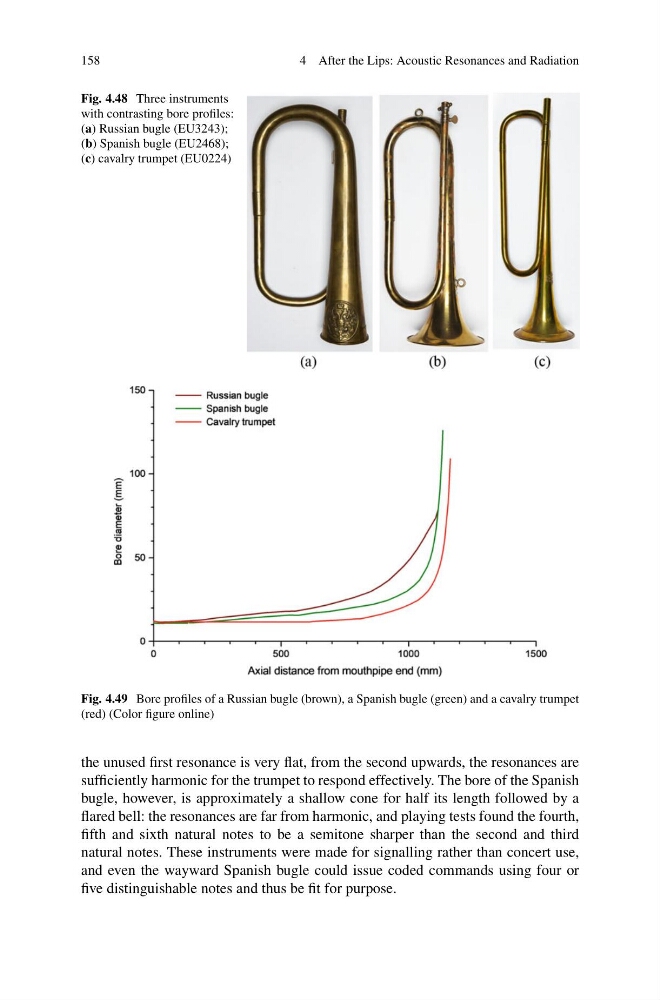
Fig. 4.48 Three instruments
with contrasting bore profiles:
(a) Russian bugle (EU3243);
(b) Spanish bugle (EU2468);
(c) cavalry trumpet (EU0224)
Fig. 4.49 Bore profiles of a Russian bugle (brown), a Spanish bugle (green) and a cavalry trumpet
(red) (Color figure online)
the unused first resonance is very flat, from the second upwards, the resonances are
sufficiently harmonic for the trumpet to respond effectively. The bore of the Spanish
bugle, however, is approximately a shallow cone for half its length followed by a
flared bell: the resonances are far from harmonic, and playing tests found the fourth,
fifth and sixth natural notes to be a semitone sharper than the second and third
natural notes. These instruments were made for signalling rather than concert use,
and even the wayward Spanish bugle could issue coded commands using four or
five distinguishable notes and thus be fit for purpose.
4 After the Lips: Acoustic Resonances and Radiation
Fig. 4.48 Three instruments
with contrasting bore profiles:
(a) Russian bugle (EU3243);
(b) Spanish bugle (EU2468);
(c) cavalry trumpet (EU0224)
Fig. 4.49 Bore profiles of a Russian bugle (brown), a Spanish bugle (green) and a cavalry trumpet
(red) (Color figure online)
the unused first resonance is very flat, from the second upwards, the resonances are
sufficiently harmonic for the trumpet to respond effectively. The bore of the Spanish
bugle, however, is approximately a shallow cone for half its length followed by a
flared bell: the resonances are far from harmonic, and playing tests found the fourth,
fifth and sixth natural notes to be a semitone sharper than the second and third
natural notes. These instruments were made for signalling rather than concert use,
and even the wayward Spanish bugle could issue coded commands using four or
five distinguishable notes and thus be fit for purpose.