

4.3 Bore Profiles of Brass Instruments
147
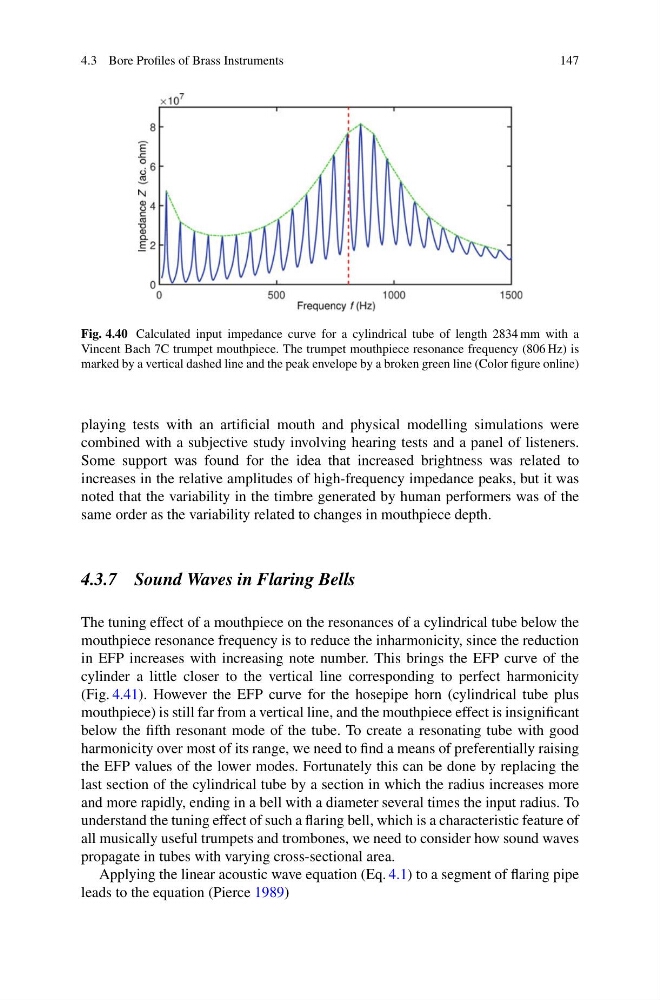
Fig. 4.40 Calculated input impedance curve for a cylindrical tube of length 2834 mm with a
Vincent Bach 7C trumpet mouthpiece. The trumpet mouthpiece resonance frequency (806 Hz) is
marked by a vertical dashed line and the peak envelope by a broken green line (Color figure online)
playing tests with an artificial mouth and physical modelling simulations were
combined with a subjective study involving hearing tests and a panel of listeners.
Some support was found for the idea that increased brightness was related to
increases in the relative amplitudes of high-frequency impedance peaks, but it was
noted that the variability in the timbre generated by human performers was of the
same order as the variability related to changes in mouthpiece depth.
4.3.7 Sound Waves in Flaring Bells
The tuning effect of a mouthpiece on the resonances of a cylindrical tube below the
mouthpiece resonance frequency is to reduce the inharmonicity, since the reduction
in EFP increases with increasing note number. This brings the EFP curve of the
cylinder a little closer to the vertical line corresponding to perfect harmonicity
(Fig. 4.41). However the EFP curve for the hosepipe horn (cylindrical tube plus
mouthpiece) is still far from a vertical line, and the mouthpiece effect is insignificant
below the fifth resonant mode of the tube. To create a resonating tube with good
harmonicity over most of its range, we need to find a means of preferentially raising
the EFP values of the lower modes. Fortunately this can be done by replacing the
last section of the cylindrical tube by a section in which the radius increases more
and more rapidly, ending in a bell with a diameter several times the input radius. To
understand the tuning effect of such a flaring bell, which is a characteristic feature of
all musically useful trumpets and trombones, we need to consider how sound waves
propagate in tubes with varying cross-sectional area.
Applying the linear acoustic wave equation (Eq. 4.1) to a segment of flaring pipe
leads to the equation (Pierce 1989)
147
Fig. 4.40 Calculated input impedance curve for a cylindrical tube of length 2834 mm with a
Vincent Bach 7C trumpet mouthpiece. The trumpet mouthpiece resonance frequency (806 Hz) is
marked by a vertical dashed line and the peak envelope by a broken green line (Color figure online)
playing tests with an artificial mouth and physical modelling simulations were
combined with a subjective study involving hearing tests and a panel of listeners.
Some support was found for the idea that increased brightness was related to
increases in the relative amplitudes of high-frequency impedance peaks, but it was
noted that the variability in the timbre generated by human performers was of the
same order as the variability related to changes in mouthpiece depth.
4.3.7 Sound Waves in Flaring Bells
The tuning effect of a mouthpiece on the resonances of a cylindrical tube below the
mouthpiece resonance frequency is to reduce the inharmonicity, since the reduction
in EFP increases with increasing note number. This brings the EFP curve of the
cylinder a little closer to the vertical line corresponding to perfect harmonicity
(Fig. 4.41). However the EFP curve for the hosepipe horn (cylindrical tube plus
mouthpiece) is still far from a vertical line, and the mouthpiece effect is insignificant
below the fifth resonant mode of the tube. To create a resonating tube with good
harmonicity over most of its range, we need to find a means of preferentially raising
the EFP values of the lower modes. Fortunately this can be done by replacing the
last section of the cylindrical tube by a section in which the radius increases more
and more rapidly, ending in a bell with a diameter several times the input radius. To
understand the tuning effect of such a flaring bell, which is a characteristic feature of
all musically useful trumpets and trombones, we need to consider how sound waves
propagate in tubes with varying cross-sectional area.
Applying the linear acoustic wave equation (Eq. 4.1) to a segment of flaring pipe
leads to the equation (Pierce 1989)