

146
4 After the Lips: Acoustic Resonances and Radiation
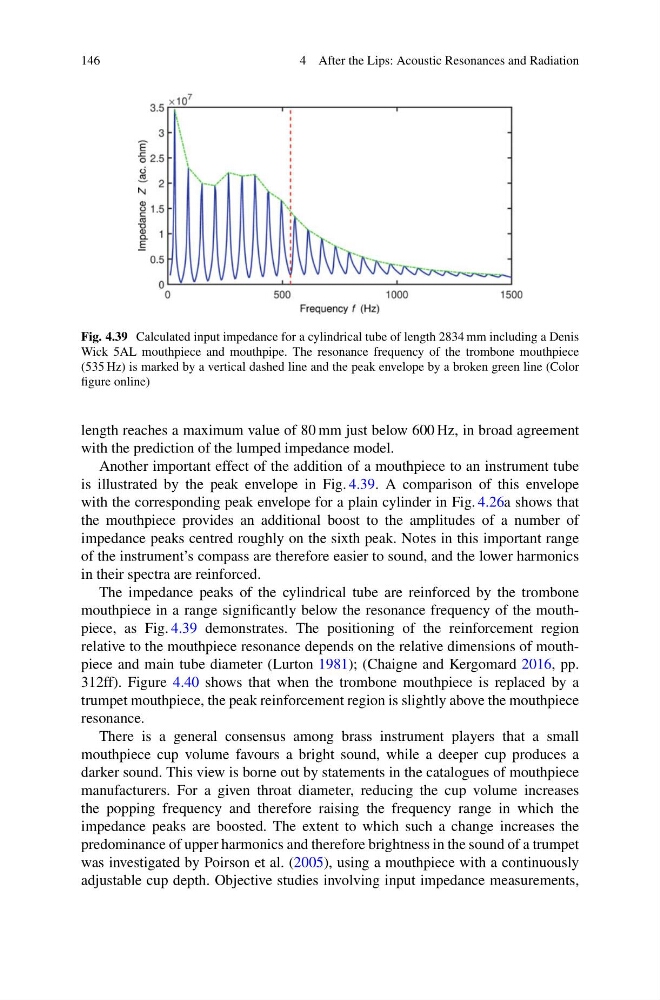
Fig. 4.39 Calculated input impedance for a cylindrical tube of length 2834 mm including a Denis
Wick 5AL mouthpiece and mouthpipe. The resonance frequency of the trombone mouthpiece
(535 Hz) is marked by a vertical dashed line and the peak envelope by a broken green line (Color
figure online)
length reaches a maximum value of 80 mm just below 600 Hz, in broad agreement
with the prediction of the lumped impedance model.
Another important effect of the addition of a mouthpiece to an instrument tube
is illustrated by the peak envelope in Fig. 4.39. A comparison of this envelope
with the corresponding peak envelope for a plain cylinder in Fig. 4.26a shows that
the mouthpiece provides an additional boost to the amplitudes of a number of
impedance peaks centred roughly on the sixth peak. Notes in this important range
of the instrument’s compass are therefore easier to sound, and the lower harmonics
in their spectra are reinforced.
The impedance peaks of the cylindrical tube are reinforced by the trombone
mouthpiece in a range significantly below the resonance frequency of the mouthpiece, as Fig. 4.39 demonstrates. The positioning of the reinforcement region
relative to the mouthpiece resonance depends on the relative dimensions of mouthpiece and main tube diameter (Lurton 1981); (Chaigne and Kergomard 2016, pp.
312ff). Figure 4.40 shows that when the trombone mouthpiece is replaced by a
trumpet mouthpiece, the peak reinforcement region is slightly above the mouthpiece
resonance.
There is a general consensus among brass instrument players that a small
mouthpiece cup volume favours a bright sound, while a deeper cup produces a
darker sound. This view is borne out by statements in the catalogues of mouthpiece
manufacturers. For a given throat diameter, reducing the cup volume increases
the popping frequency and therefore raising the frequency range in which the
impedance peaks are boosted. The extent to which such a change increases the
predominance of upper harmonics and therefore brightness in the sound of a trumpet
was investigated by Poirson et al. (2005), using a mouthpiece with a continuously
adjustable cup depth. Objective studies involving input impedance measurements,
4 After the Lips: Acoustic Resonances and Radiation
Fig. 4.39 Calculated input impedance for a cylindrical tube of length 2834 mm including a Denis
Wick 5AL mouthpiece and mouthpipe. The resonance frequency of the trombone mouthpiece
(535 Hz) is marked by a vertical dashed line and the peak envelope by a broken green line (Color
figure online)
length reaches a maximum value of 80 mm just below 600 Hz, in broad agreement
with the prediction of the lumped impedance model.
Another important effect of the addition of a mouthpiece to an instrument tube
is illustrated by the peak envelope in Fig. 4.39. A comparison of this envelope
with the corresponding peak envelope for a plain cylinder in Fig. 4.26a shows that
the mouthpiece provides an additional boost to the amplitudes of a number of
impedance peaks centred roughly on the sixth peak. Notes in this important range
of the instrument’s compass are therefore easier to sound, and the lower harmonics
in their spectra are reinforced.
The impedance peaks of the cylindrical tube are reinforced by the trombone
mouthpiece in a range significantly below the resonance frequency of the mouthpiece, as Fig. 4.39 demonstrates. The positioning of the reinforcement region
relative to the mouthpiece resonance depends on the relative dimensions of mouthpiece and main tube diameter (Lurton 1981); (Chaigne and Kergomard 2016, pp.
312ff). Figure 4.40 shows that when the trombone mouthpiece is replaced by a
trumpet mouthpiece, the peak reinforcement region is slightly above the mouthpiece
resonance.
There is a general consensus among brass instrument players that a small
mouthpiece cup volume favours a bright sound, while a deeper cup produces a
darker sound. This view is borne out by statements in the catalogues of mouthpiece
manufacturers. For a given throat diameter, reducing the cup volume increases
the popping frequency and therefore raising the frequency range in which the
impedance peaks are boosted. The extent to which such a change increases the
predominance of upper harmonics and therefore brightness in the sound of a trumpet
was investigated by Poirson et al. (2005), using a mouthpiece with a continuously
adjustable cup depth. Objective studies involving input impedance measurements,