

134
4 After the Lips: Acoustic Resonances and Radiation
the frequency of the fundamental of the cylinder of the same length, and in fact
the frequencies of the cone series are interleaved between the frequencies of the
cylinder series.
It is at first sight paradoxical that a conical tube has a complete harmonic series
of resonance frequencies. We saw in Sect. 4.3.2 that the requirement for a pressure
antinode at the input and a pressure node at the output was responsible for the lack
of even harmonics in the cylinder; the same requirement is present in the case of the
cone. A qualitative understanding of why this requirement leads to different patterns
of standing waves in cylindrical and conical tubes can be obtained by considering
the nature of a travelling spherical wave.
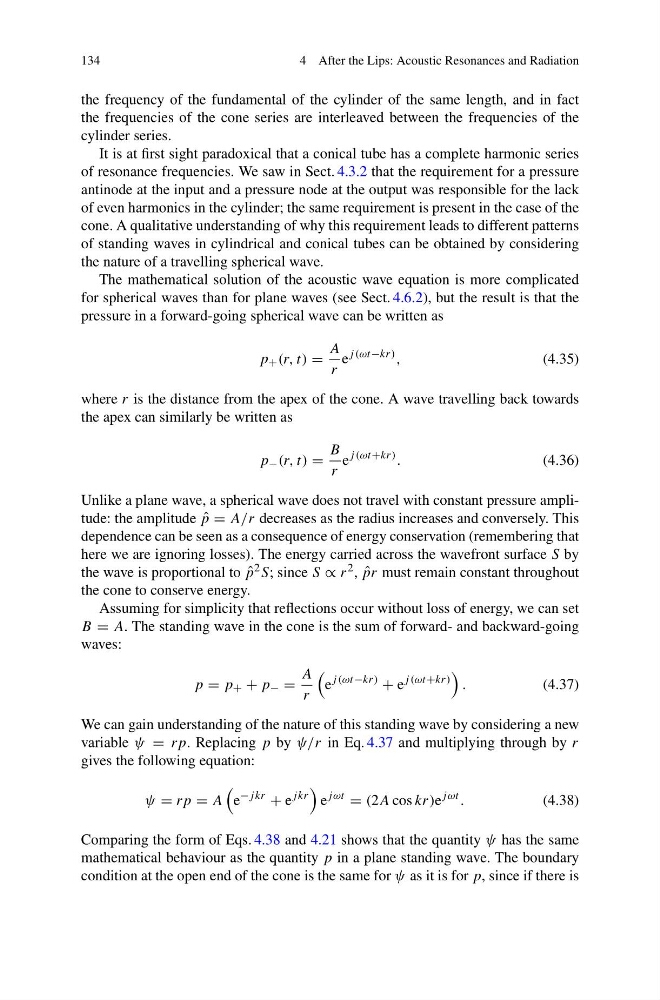
The mathematical solution of the acoustic wave equation is more complicated
for spherical waves than for plane waves (see Sect. 4.6.2), but the result is that the
pressure in a forward-going spherical wave can be written as
p + (r, t) =
A
r
e
j (ωt−kr) ,
(4.35)
where r is the distance from the apex of the cone. A wave travelling back towards
the apex can similarly be written as
p − (r, t) =
B
r
e
j (ωt+kr) .
(4.36)
Unlike a plane wave, a spherical wave does not travel with constant pressure amplitude: the amplitude ˆ
p = A/r decreases as the radius increases and conversely. This
dependence can be seen as a consequence of energy conservation (remembering that
here we are ignoring losses). The energy carried across the wavefront surface S by
the wave is proportional to ˆ
p 2 S; since S ∝ r 2 , ˆ
pr must remain constant throughout
the cone to conserve energy.
Assuming for simplicity that reflections occur without loss of energy, we can set
B = A. The standing wave in the cone is the sum of forward- and backward-going
waves:
p = p + + p − =
A
r
e
j (ωt−kr)
+ e
j (ωt+kr)
.
(4.37)
We can gain understanding of the nature of this standing wave by considering a new
variable ψ = rp. Replacing p by ψ/r in Eq. 4.37 and multiplying through by r
gives the following equation:
ψ = rp = A
e
−jkr
+ e
jkr
e
jωt
= (2A cos kr)e
jωt .
(4.38)
Comparing the form of Eqs. 4.38 and 4.21 shows that the quantity ψ has the same
mathematical behaviour as the quantity p in a plane standing wave. The boundary
condition at the open end of the cone is the same for ψ as it is for p, since if there is
4 After the Lips: Acoustic Resonances and Radiation
the frequency of the fundamental of the cylinder of the same length, and in fact
the frequencies of the cone series are interleaved between the frequencies of the
cylinder series.
It is at first sight paradoxical that a conical tube has a complete harmonic series
of resonance frequencies. We saw in Sect. 4.3.2 that the requirement for a pressure
antinode at the input and a pressure node at the output was responsible for the lack
of even harmonics in the cylinder; the same requirement is present in the case of the
cone. A qualitative understanding of why this requirement leads to different patterns
of standing waves in cylindrical and conical tubes can be obtained by considering
the nature of a travelling spherical wave.
The mathematical solution of the acoustic wave equation is more complicated
for spherical waves than for plane waves (see Sect. 4.6.2), but the result is that the
pressure in a forward-going spherical wave can be written as
p + (r, t) =
A
r
e
j (ωt−kr) ,
(4.35)
where r is the distance from the apex of the cone. A wave travelling back towards
the apex can similarly be written as
p − (r, t) =
B
r
e
j (ωt+kr) .
(4.36)
Unlike a plane wave, a spherical wave does not travel with constant pressure amplitude: the amplitude ˆ
p = A/r decreases as the radius increases and conversely. This
dependence can be seen as a consequence of energy conservation (remembering that
here we are ignoring losses). The energy carried across the wavefront surface S by
the wave is proportional to ˆ
p 2 S; since S ∝ r 2 , ˆ
pr must remain constant throughout
the cone to conserve energy.
Assuming for simplicity that reflections occur without loss of energy, we can set
B = A. The standing wave in the cone is the sum of forward- and backward-going
waves:
p = p + + p − =
A
r
e
j (ωt−kr)
+ e
j (ωt+kr)
.
(4.37)
We can gain understanding of the nature of this standing wave by considering a new
variable ψ = rp. Replacing p by ψ/r in Eq. 4.37 and multiplying through by r
gives the following equation:
ψ = rp = A
e
−jkr
+ e
jkr
e
jωt
= (2A cos kr)e
jωt .
(4.38)
Comparing the form of Eqs. 4.38 and 4.21 shows that the quantity ψ has the same
mathematical behaviour as the quantity p in a plane standing wave. The boundary
condition at the open end of the cone is the same for ψ as it is for p, since if there is