

130
4 After the Lips: Acoustic Resonances and Radiation
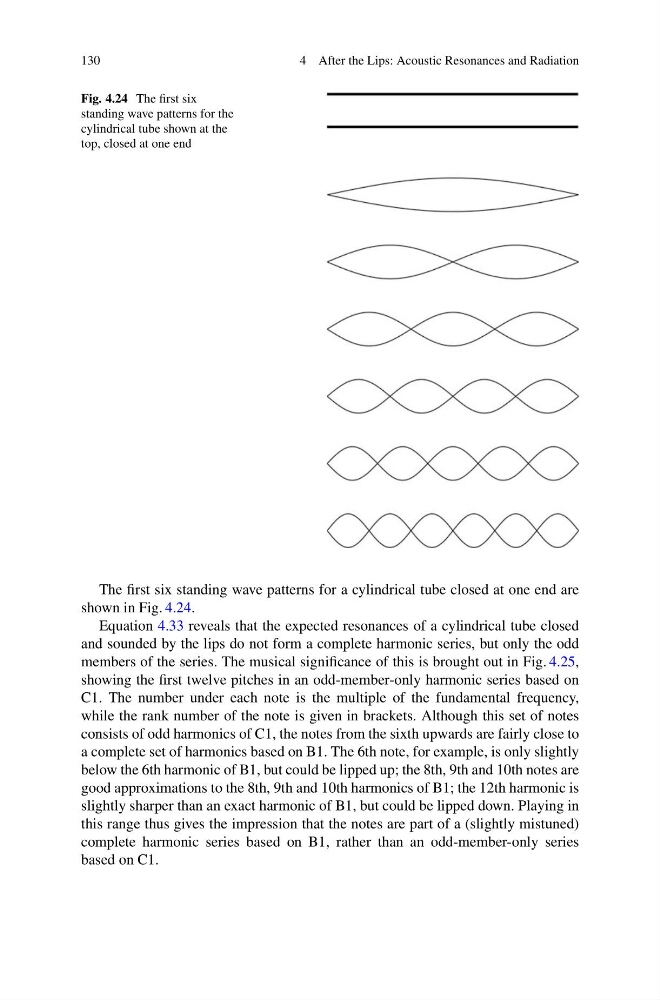
Fig. 4.24 The first six
standing wave patterns for the
cylindrical tube shown at the
top, closed at one end
The first six standing wave patterns for a cylindrical tube closed at one end are
shown in Fig. 4.24.
Equation 4.33 reveals that the expected resonances of a cylindrical tube closed
and sounded by the lips do not form a complete harmonic series, but only the odd
members of the series. The musical significance of this is brought out in Fig. 4.25,
showing the first twelve pitches in an odd-member-only harmonic series based on
C1. The number under each note is the multiple of the fundamental frequency,
while the rank number of the note is given in brackets. Although this set of notes
consists of odd harmonics of C1, the notes from the sixth upwards are fairly close to
a complete set of harmonics based on B1. The 6th note, for example, is only slightly
below the 6th harmonic of B1, but could be lipped up; the 8th, 9th and 10th notes are
good approximations to the 8th, 9th and 10th harmonics of B1; the 12th harmonic is
slightly sharper than an exact harmonic of B1, but could be lipped down. Playing in
this range thus gives the impression that the notes are part of a (slightly mistuned)
complete harmonic series based on B1, rather than an odd-member-only series
based on C1.
4 After the Lips: Acoustic Resonances and Radiation
Fig. 4.24 The first six
standing wave patterns for the
cylindrical tube shown at the
top, closed at one end
The first six standing wave patterns for a cylindrical tube closed at one end are
shown in Fig. 4.24.
Equation 4.33 reveals that the expected resonances of a cylindrical tube closed
and sounded by the lips do not form a complete harmonic series, but only the odd
members of the series. The musical significance of this is brought out in Fig. 4.25,
showing the first twelve pitches in an odd-member-only harmonic series based on
C1. The number under each note is the multiple of the fundamental frequency,
while the rank number of the note is given in brackets. Although this set of notes
consists of odd harmonics of C1, the notes from the sixth upwards are fairly close to
a complete set of harmonics based on B1. The 6th note, for example, is only slightly
below the 6th harmonic of B1, but could be lipped up; the 8th, 9th and 10th notes are
good approximations to the 8th, 9th and 10th harmonics of B1; the 12th harmonic is
slightly sharper than an exact harmonic of B1, but could be lipped down. Playing in
this range thus gives the impression that the notes are part of a (slightly mistuned)
complete harmonic series based on B1, rather than an odd-member-only series
based on C1.