

124
4 After the Lips: Acoustic Resonances and Radiation
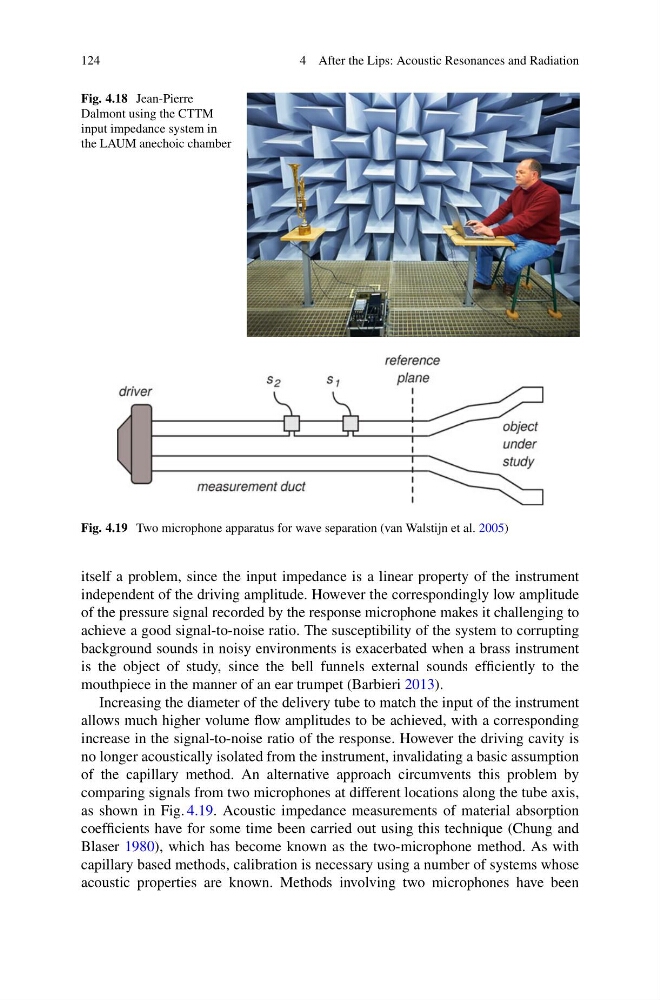
Fig. 4.18 Jean-Pierre
Dalmont using the CTTM
input impedance system in
the LAUM anechoic chamber
Fig. 4.19 Two microphone apparatus for wave separation (van Walstijn et al. 2005)
itself a problem, since the input impedance is a linear property of the instrument
independent of the driving amplitude. However the correspondingly low amplitude
of the pressure signal recorded by the response microphone makes it challenging to
achieve a good signal-to-noise ratio. The susceptibility of the system to corrupting
background sounds in noisy environments is exacerbated when a brass instrument
is the object of study, since the bell funnels external sounds efficiently to the
mouthpiece in the manner of an ear trumpet (Barbieri 2013).
Increasing the diameter of the delivery tube to match the input of the instrument
allows much higher volume flow amplitudes to be achieved, with a corresponding
increase in the signal-to-noise ratio of the response. However the driving cavity is
no longer acoustically isolated from the instrument, invalidating a basic assumption
of the capillary method. An alternative approach circumvents this problem by
comparing signals from two microphones at different locations along the tube axis,
as shown in Fig. 4.19. Acoustic impedance measurements of material absorption
coefficients have for some time been carried out using this technique (Chung and
Blaser 1980), which has become known as the two-microphone method. As with
capillary based methods, calibration is necessary using a number of systems whose
acoustic properties are known. Methods involving two microphones have been
4 After the Lips: Acoustic Resonances and Radiation
Fig. 4.18 Jean-Pierre
Dalmont using the CTTM
input impedance system in
the LAUM anechoic chamber
Fig. 4.19 Two microphone apparatus for wave separation (van Walstijn et al. 2005)
itself a problem, since the input impedance is a linear property of the instrument
independent of the driving amplitude. However the correspondingly low amplitude
of the pressure signal recorded by the response microphone makes it challenging to
achieve a good signal-to-noise ratio. The susceptibility of the system to corrupting
background sounds in noisy environments is exacerbated when a brass instrument
is the object of study, since the bell funnels external sounds efficiently to the
mouthpiece in the manner of an ear trumpet (Barbieri 2013).
Increasing the diameter of the delivery tube to match the input of the instrument
allows much higher volume flow amplitudes to be achieved, with a corresponding
increase in the signal-to-noise ratio of the response. However the driving cavity is
no longer acoustically isolated from the instrument, invalidating a basic assumption
of the capillary method. An alternative approach circumvents this problem by
comparing signals from two microphones at different locations along the tube axis,
as shown in Fig. 4.19. Acoustic impedance measurements of material absorption
coefficients have for some time been carried out using this technique (Chung and
Blaser 1980), which has become known as the two-microphone method. As with
capillary based methods, calibration is necessary using a number of systems whose
acoustic properties are known. Methods involving two microphones have been