

4.2 Measuring Input Impedance
121
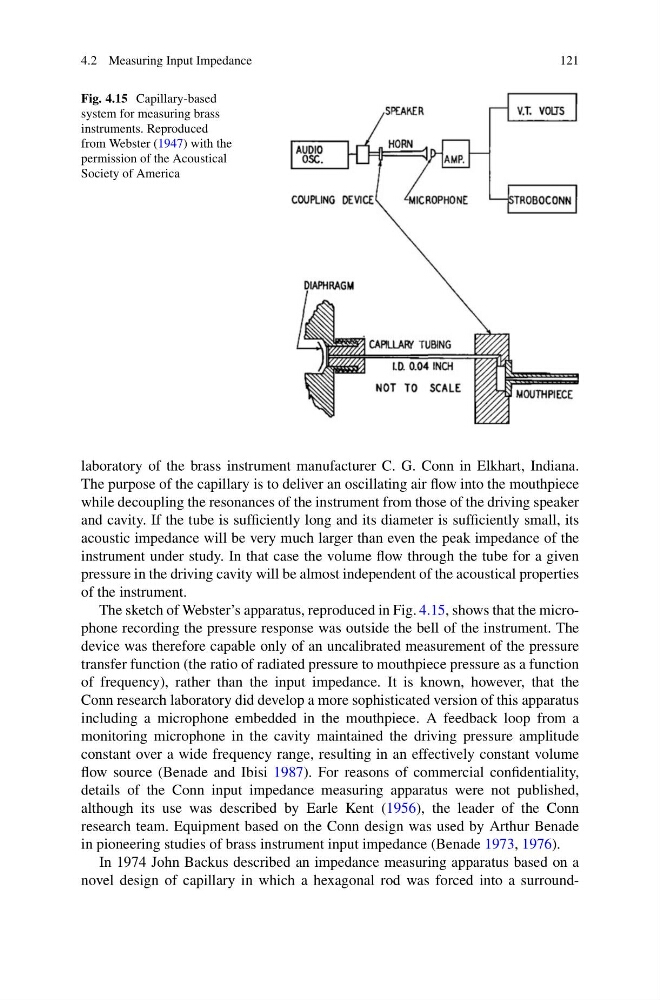
Fig. 4.15 Capillary-based
system for measuring brass
instruments. Reproduced
from Webster (1947) with the
permission of the Acoustical
Society of America
laboratory of the brass instrument manufacturer C. G. Conn in Elkhart, Indiana.
The purpose of the capillary is to deliver an oscillating air flow into the mouthpiece
while decoupling the resonances of the instrument from those of the driving speaker
and cavity. If the tube is sufficiently long and its diameter is sufficiently small, its
acoustic impedance will be very much larger than even the peak impedance of the
instrument under study. In that case the volume flow through the tube for a given
pressure in the driving cavity will be almost independent of the acoustical properties
of the instrument.
The sketch of Webster’s apparatus, reproduced in Fig. 4.15, shows that the microphone recording the pressure response was outside the bell of the instrument. The
device was therefore capable only of an uncalibrated measurement of the pressure
transfer function (the ratio of radiated pressure to mouthpiece pressure as a function
of frequency), rather than the input impedance. It is known, however, that the
Conn research laboratory did develop a more sophisticated version of this apparatus
including a microphone embedded in the mouthpiece. A feedback loop from a
monitoring microphone in the cavity maintained the driving pressure amplitude
constant over a wide frequency range, resulting in an effectively constant volume
flow source (Benade and Ibisi 1987). For reasons of commercial confidentiality,
details of the Conn input impedance measuring apparatus were not published,
although its use was described by Earle Kent (1956), the leader of the Conn
research team. Equipment based on the Conn design was used by Arthur Benade
in pioneering studies of brass instrument input impedance (Benade 1973, 1976).
In 1974 John Backus described an impedance measuring apparatus based on a
novel design of capillary in which a hexagonal rod was forced into a surround-
121
Fig. 4.15 Capillary-based
system for measuring brass
instruments. Reproduced
from Webster (1947) with the
permission of the Acoustical
Society of America
laboratory of the brass instrument manufacturer C. G. Conn in Elkhart, Indiana.
The purpose of the capillary is to deliver an oscillating air flow into the mouthpiece
while decoupling the resonances of the instrument from those of the driving speaker
and cavity. If the tube is sufficiently long and its diameter is sufficiently small, its
acoustic impedance will be very much larger than even the peak impedance of the
instrument under study. In that case the volume flow through the tube for a given
pressure in the driving cavity will be almost independent of the acoustical properties
of the instrument.
The sketch of Webster’s apparatus, reproduced in Fig. 4.15, shows that the microphone recording the pressure response was outside the bell of the instrument. The
device was therefore capable only of an uncalibrated measurement of the pressure
transfer function (the ratio of radiated pressure to mouthpiece pressure as a function
of frequency), rather than the input impedance. It is known, however, that the
Conn research laboratory did develop a more sophisticated version of this apparatus
including a microphone embedded in the mouthpiece. A feedback loop from a
monitoring microphone in the cavity maintained the driving pressure amplitude
constant over a wide frequency range, resulting in an effectively constant volume
flow source (Benade and Ibisi 1987). For reasons of commercial confidentiality,
details of the Conn input impedance measuring apparatus were not published,
although its use was described by Earle Kent (1956), the leader of the Conn
research team. Equipment based on the Conn design was used by Arthur Benade
in pioneering studies of brass instrument input impedance (Benade 1973, 1976).
In 1974 John Backus described an impedance measuring apparatus based on a
novel design of capillary in which a hexagonal rod was forced into a surround-